Sodium Lauryl Sulfate (SLS) – Forms, Grades and Selection
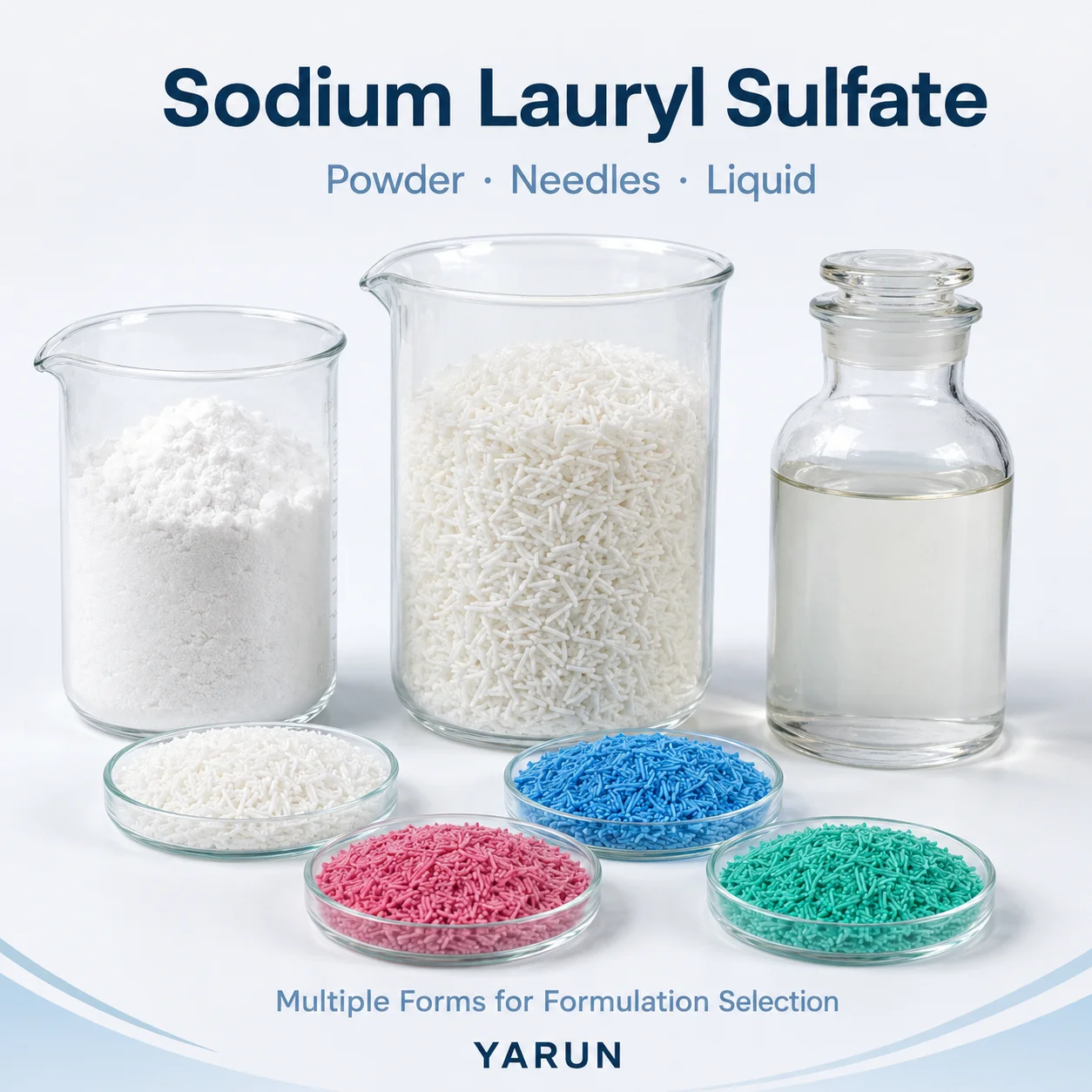
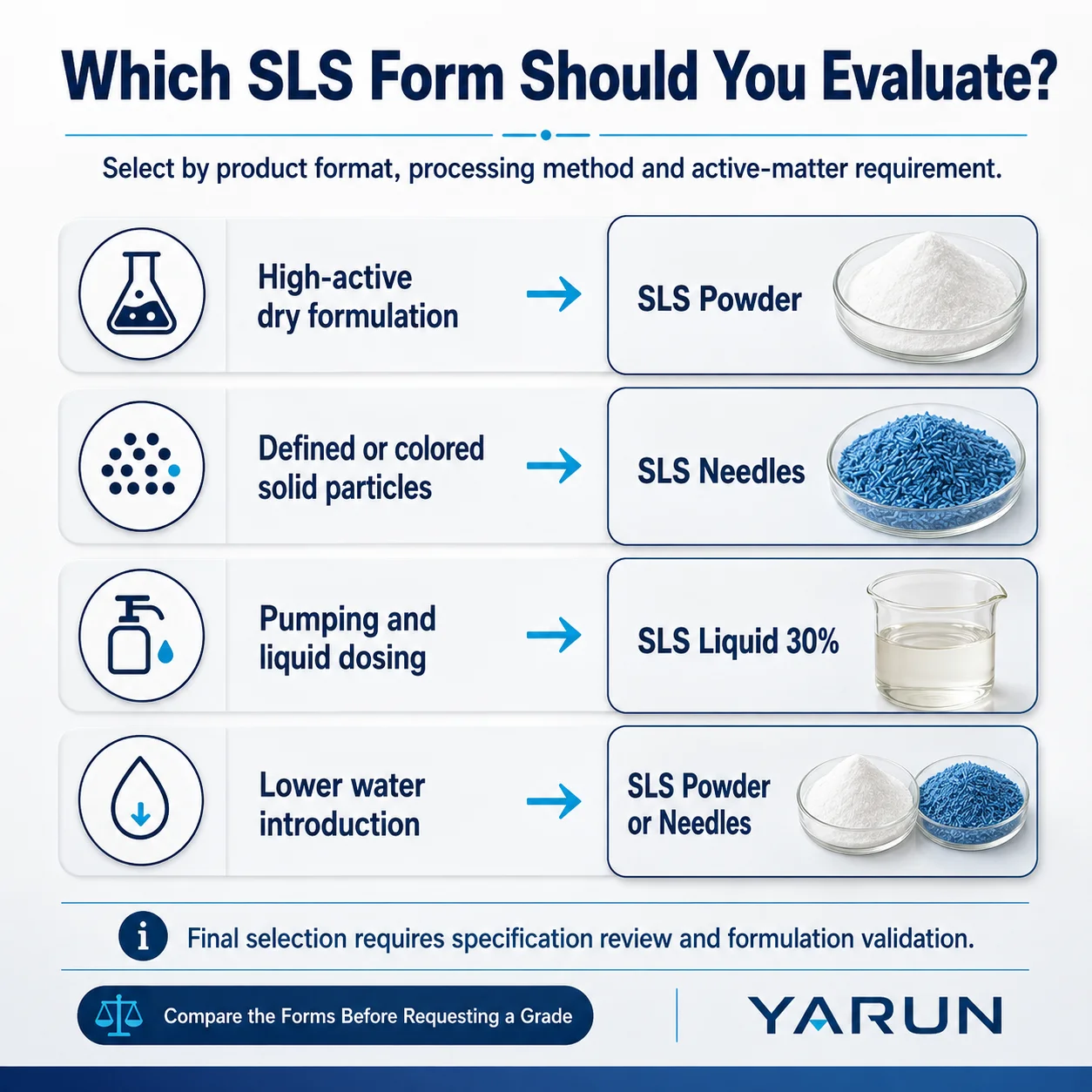
Sodium Lauryl Sulfate (SLS) is an anionic surfactant used for wetting, foaming, detergency and dispersion. YARUN offers SLS in powder, needle and liquid forms, including powder and needle grades at 92%, 93% and 95% active matter and SLS Liquid 30%. This page compares the available forms and helps buyers select an appropriate starting option according to product format, processing method and active-matter requirements.
| NAME | VALUE |
|---|---|
| Product Name | Sodium Lauryl Sulfate |
| CAS Number | 151-21-3 |
| Reference HS Code | 3402390000 |
| Surfactant Class | Anionic Surfactant |
| Available Forms | Powder / Needles / Liquid |
| Powder Grades | 92% / 93% / 95% |
| Needle Grades | 92% / 93% / 95% |
| Liquid Grade | 30% |
| Needle Colors | White / Blue / Pink / Green |
| Minimum Order Quantity | 1 MT per confirmed grade |
Product Description
Sodium Lauryl Sulfate, commonly abbreviated as SLS and also known as Sodium Dodecyl Sulfate, is an anionic surfactant used in selected household cleaning, personal cleansing, oral-care and industrial cleaning formulations.
SLS can provide wetting, foaming, detergency and dispersion functions. Its actual contribution depends on the selected grade, active-matter concentration, physical form, other formulation ingredients and the conditions under which the finished product is manufactured and used.
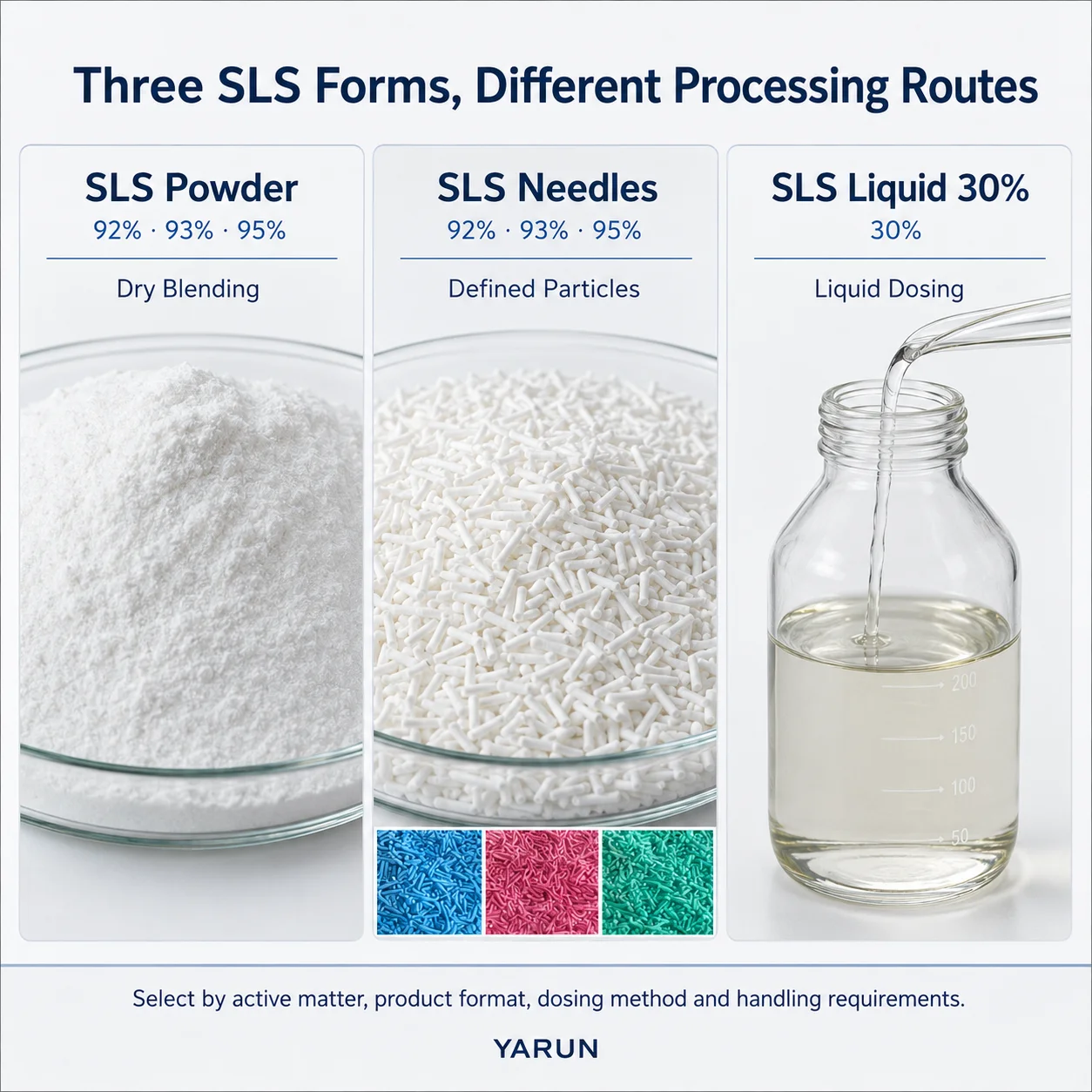
YARUN supplies three SLS product forms:
- SLS Powder: available in 92%, 93% and 95% grades;
- SLS Needles: available in 92%, 93% and 95% grades;
- SLS Liquid: available as a 30% grade.
Selected SLS needle products are available in white, blue, pink and green. Color provides visual differentiation but does not represent a different surfactant mechanism or automatically indicate stronger cleaning performance.
Powder, needles and liquid SLS should not be selected only by comparing price per metric tonne. A meaningful comparison also considers active matter, water content, processing method, handling requirements, packaging, freight and the quantity of usable surfactant delivered.
How Sodium Lauryl Sulfate Works
1. Molecular Structure and Interfacial Activity
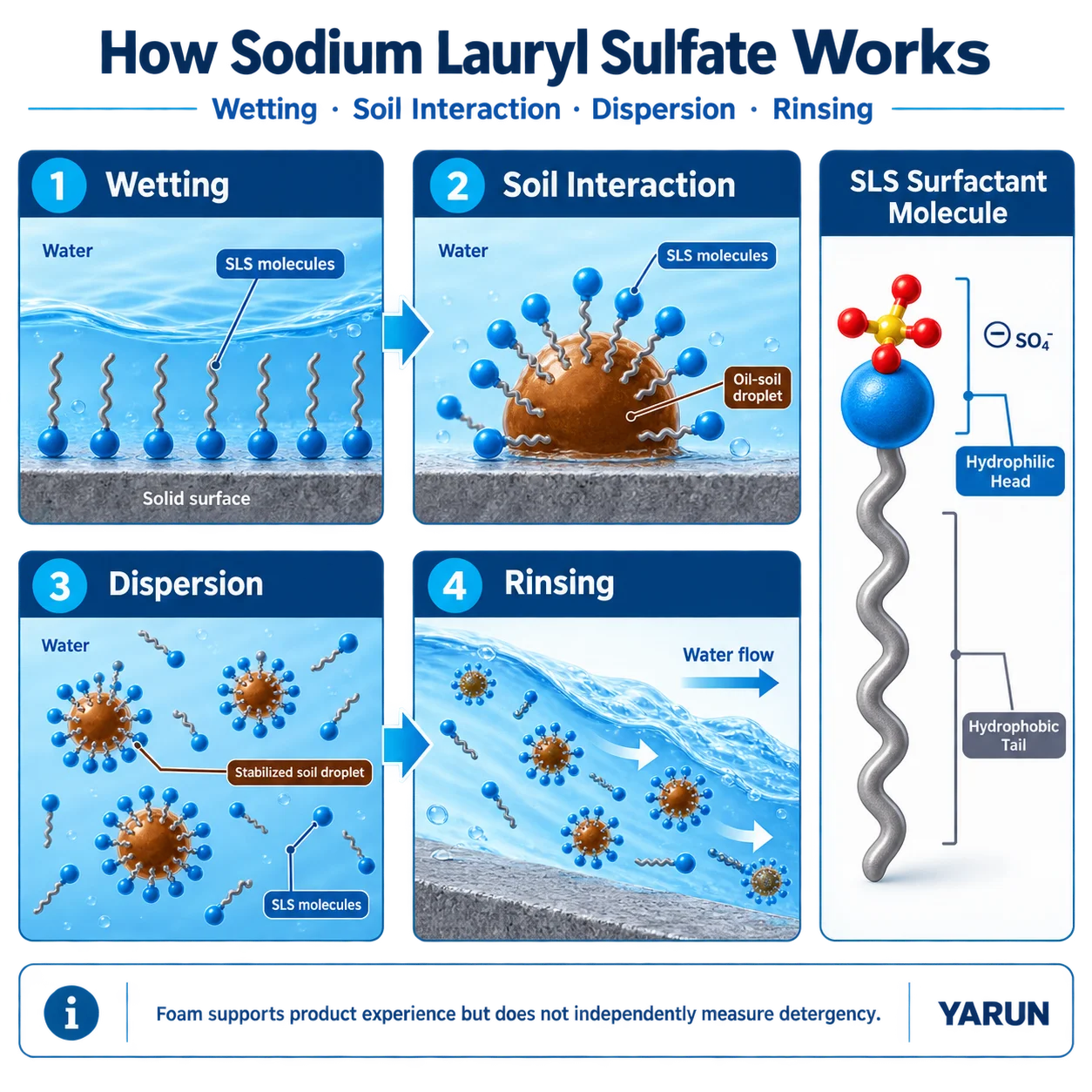
SLS has an amphiphilic molecular structure:
- A hydrophilic sulfate head interacts with the water phase;
- A hydrophobic alkyl chain interacts with oils and other non-polar materials.
This structure allows SLS molecules to accumulate at interfaces between water, air, oil and solid surfaces.
2. Wetting
By reducing surface and interfacial tension, SLS helps the aqueous phase spread across fabrics, particles and hard surfaces. Improved wetting increases contact between the cleaning solution and the material to be removed.
Wetting performance is affected by concentration, temperature, water quality, surface type and the other ingredients in the formulation.
3. Soil Removal and Dispersion
The hydrophobic part of the molecule can interact with oily material, while the hydrophilic part remains associated with water. Under suitable formulation conditions, this behavior helps loosen and disperse hydrophobic soil in the aqueous phase.
At an appropriate concentration, surfactant molecules can form micellar structures that help keep dispersed oily material in the cleaning solution.
SLS alone does not determine the final cleaning result. Finished-product performance also depends on:
- Total surfactant system;
- Builders and chelating agents;
- Enzymes;
- Formula pH;
- Water hardness;
- Temperature;
- Soil type and loading;
- Contact time;
- Mechanical action.
4. Foaming
SLS can help generate foam by reducing tension at the air–water interface and supporting the formation of foam films.
Foam height and stability depend on the complete formulation and operating conditions. High foam should not automatically be interpreted as higher detergency.
Technical boundary: Foam volume is a formulation characteristic, not a standalone measurement of cleaning performance.
5. Why Physical Form Matters
Powder, needles and liquid SLS share the same fundamental anionic surfactant mechanism. Their practical differences relate mainly to:
- Active-matter concentration;
- Water introduced into the formula;
- Particle form;
- Dust-control requirements;
- Dosing and incorporation method;
- Dissolution and dispersion;
- Storage and handling;
- Packaging efficiency;
- Freight per unit of active matter.
The appropriate SLS form is therefore a processing and commercial decision as well as a formulation decision.
Available SLS Forms and Grades
| Product Series | Physical Form | Available Grades | Color Options | Main Selection Focus |
|---|---|---|---|---|
| SLS Powder | Powder | 92% / 93% / 95% | White to off-white | Dry blending, high active matter and powder processing |
| SLS Needles | Needles | 92% / 93% / 95% | White / Blue / Pink / Green | Defined particles, visual differentiation and handling preference |
| SLS Liquid | Liquid | 30% | According to the approved specification | Pumping, metering, dilution and liquid-phase incorporation |
Grade, color, packaging and sample availability must be confirmed for the selected product before commercial approval.
Final batch acceptance should be based on the agreed product specification and applicable batch Certificate of Analysis.
SLS Powder
SLS powder is the primary form to evaluate when the manufacturing process requires a high-active powdered anionic surfactant.
It may be considered for dry-blended products and other formulations in which powder incorporation, active-matter efficiency and dispersion are important selection factors.
Evaluate SLS Powder When You Need
- A powdered surfactant for dry processing;
- 92%, 93% or 95% active grade options;
- Lower water introduction than SLS Liquid 30%;
- Efficient transport of active matter;
- Incorporation into powder detergent or cleaning systems.
Confirm Before Selection
- Required active grade;
- Powder appearance and condition;
- Sodium sulfate limit;
- Unsulfated matter limit;
- Moisture;
- Dust-control method;
- Dissolution and dispersion process;
- Packaging and storage conditions.
Related product:
View SLS Powder 92%, 93% and 95%
SLS Needles
SLS needles provide an alternative to powder where a defined particle form, visible solid particles or a different handling profile is required.
White needles can be selected for formulations requiring a neutral appearance. Blue, pink and green needles can be evaluated for products that use visible particles as part of product identification or visual design.
Color alone does not change the underlying SLS cleaning mechanism.
Evaluate SLS Needles When You Need
- A defined needle-shaped particle;
- White or colored particles in a solid product;
- An alternative handling profile to fine powder;
- 92%, 93% or 95% active grade options;
- Visual differentiation in selected detergent or cleaning products.
Confirm Before Selection
- Active grade;
- Particle form and consistency;
- Available color;
- Color tolerance;
- Color migration or staining risk;
- Dissolution behavior;
- Batch-to-batch color consistency;
- MOQ for the selected grade and color.
Colored needles require sample approval before a commercial order is confirmed.
Related product:
View SLS Needles 92%, 93% and 95%
SLS Liquid 30%
SLS Liquid 30% is designed for processes that prefer liquid-phase dosing, pumping or metering.
Compared with high-active powder and needle grades, SLS Liquid 30% introduces more water into the formulation and requires more delivered product to provide the same amount of active SLS. Its value therefore lies primarily in processing convenience rather than active-matter transport efficiency.
Evaluate SLS Liquid 30% When You Need
- Liquid dosing or pumping;
- Metered addition;
- Direct incorporation into a liquid phase;
- Reduced handling of dry particles;
- A pre-diluted SLS form.
Confirm Before Selection
- Active matter;
- Appearance;
- pH;
- Viscosity;
- Density;
- Pumpability;
- Dilution behavior;
- Storage temperature;
- Packaging format;
- Cost per unit of active matter.
Related product:
View SLS Liquid 30%
Application Areas
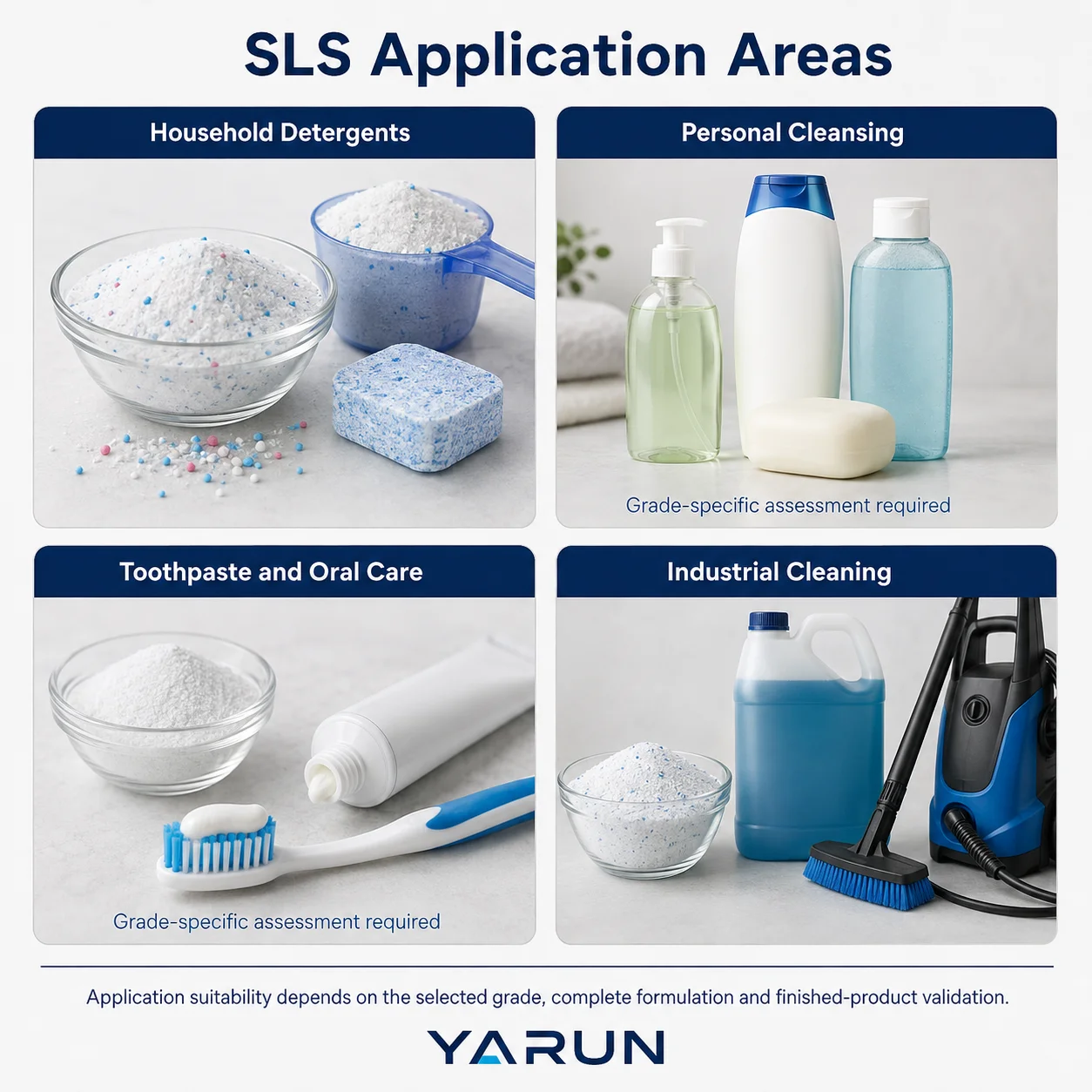
SLS selection should be based on the finished-product format, required function, applicable product grade and completed formulation testing.
Household Detergents and Cleaning Products
Application Types
- Laundry detergent powder;
- Concentrated detergent powder;
- Hand-wash detergent powder;
- Scouring powder;
- Kitchen cleaning powder;
- Bathroom cleaning powder;
- Cleaning tablets;
- Solid cleaning blocks;
- Colored detergent particles;
- Liquid household cleaners;
- Hard-surface cleaners.
Possible Functions of SLS
Depending on the form and formulation, SLS may support:
- Wetting of fabrics and hard surfaces;
- Contact between the cleaning solution and soil;
- Dispersion of oily material;
- Foam generation;
- Incorporation of an anionic surfactant into powder or liquid products;
- Visible particle differentiation when colored needles are used.
Initial Form Selection
| Finished Product | Initial SLS Form to Evaluate |
|---|---|
| Laundry detergent powder | SLS Powder |
| Scouring or cleaning powder | SLS Powder |
| Colored detergent particles | Colored SLS Needles |
| Cleaning tablets or blocks | SLS Powder or SLS Needles |
| Liquid household cleaner | SLS Liquid 30% |
The table identifies a starting point for evaluation, not a universal formulation recommendation.
Personal Cleansing and Care
Application Types
- Shampoo;
- Body wash;
- Hand-cleansing products;
- Liquid soap;
- Facial cleansing products;
- Cleansing bars;
- Shaving products.
Possible Functions of SLS
In a suitable rinse-off formulation, SLS may contribute to:
- Surface wetting;
- Removal of oil and surface soil;
- Foaming;
- Dispersion;
- Cleansing-system performance.
Application Boundary
Personal-care suitability cannot be determined from active matter alone. The selected product must have an appropriate specification and impurity profile, and the complete formulation must be evaluated for stability, performance and user tolerance.
SLS may cause skin or eye irritation under unsuitable conditions. An industrial SLS grade must not automatically be described or sold as a personal-care grade.
Toothpaste and Oral Care
Application Types
- Adult toothpaste;
- Functional toothpaste;
- Tooth powder;
- Selected professional oral-cleaning products.
Possible Functions of SLS
In an appropriately designed oral-care formulation, SLS may support:
- Wetting of the tooth surface;
- Distribution of the formulation during brushing;
- Dispersion of loosened material;
- Foam generation;
- Overall cleaning-system function.
Application Boundary
Oral-care suitability requires more than a stated active-matter percentage. The selected grade must be supported by an appropriate specification, impurity controls, quality documentation and finished-product evaluation.
The European Medicines Agency has separately reviewed sodium laurilsulfate as an excipient and documents its use across several product categories, illustrating why concentration and application context must be evaluated rather than treated as interchangeable.EMA Sodium Laurilsulfate Scientific Guideline
Until a dedicated toothpaste-grade SLS specification is approved, oral care should remain an application for technical assessment rather than an unconditional suitability claim.
Industrial and Institutional Cleaning
Application Types
- Industrial cleaning powder;
- Degreasing cleaners;
- Vehicle-cleaning products;
- Commercial laundry products;
- Hard-surface cleaners;
- Institutional cleaning products;
- High-foam cleaning systems;
- Professional cleaning concentrates.
Possible Functions of SLS
Depending on the selected form and complete formulation, SLS may support:
- Rapid surface wetting;
- Contact with oily or particulate soil;
- Soil dispersion;
- Foam generation;
- Incorporation into powder or liquid processing systems;
- Combination with other surfactants and cleaning ingredients.
Suitability for food-contact environments, medical environments or other regulated settings must be assessed according to the final product, cleaning process and applicable requirements.
SLS Selection Guide
| Purchasing or Processing Priority | Starting Option | Selection Reason |
|---|---|---|
| High-active dry formulation | SLS Powder | Designed for powder processing and dry blending |
| Defined solid particles | SLS Needles | Needle-shaped physical form |
| Colored visible particles | Colored SLS Needles | White, blue, pink and green options |
| Pumped or metered addition | SLS Liquid 30% | Liquid-phase processing |
| Lower water introduction | SLS Powder or Needles | Higher active matter than SLS Liquid 30% |
| Higher active-matter transport efficiency | Compare 92%, 93% and 95% | Less delivered material per unit of active matter |
| Avoid handling dry particles | SLS Liquid 30% | Liquid handling instead of dry-particle dosing |
| Balance processing and delivered cost | Compare all three forms | Requires formulation, packaging and freight analysis |
This guide defines a starting point. Final selection requires a review of the agreed specification, processing method and finished-product test results.
Comparing Cost per Unit of Active Matter
Price per delivered metric tonne does not provide a complete comparison between SLS grades.
The theoretical raw-material requirement can be calculated as:
To provide one metric tonne of active SLS, the theoretical quantities are:
| Product Grade | Theoretical Product Required |
|---|---|
| SLS 92% | 1.087 MT |
| SLS 93% | 1.075 MT |
| SLS 95% | 1.053 MT |
| SLS Liquid 30% | 3.333 MT |
This mathematical comparison does not establish which product is commercially preferable.
A complete purchasing comparison should also include:
- Delivered product price;
- Packaging;
- Freight;
- Storage;
- Handling;
- Processing time;
- Water introduced into the formulation;
- Manufacturing loss;
- Finished-product performance.
Formulation and Processing Considerations
Before selecting an SLS form or grade, evaluate:
- Target active matter in the finished formulation;
- Powder or liquid manufacturing process;
- Addition sequence;
- Mixing capacity;
- Dissolution and dispersion conditions;
- Dust-control requirements;
- Formula temperature;
- Formula pH;
- Water hardness;
- Target foam profile;
- Compatibility with other surfactants;
- Finished-product viscosity;
- Moisture sensitivity;
- Color stability for colored needles;
- Finished-product stability;
- Application-performance testing.
There is no single SLS addition level or processing method that is suitable for every application. Dosage and processing conditions should be established through formulation trials and finished-product verification.
Packaging and Storage
Packaging depends on the selected SLS form, grade and confirmed commercial order.
General storage practices include:
- Keep the material in its original sealed packaging;
- Store in a clean, dry and ventilated area;
- Protect powder and needle products from moisture;
- Avoid contamination during opening, transfer and dosing;
- Reseal partially used packaging;
- Prevent mixing between different colored grades;
- Confirm pumping and storage-temperature requirements for SLS Liquid 30%;
- Follow the applicable SDS and agreed storage conditions.
Packaging type, net weight and shelf life should be confirmed on the individual product page and commercial documentation.
Product and Quality Documents
According to the selected product and order stage, the available document package may include:
- YARUN Technical Data Sheet;
- Applicable Safety Data Sheet;
- Agreed product specification;
- Representative or commercial batch Certificate of Analysis;
- Packaging information;
- Sample information.
Document title, version and applicability should be confirmed for the selected SLS form and grade.
Frequently Asked Questions
What is the difference between SLS powder, needles and liquid?
They share the same fundamental anionic surfactant mechanism but differ in active matter, water content, particle form, handling, incorporation method, packaging efficiency and delivered cost per unit of active matter.
What is the difference between SLS 92%, 93% and 95%?
The numbers identify active-matter grades. The grades may also have different limits for sodium sulfate, unsulfated matter, moisture and other specification items. Selection should be based on the complete specification, not active matter alone.
Which SLS form should be evaluated for detergent powder?
SLS powder is normally the first option to evaluate for dry-blended detergent and cleaning powders. SLS needles may also be considered when defined particles or visible colored particles are required.
Do colored SLS needles clean differently?
No performance difference should be assumed from color alone. Color is primarily a visual or identification feature. Cleaning performance depends on the active grade, complete formulation and test conditions.
Can YARUN provide customized SLS needle colors?
White, blue, pink and green options are planned within the product range. Availability depends on the selected grade, color requirement, sample approval, MOQ and commercial confirmation.
Is SLS Liquid 30% cheaper than high-active SLS?
Price per delivered tonne is not sufficient for comparison. SLS Liquid 30% contains more water and requires more delivered material per tonne of active SLS, but it may provide processing advantages in liquid dosing and pumping systems.
Can SLS be used in toothpaste or personal-care products?
Only a grade supported by the appropriate specification and quality controls should be evaluated for these applications. Active matter alone does not establish suitability.
What is the minimum order quantity?
The standard starting MOQ is 1 MT per confirmed grade. MOQ for a particular colored needle product must be confirmed separately.
Which documents can be provided?
Depending on the selected product and order stage, YARUN may provide a TDS, applicable SDS, agreed specification and relevant COA.
Request an SLS Product Review and Quote
Selecting SLS by active matter alone can result in an unsuitable choice of product form, processing route or delivered cost.
Provide the following project information:
- Required SLS form;
- Required active grade;
- Required needle color, if applicable;
- Finished-product application;
- Expected quantity in metric tonnes;
- Packaging preference;
- Required documents;
- Sample requirement.
YARUN will review the request and confirm the applicable product option, documentation status and commercial terms.
Related Products
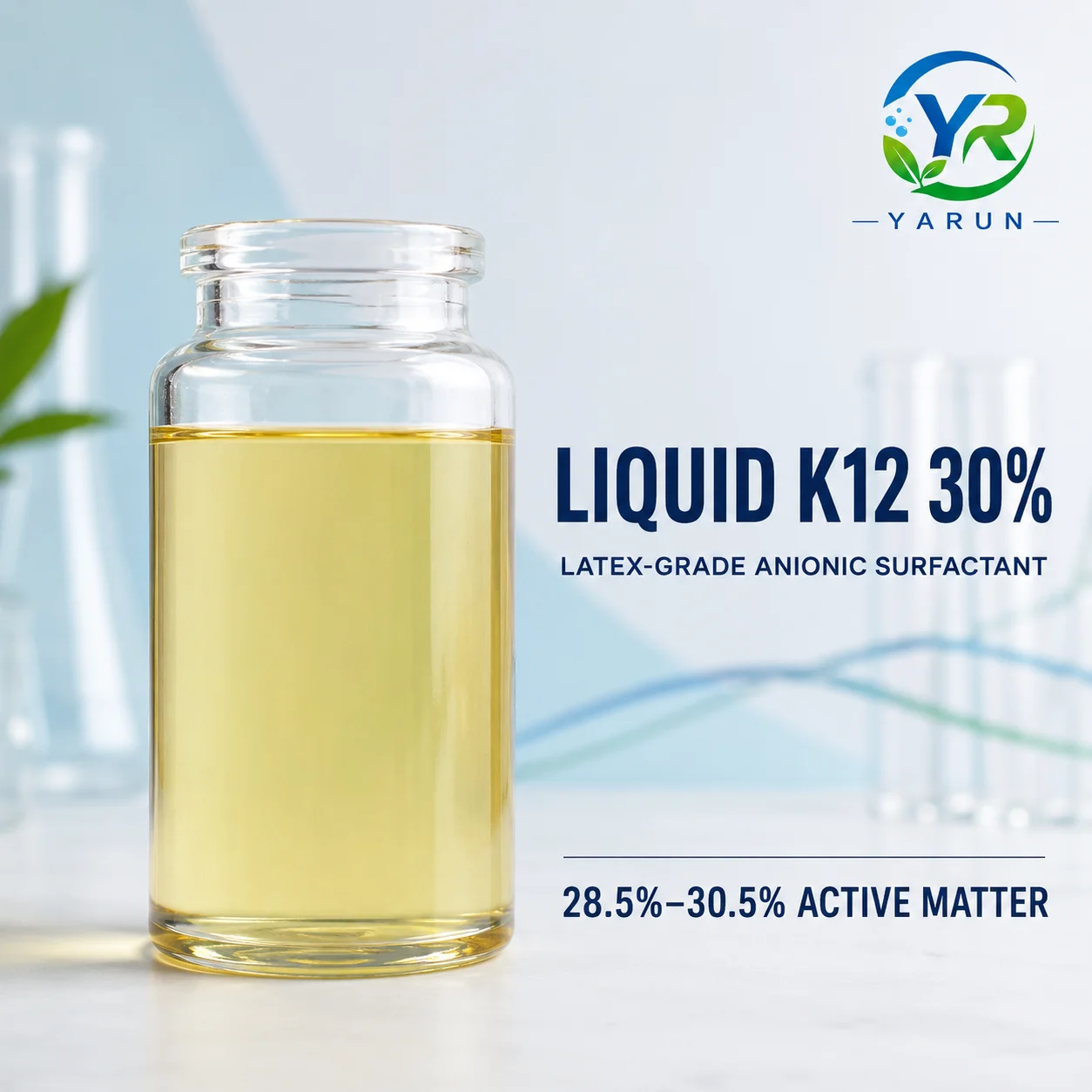
SLS Liquid 30% (Liquid K12) – Latex Grade
Liquid K12 30% is a latex-grade anionic surfactant supplied as a pale yellow transparent liquid with 28.5%–30.5% active matter. It is designed for liquid-phase dosing and may be evaluated as an emulsifier in selected synthetic latex, rubber and resin emulsion-polymerization systems. YARUN supplies the product in drums or IBC totes with a minimum order quantity of 1 MT. Final suitability depends on the applicable specification, processing conditions and completed formulation or polymerization trials.
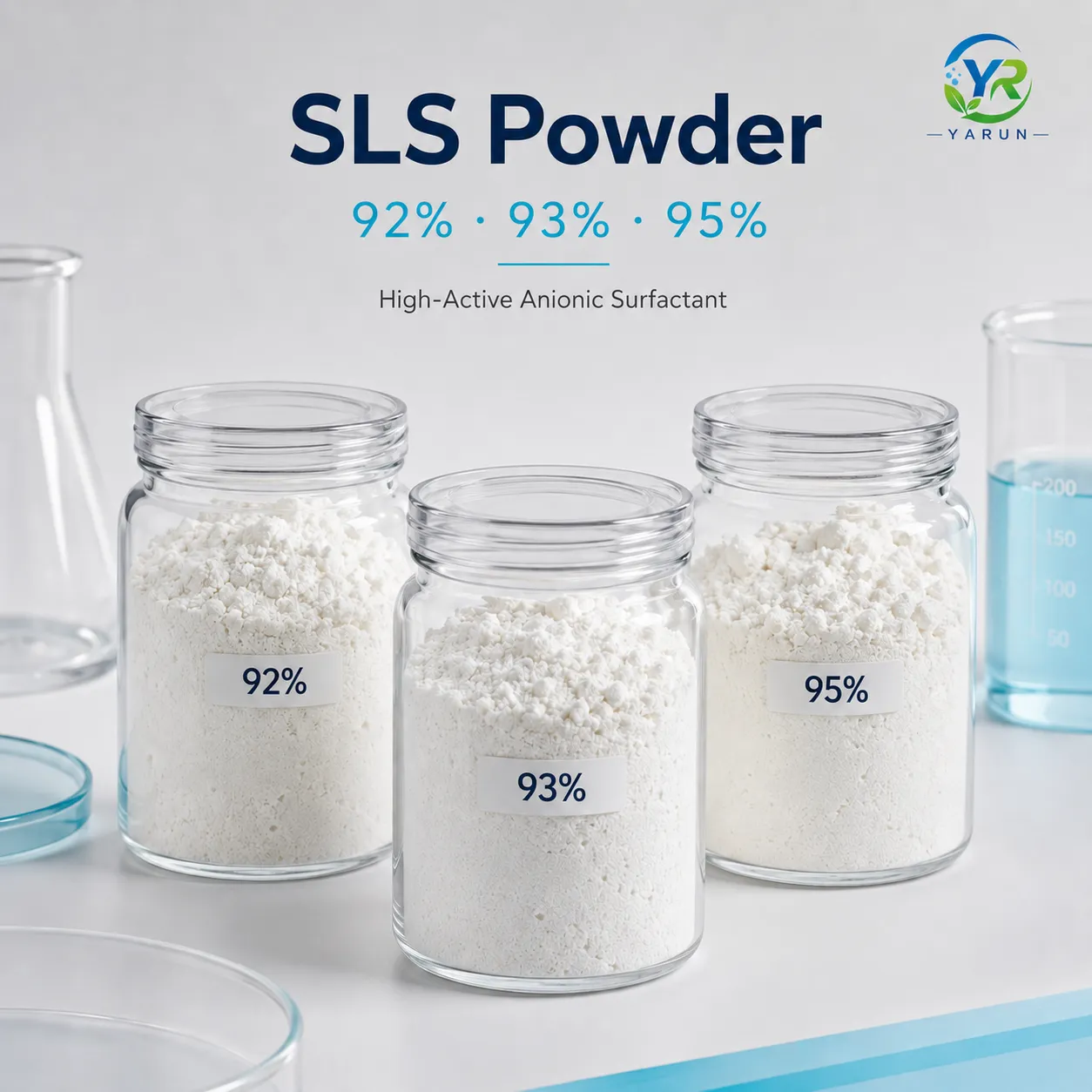
SLS Powder 92%, 93% and 95%
SLS Powder is a high-active anionic surfactant available in 92%, 93% and 95% grades. The three grades share the same powder form and fundamental surfactant mechanism but differ in active matter and sodium sulfate limits. YARUN helps detergent manufacturers compare grade concentration, inorganic-salt load, processing requirements and delivered cost per unit of active matter.
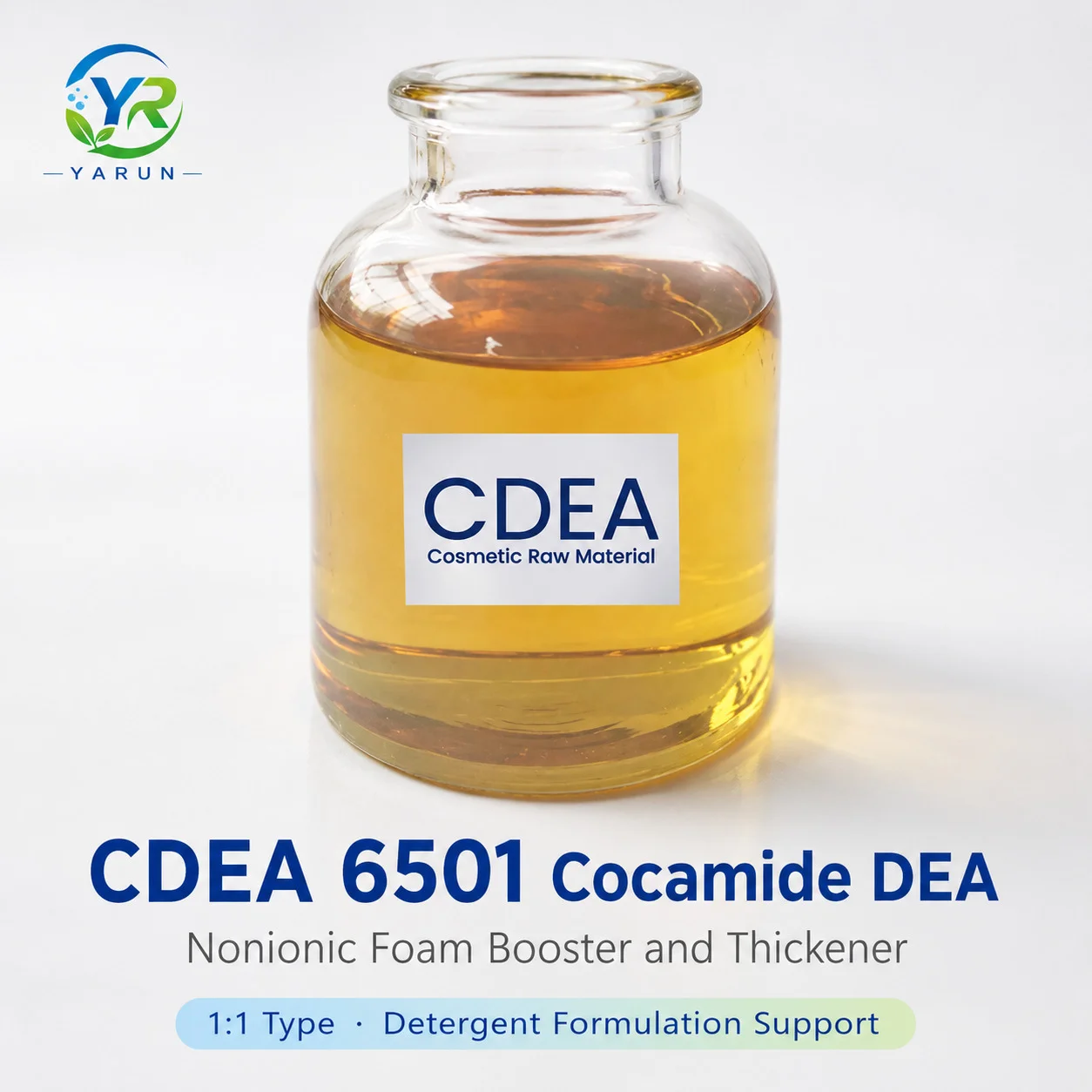
CDEA 6501 Cocamide DEA Foam Booster and Thickener
YARUN CDEA 6501 is a 1:1 type Cocamide DEA nonionic co-surfactant used to support foam stability, viscosity development and formulation compatibility in liquid detergent, dishwashing liquid, shampoo, hand wash and industrial cleaning products. It can be combined with SLES, LABSA, AOS, SLS and other suitable surfactants according to the target formulation.
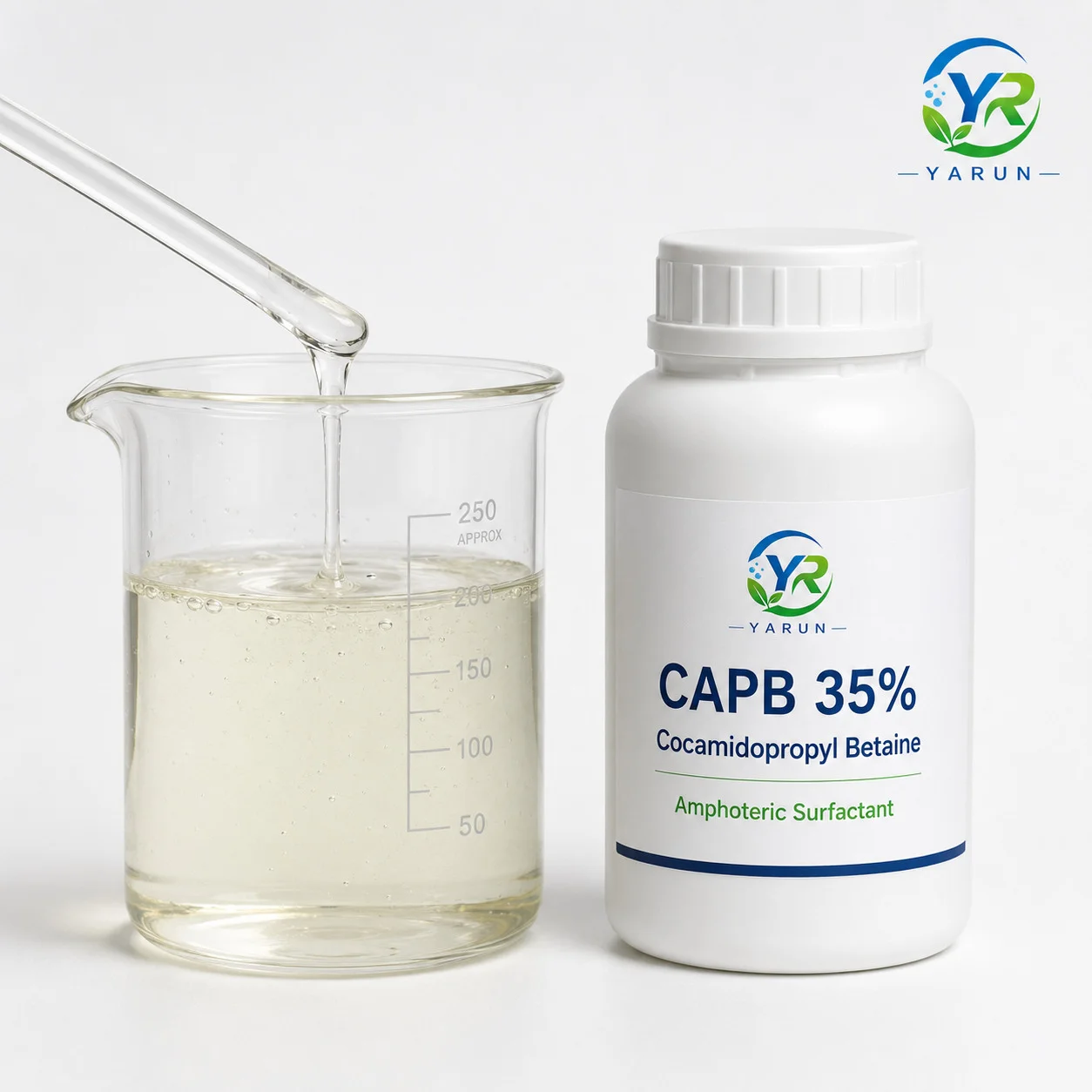
CAPB 35% Cocamidopropyl Betaine Amphoteric Surfactant
YARUN CAPB 35% is a versatile amphoteric surfactant used to improve foam stability, formulation mildness and viscosity in shampoo, hand wash, body wash, liquid soap, dishwashing liquid and household cleaning products. It is compatible with common anionic, nonionic and cationic surfactants and is especially suitable for combination with SLES, AOS and SLS.