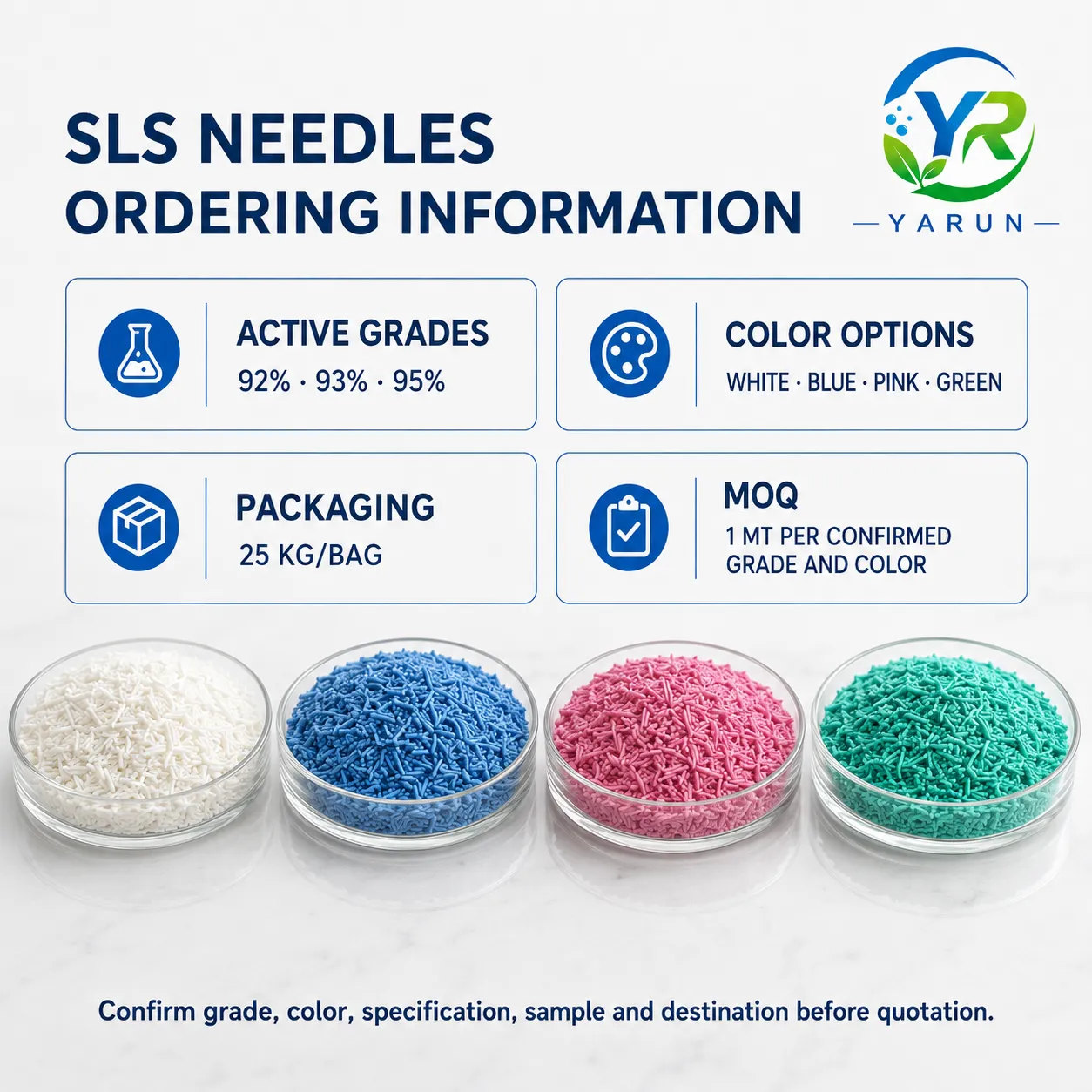
SLS Needles 92%, 93% and 95% – White and Colored Grades
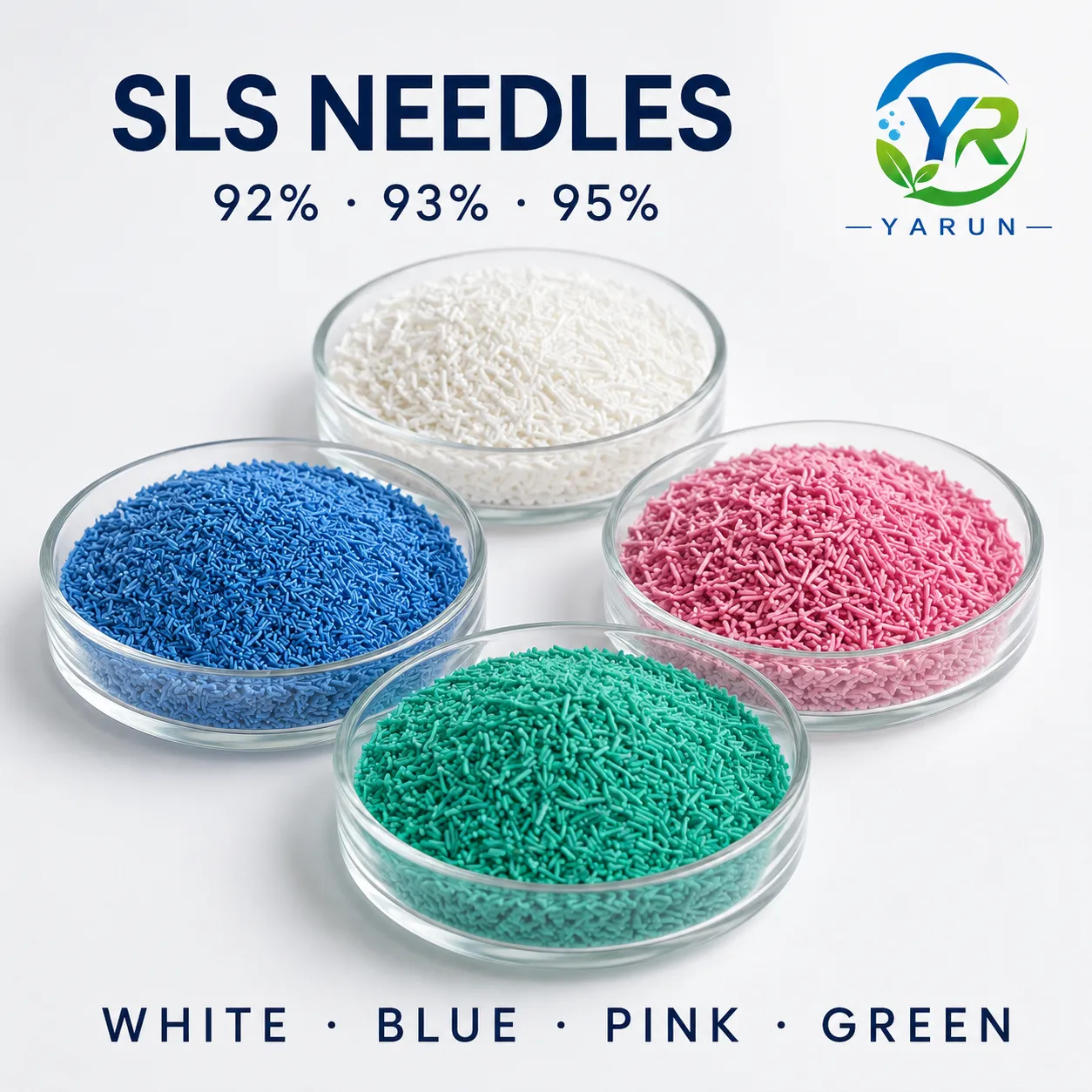
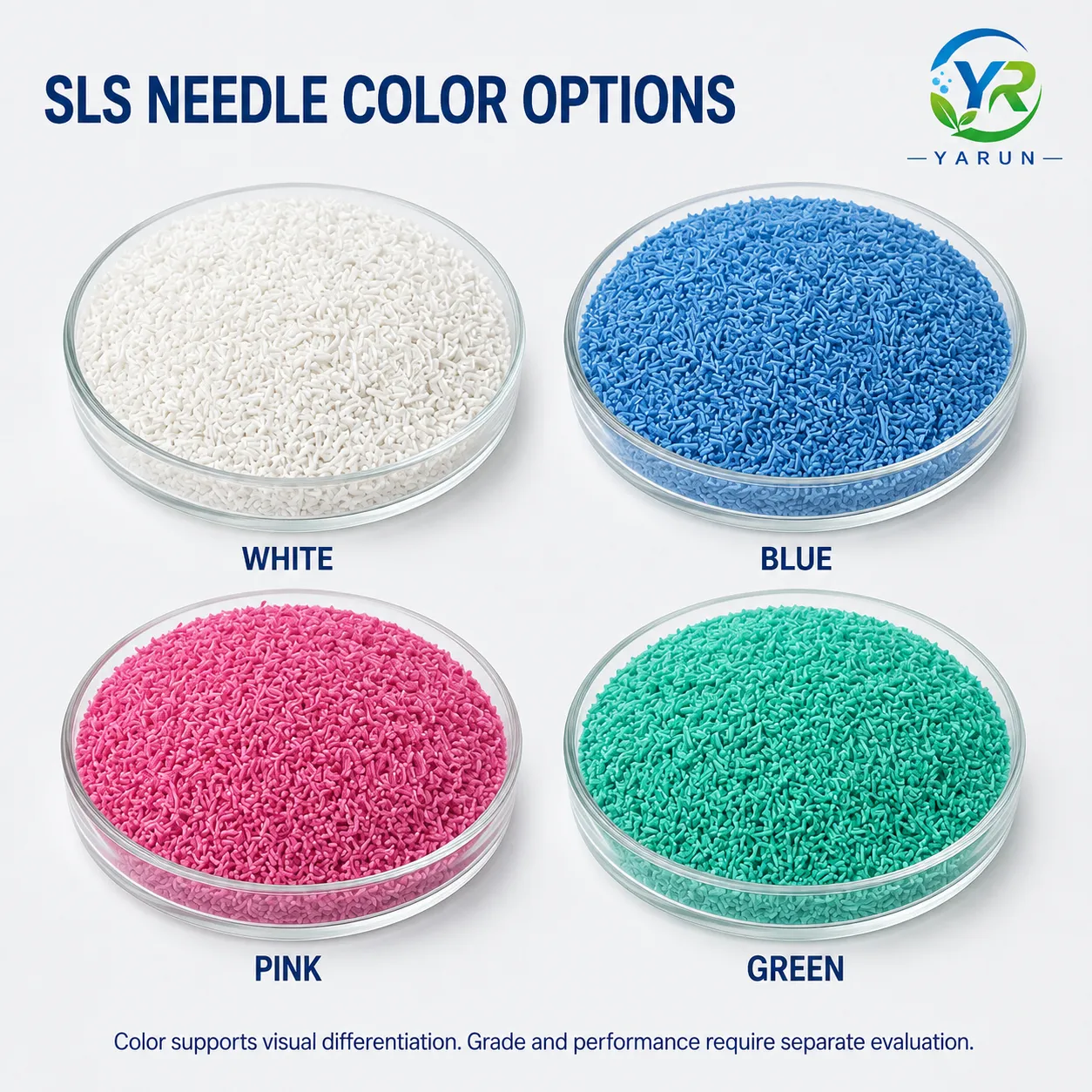
SLS Needles are high-active anionic surfactants available in 92%, 93% and 95% grades. YARUN supplies white, blue, pink and green needle-shaped products in 25 kg bags for selected detergent, household-cleaning and industrial-cleaning formulations. The grades share the same fundamental surfactant mechanism but differ in minimum active matter and applicable quality limits. Color provides visual differentiation and does not represent a different cleaning mechanism or an independent measure of performance.
| NAME | VALUE |
|---|---|
| Chemical Name | Sodium Lauryl Sulfate Needles |
| Chemical Description | Sodium Alkyl Sulfate |
| CAS Number | 73296-89-6 |
| Surfactant Class | Anionic Surfactant |
| Available Grades | 92% / 93% / 95% |
| Physical Form | Needle-Shaped Particles |
| Available Colors | White / Blue / Pink / Green |
| HS Code | 3402390000 |
| Packaging | 25kg/ bags |
| MOQ | 1MT per confirmed grade and color |
Product Description
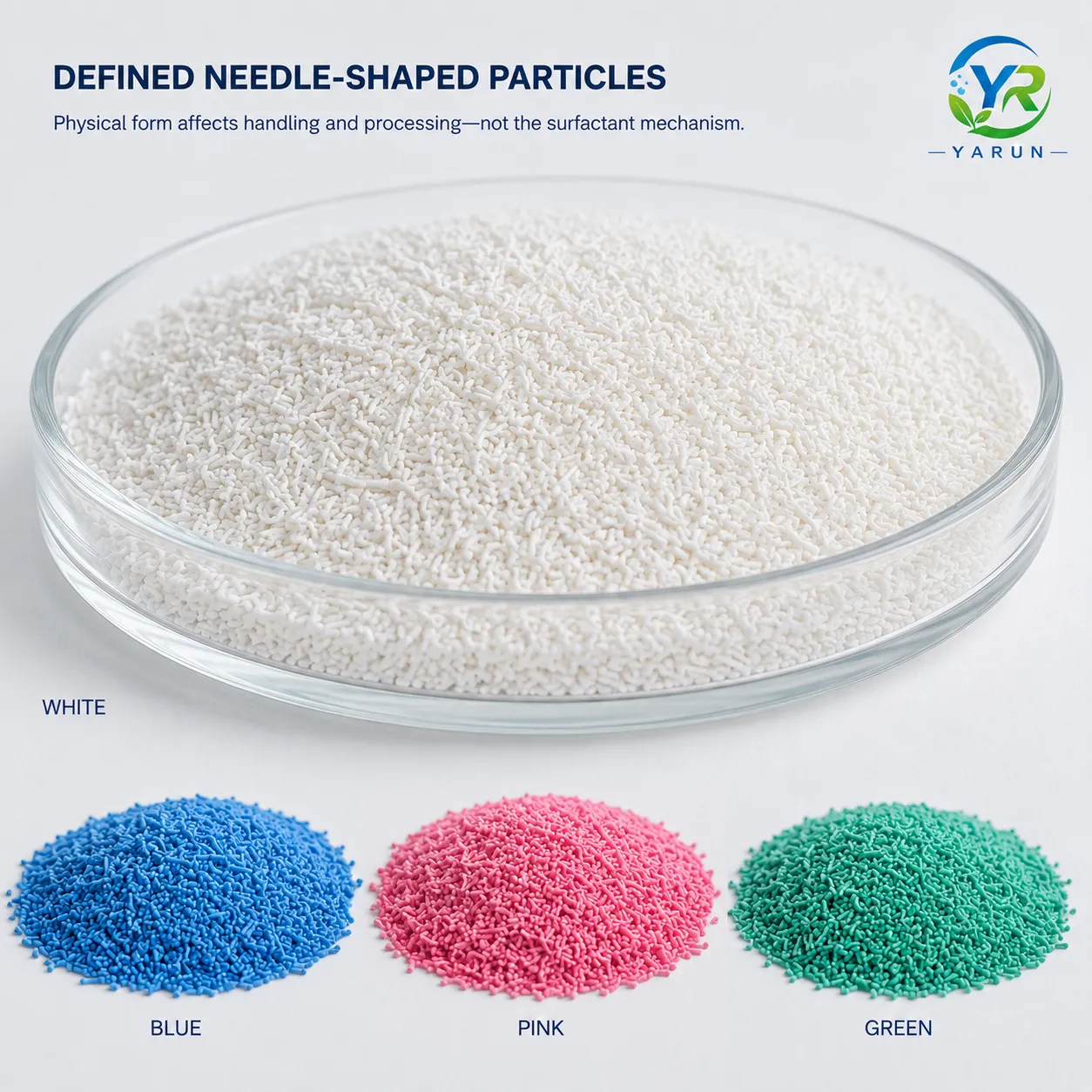
SLS Needles are high-active solid anionic surfactants supplied in a defined needle-shaped particle form. They are available in 92%, 93% and 95% active-matter grades for selected detergent, household-cleaning and industrial-cleaning formulations.
YARUN supplies the following color options:
White;
Blue;
Pink;
Green.
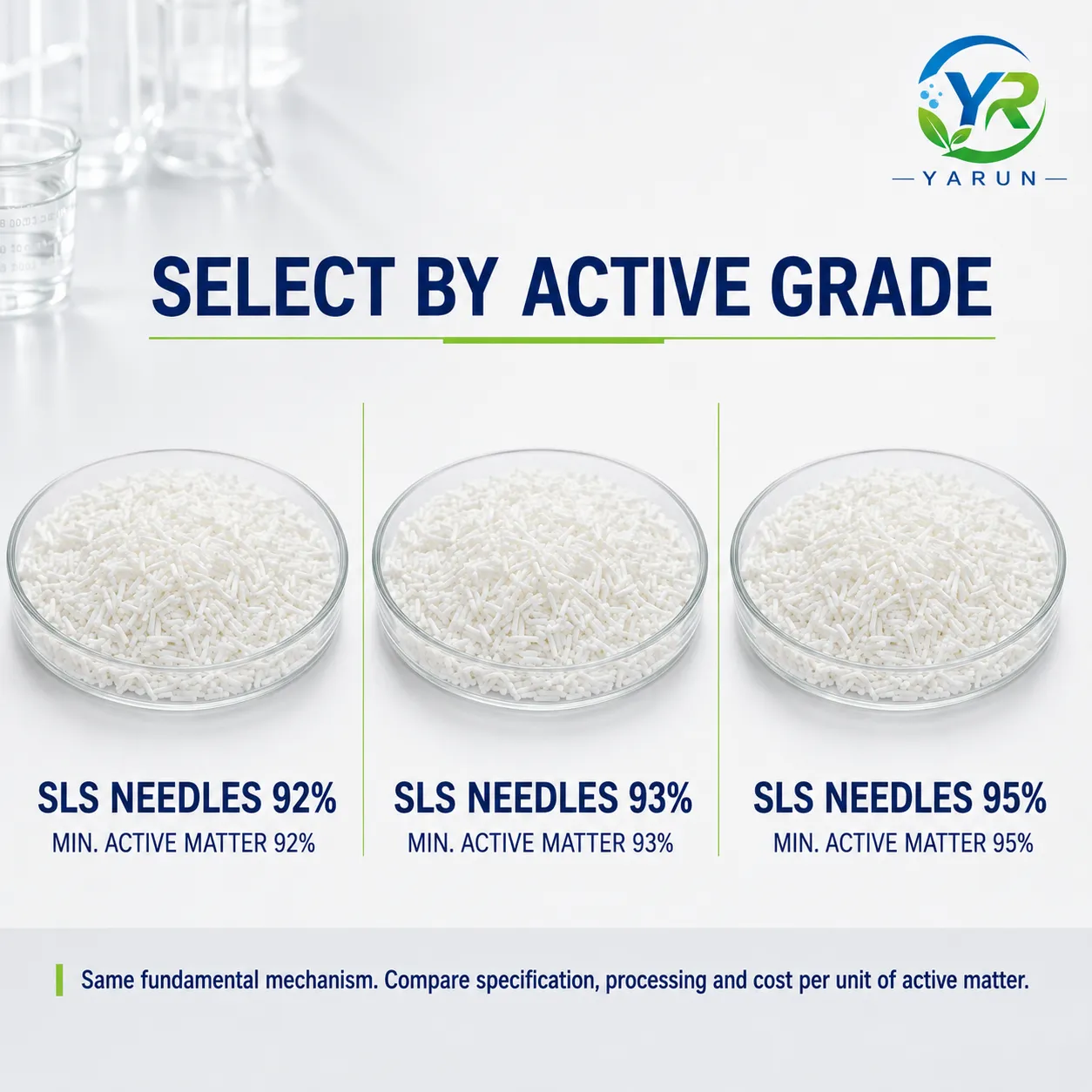
All three grades share the same fundamental surfactant mechanism. The grade number identifies the minimum active-matter level of the applicable product. It does not indicate a different molecule or a different cleaning mechanism.
Color provides visual differentiation and product identification. Blue, pink and green needles should not be assumed to produce stronger cleaning, higher foam or faster dissolution than white needles.
The appropriate grade and color should be selected according to the agreed specification, required product appearance, manufacturing process, formulation tolerance, delivered cost and finished-product test results.
SLS Needles at a Glance
SLS Needles combine high active matter with a defined solid particle form. They may be evaluated when a manufacturing process or finished product requires:
A solid anionic surfactant;
92%, 93% or 95% active-matter options;
Defined needle-shaped particles;
White or colored visual particles;
Dry-material dosing;
Lower water introduction than a diluted liquid surfactant;
Incorporation into selected powders, tablets, blocks or other solid cleaning systems.
The needle shape does not create a different molecular cleaning mechanism from an equivalent SLS powder after the material has been adequately dispersed or dissolved.
Its practical significance relates primarily to physical appearance, dosing, particle distribution, mixing, dispersion, storage and manufacturing requirements.
Product Identification
| Identification Item | Product Information |
|---|---|
| Commercial Product Name | SLS Needles |
| Chemical Description | Sodium Alkyl Sulfate |
| CAS Number | 73296-89-6 |
| Reference HS Code | 3402390000 |
| Ionic Classification | Anionic Surfactant |
| Available Grades | 92% / 93% / 95% |
| Physical Form | Needle-Shaped Particles |
| Available Colors | White / Blue / Pink / Green |
| Packaging | 25 kg/bag |
| Minimum Order Quantity | 1 MT per confirmed grade and color |
CAS No. 73296-89-6 follows the approved identification for this commercial SLS needle range. Product identity should be checked against the applicable TDS, SDS and commercial documentation.
The reference HS code does not replace customs classification. Importers should confirm the applicable tariff classification according to the final composition, shipment documents and destination-country requirements.
Available Grades and Colors
| Product Grade | Minimum Active Matter | Physical Form | Available Colors |
|---|---|---|---|
| SLS Needles 92% | 92% | Needle-shaped particles | White / Blue / Pink / Green |
| SLS Needles 93% | 93% | Needle-shaped particles | White / Blue / Pink / Green |
| SLS Needles 95% | 95% | Needle-shaped particles | White / Blue / Pink / Green |
Before ordering, confirm:
Required active grade;
Required color;
Applicable quality limits;
Appearance and color tolerance;
Sample requirement;
Required documents;
Order quantity;
Destination;
Delivery schedule.
Colored needles require sample approval before commercial production because perceived color can vary with lighting, dosage, surrounding raw materials and the visual characteristics of the finished product.
Product Specification Framework
The final technical specification depends on the selected grade and color.
| Specification Item | Acceptance Basis |
|---|---|
| Appearance | Needle-shaped particles in the confirmed color |
| Active Matter | Minimum 92%, 93% or 95%, according to grade |
| Petroleum Ether Soluble Matter or Unsulfated Matter | Applicable grade specification and test method |
| Sodium Sulfate | Applicable grade specification |
| Sodium Chloride | Applicable grade specification |
| Moisture | Applicable grade specification |
| pH | Applicable solution concentration and test method |
| Free Alkali | Applicable grade specification and test method |
| Color | Approved sample and agreed tolerance |
| Particle Appearance | Agreed visual standard |
Final commercial-batch acceptance should be based on:
The confirmed product grade;
The confirmed color;
The agreed product specification;
The approved reference sample, where applicable;
The Certificate of Analysis corresponding to the supplied batch.
A result reported for one sample or batch should not automatically be treated as the guaranteed value for every future commercial batch.
Analytical terms such as petroleum ether soluble matter, unsulfated matter and free oil should only be used according to the terminology and test method stated in the applicable specification.
How SLS Works at the Molecular Level
SLS is an anionic surfactant with an amphiphilic molecular structure. Each surfactant molecule contains two functionally different regions:
A hydrophilic sulfate head that interacts with the aqueous phase;
A hydrophobic alkyl chain that interacts with oils, hydrophobic soil and non-polar interfaces.
This structure allows dissolved SLS molecules to concentrate at interfaces rather than remaining randomly distributed throughout the water phase.
Relevant interfaces in a cleaning system include:
Water and air;
Water and oil;
Water and fabric;
Water and hard surfaces;
Water and solid particles.
SLS Needles must first be adequately dispersed or dissolved before the surfactant molecules can fully participate in these interfacial processes. The visible needle shape does not directly remove soil.
Interfacial Adsorption and Wetting
Water has relatively high surface tension. On a hydrophobic or contaminated surface, it may form droplets instead of spreading evenly.
When SLS is present in the aqueous phase, its molecules can adsorb at the interface. The hydrophilic sulfate heads remain associated with water, while the hydrophobic chains orient toward air, oil or a hydrophobic surface.
This molecular arrangement lowers surface and interfacial tension and can help the cleaning solution:
Spread across fabrics and hard surfaces;
Wet solid particles;
Increase contact with contaminated surfaces;
Penetrate between soil and the underlying substrate;
Support the subsequent removal and dispersion of soil.
Wetting is an important stage in a cleaning process, but it does not independently prove complete soil removal.
Interaction with Oily Soil
At a water–oil interface, the hydrophobic chains can associate with oily material while the sulfate heads remain exposed to water.
This reduces the interfacial incompatibility between the oil and water phases and can help the complete cleaning system detach oily material from a surface.
The process is associated with:
Wetting;
Interfacial interaction;
Soil detachment;
Dispersion under suitable conditions;
Reduction of immediate soil redeposition.
SLS does not chemically destroy oil. Final cleaning performance also depends on mechanical action, builders, chelating agents, other surfactants, water quality, temperature, pH, soil type and contact time.
Micelle Formation and Soil Dispersion
As the concentration of dissolved surfactant increases, aggregation can become favourable. SLS molecules can then form micellar structures in the aqueous phase.
In a simplified micelle:
The hydrophobic chains are oriented toward the interior;
The hydrophilic sulfate heads remain in contact with water.
These structures can help accommodate hydrophobic material in the aqueous phase and reduce the immediate redeposition of detached oily soil.
Micelle formation in a commercial formulation is affected by:
Temperature;
Electrolyte concentration;
Water hardness;
Other surfactants;
Builders;
Solvents;
Soil loading;
Formula pH.
A critical micelle concentration measured in a simplified laboratory system should not be treated as a universal addition level for finished detergent products.
Foam Formation
At the water–air interface, SLS can support the formation of liquid films around air bubbles and contribute to foam generation.
Foam height and stability are affected by:
SLS concentration;
Other surfactants;
Electrolytes;
Water hardness;
Temperature;
Builders;
Soil and oil loading;
Mechanical agitation;
Air incorporation;
Rinsing conditions.
Visible foam may be desirable in hand-wash products and selected cleaning applications. It may be unsuitable in systems requiring controlled or low foam.
Foam volume does not independently measure detergency. A formulation can produce visible foam without delivering the required soil removal, while an effective cleaning system does not always require high foam.
SLS Needles Compared with SLS Powder
SLS powder and SLS needles can share the same fundamental anionic surfactant mechanism after adequate dispersion or dissolution.
Their principal difference is physical form rather than a fundamentally different chemical cleaning mechanism.
| Selection Factor | SLS Needles | SLS Powder |
|---|---|---|
| Physical form | Defined needle-shaped particles | Fine powder |
| Visual options | White or colored particles | Uniform powder appearance |
| Dosing | Depends on particle flow and dosing equipment | Depends on powder flow and dosing equipment |
| Dispersion | Must be tested under actual processing conditions | Must be tested under actual processing conditions |
| Dissolution | Depends on grade, temperature, mixing and formulation | Depends on grade, temperature, mixing and formulation |
| Main selection focus | Defined particles and visual differentiation | Conventional powder processing |
| Performance basis | Active composition and complete formulation | Active composition and complete formulation |
Physical form may affect:
Material transfer;
Dosing behaviour;
Particle distribution;
Mixing;
Visual appearance;
Dispersion;
Moisture control;
Manufacturing sequence.
These factors should be evaluated using the actual product sample and intended manufacturing process.
For conventional powder-form SLS, review SLS Powder 92%, 93% and 95%.
Buyers who are still selecting between powder, needle and liquid forms can compare all Sodium Lauryl Sulfate forms and grades.
Understanding the Three Active Grades
SLS Needles 92%
SLS Needles 92% provide a minimum active-matter level of 92%.
This grade may be evaluated when:
The formulation can accommodate its applicable quality limits;
A defined needle-shaped particle is required;
White or colored particles are needed;
Its delivered cost provides a suitable commercial balance;
Finished-product trials confirm acceptable performance.
The 92% grade should not automatically be treated as a lower-performance product. When grades are compared at the same active SLS dosage, performance must be established through controlled finished-product testing.
SLS Needles 93%
SLS Needles 93% provide a minimum active-matter level of 93%.
This intermediate grade may be evaluated when a project requires:
A higher minimum active level than the 92% grade;
A defined needle-shaped particle;
White or colored visual particles;
A balance between active concentration and delivered cost;
An applicable specification that fits the finished formulation.
SLS Needles 95%
SLS Needles 95% provide the highest minimum active-matter level in the current needle range.
This grade may be evaluated when:
Higher active matter per kilogram of delivered product is important;
Lower introduction of non-active material is required;
Freight and packaging are being compared per unit of active matter;
The applicable specification fits the finished formulation;
Finished-product testing confirms suitability.
The 95% grade is not automatically the best choice for every application. Grade selection should also consider composition, processing, delivered price and finished-product performance.
Comparing Product Requirement by Active Matter
Price per delivered metric tonne does not provide a complete comparison between SLS grades.
The theoretical product requirement can be calculated as:
Product Required = Required Active SLS ÷ Product Active Fraction
To provide one metric tonne of active SLS:
| Product Grade | Theoretical Product Required |
|---|---|
| SLS Needles 92% | 1.087 MT |
| SLS Needles 93% | 1.075 MT |
| SLS Needles 95% | 1.053 MT |
The theoretical difference between the 92% and 95% grades is approximately 34 kg of delivered product for each metric tonne of active SLS.
This calculation does not determine which grade is commercially preferable.
A complete purchasing comparison should include:
Delivered product price;
Minimum active matter;
Applicable impurity limits;
Packaging;
Freight;
Storage;
Handling;
Processing requirements;
Manufacturing loss;
Color requirements;
Finished-product performance;
Cost per kilogram of usable active matter.
White and Colored SLS Needles
White SLS Needles
White needles may be selected when:
A neutral particle appearance is required;
Added visual color is unnecessary;
The formulation has an established color system;
A standard white needle appearance is preferred.
White color does not independently indicate a higher active grade, higher purity or stronger performance.
Blue SLS Needles
Blue needles may be evaluated for products requiring visible blue particles or a blue identification element.
The buyer should confirm:
Blue shade;
Color tolerance;
Dosage;
Particle distribution;
Finished-product appearance;
Storage stability.
Pink SLS Needles
Pink needles may be evaluated where a pink visual element supports the intended finished-product design.
The buyer should confirm:
Pink shade;
Color tolerance;
Particle visibility;
Distribution in the finished product;
Color migration risk;
Storage stability.
Green SLS Needles
Green needles may be evaluated for products requiring visible green particles or visual product differentiation.
The buyer should confirm:
Green shade;
Color tolerance;
Dosage;
Particle distribution;
Finished-product appearance;
Packaging presentation;
Storage stability.
Performance Boundary for Colored Needles
Color should not be used as evidence of:
Higher detergency;
Stronger foam;
Faster dissolution;
Antibacterial activity;
Disinfection;
Enzyme activity;
Fragrance release;
Higher active matter.
Colored needles are visual product options. Their performance depends on the selected grade, complete composition, dosage, formulation and use conditions.
Application Areas
SLS Needles may be evaluated in selected solid cleaning formulations where high active matter, defined particles or visual differentiation are relevant.
Laundry Detergent Powder
Depending on the complete formulation, SLS may contribute to:
Fabric and surface wetting;
Oily-soil interaction;
Soil dispersion;
Foam generation;
Anionic surfactant activity;
Visible white or colored particles.
Suitability depends on:
Total surfactant system;
Builders;
Water hardness;
Powder moisture;
Particle distribution;
Target foam profile;
Washing method;
Finished-product testing.
Colored needles should be tested for uniform distribution, color stability and possible staining or color transfer before commercial use.
Household Cleaning Powders
SLS Needles may be evaluated in:
Multipurpose cleaning powders;
Scouring powders;
Kitchen cleaning powders;
Bathroom cleaning powders;
Other selected solid household cleaners.
The selected particle form must be compatible with the other raw materials and the intended cleaning surface.
SLS provides surfactant activity. Abrasive cleaning performance depends on the complete formulation and should not be attributed to the needle particles alone.
Detergent Tablets
SLS Needles may be considered for selected tablet systems requiring a high-active solid surfactant.
Evaluate:
Particle distribution;
Compression process;
Tablet integrity;
Moisture;
Disintegration;
Dissolution;
Storage stability;
Foam profile;
Residue after use.
Needle form alone does not guarantee tablet strength, rapid dissolution or residue-free performance.
Solid Cleaning Blocks
SLS Needles may be evaluated in cleaning blocks and other compact solid products.
Compatibility should be checked with:
Binders;
Builders;
Fillers;
Fragrances;
Colorants;
Other surfactants;
Moisture-control systems.
Visible Detergent Particles
Blue, pink and green SLS Needles may be used as visible particles where visual differentiation forms part of the finished-product design.
Commercial approval should consider:
Color;
Particle appearance;
Dosage;
Distribution;
Finished-product appearance;
Storage stability;
Packaging presentation.
The visible particles should not be represented as providing an independent cleaning function unless supporting test evidence is available.
Selected Industrial Cleaning Products
SLS Needles may also be evaluated in selected industrial or institutional solid-cleaning formulations requiring:
Wetting;
Anionic surfactant activity;
Foam generation;
Solid-form processing;
Defined particles.
Suitability for food-contact, medical, disinfecting or other regulated applications cannot be established from the SLS grade alone.
Formulation and Processing Considerations
Before selecting an SLS needle grade, evaluate:
Required active matter;
Target SLS dosage;
Needle color;
Particle distribution;
Dry-mixing equipment;
Dosing system;
Addition sequence;
Mixing time;
Formula temperature;
Formula moisture;
Water hardness;
Electrolyte concentration;
Formula pH;
Other surfactants;
Builders;
Chelating agents;
Fragrances;
Colorants;
Enzymes;
Binders;
Target foam profile;
Dissolution or dispersion;
Storage stability;
Packaging compatibility.
There is no universal SLS addition level suitable for every product.
The appropriate dosage and processing method should be established through formulation trials and finished-product evaluation.
Dissolution and Dispersion
Needle-shaped particles do not have one fixed dissolution time.
Dissolution and dispersion can be affected by:
Active grade;
Particle dimensions;
Water temperature;
Mixing energy;
Addition rate;
Addition sequence;
Electrolyte concentration;
Other surfactants;
Formula viscosity;
Available water;
Batch scale.
A dissolution result measured in water alone should not automatically be applied to a concentrated commercial formulation.
Color Evaluation
Colored needles should be evaluated using:
The intended base formulation;
The planned dosage;
The actual mixing process;
The proposed packaging;
Relevant storage conditions;
The expected commercial distribution environment.
A retained approved sample can support later comparison of color and appearance.
Compatibility Evaluation
SLS may be evaluated with suitable:
Anionic surfactants;
Nonionic surfactants;
Amphoteric surfactants;
Builders;
Chelating agents;
Functional cleaning additives.
Compatibility cannot be determined from ionic classification alone.
The complete formulation should be evaluated for:
Stability;
Cleaning performance;
Foam profile;
Color;
Odor;
Residue;
Processing;
Storage.
Packaging
Standard packaging:
25 kg/bag
Packaging material, inner liner, palletization, shipping marks and labeling should be confirmed before commercial shipment.
Order quantities should be planned in complete packaging units.
Storage and Handling
Recommended storage and handling practices include:
Keep the product in its original sealed packaging;
Store in a clean, dry and ventilated area;
Protect the product from moisture and excessive heat;
Prevent contamination during opening and transfer;
Reseal partially used bags promptly;
Keep different grades and colors properly identified;
Prevent mixing between different colored products;
Use appropriate dust-control measures;
Use suitable personal protective equipment;
Follow the applicable SDS;
Apply suitable inventory-control procedures.
Exposure to moisture may affect particle condition, flow and handling. Storage life should be confirmed from the applicable commercial documentation.
Quality Control and Batch Acceptance
Product specifications and batch test results serve different purposes.
Agreed Product Specification
The agreed specification defines the acceptance limits for the selected grade and color.
Approved Sample
An approved sample may be used to confirm:
Color;
Particle appearance;
Visual tolerance;
Preliminary processing behaviour;
Suitability for further formulation testing.
Commercial Batch Certificate of Analysis
The commercial batch COA reports the applicable test results for the supplied batch.
Commercial acceptance should confirm:
Correct product name;
Correct grade;
Correct color;
Traceable batch number;
Agreed test items;
Applicable limits;
Reported results;
Packaging identification;
Shipment documents.
A representative sample result does not replace the COA corresponding to the supplied commercial batch.
Product Documents
Depending on the selected product and order stage, available documentation may include:
Technical Data Sheet;
Applicable Safety Data Sheet;
Agreed product specification;
Representative sample report;
Commercial batch Certificate of Analysis;
Packaging information;
Sample information;
Commercial invoice;
Packing list;
Certificate of Origin, where required;
Other available export documents.
Document identity, grade, color, version and applicability should be confirmed before use.
An SDS provides safety information and does not replace a batch COA. A COA reports batch quality results and does not replace the applicable SDS.
SLS Needle Selection Guide
| Purchasing Requirement | Starting Option |
|---|---|
| Standard high-active needle product | Evaluate SLS Needles 92% |
| Intermediate active-matter grade | Evaluate SLS Needles 93% |
| Highest minimum active matter in the range | Evaluate SLS Needles 95% |
| Neutral particle appearance | White SLS Needles |
| Visible blue particles | Blue SLS Needles |
| Visible pink particles | Pink SLS Needles |
| Visible green particles | Green SLS Needles |
| Conventional powder processing | Compare with SLS Powder |
| Selection between physical forms | Compare all SLS forms and grades |
This guide provides an initial selection direction. Final approval requires specification review, sample evaluation and finished-product validation.
Frequently Asked Questions
What are SLS Needles?
SLS Needles are a solid needle-shaped form of an anionic sodium alkyl sulfate surfactant used for wetting, foaming and soil dispersion in selected cleaning formulations.
What is the CAS number for this SLS needle range?
The CAS number used for this commercial SLS needle range is 73296-89-6.
What is the difference between SLS Needles 92%, 93% and 95%?
The figures identify the minimum active-matter grades. Applicable quality limits may also differ. Selection should be based on the complete grade specification rather than active matter alone.
Are SLS powder and SLS needles chemically different?
They can share the same fundamental anionic surfactant mechanism. Their principal difference is physical form. Exact identity and composition should be confirmed using the documentation applicable to each commercial product.
Do SLS Needles produce less dust than SLS powder?
Dust behaviour depends on particle condition, handling, transfer method, equipment and workplace controls. It should be evaluated using the actual product and manufacturing process.
Do SLS Needles dissolve more slowly than powder?
Not under every condition. Dissolution depends on particle form, temperature, mixing, available water, electrolyte concentration and the complete formulation.
Do blue, pink and green SLS Needles clean differently?
No performance difference should be assumed from color alone. Color primarily provides visual differentiation. Cleaning performance depends on active grade, composition, dosage, formulation and use conditions.
Which colors are available?
White, blue, pink and green SLS Needles are available. The required grade, color, sample and commercial schedule should be confirmed before ordering.
Can colored needles cause color transfer?
Color-transfer or staining risk cannot be excluded from appearance alone. The selected color and dosage should be tested in the finished formulation and intended application before commercial approval.
Which active grade should I select?
Selection should consider required active matter, applicable quality limits, formulation tolerance, delivered cost and intended color. Final selection should follow sample and finished-product testing.
Are SLS Needles suitable for detergent powder?
They may be evaluated in selected detergent powders where a high-active solid surfactant or visible particles are required. Suitability depends on processing, distribution, moisture, formula composition and finished-product performance.
Can SLS Needles be used in detergent tablets?
They may be evaluated in selected tablet formulations. Needle form alone does not guarantee tablet strength, dissolution or residue performance.
Are SLS Needles suitable for liquid detergent?
SLS may be incorporated into selected liquid systems after appropriate dissolution and compatibility evaluation. The complete formulation and manufacturing process must be tested.
What is the standard packaging?
Standard packaging is 25 kg/bag.
What is the minimum order quantity?
The standard starting MOQ is 1 MT per confirmed grade and color.
Can samples be provided?
Sample availability depends on the selected grade, color and current supply conditions. Colored samples should be approved before a commercial order is confirmed.
Which documents can be provided?
Depending on the selected product and order stage, available documents may include the applicable TDS, SDS, agreed specification and relevant COA.
What information is required for a quotation?
Provide the required grade, color, quantity, application, destination country and port, Incoterm, sample requirement and required documents.
Request SLS Needle Specifications and Quote
Selecting SLS Needles by color or active percentage alone may result in an unsuitable grade, processing route or visual outcome.
Please provide:
Required active grade;
Required needle color;
Finished-product application;
Required quantity;
Destination country and port;
Required Incoterm;
Required documents;
Sample requirement;
Target delivery schedule.
YARUN will review the request and confirm the applicable product option, specification status, MOQ, documentation and commercial terms.
Related Products
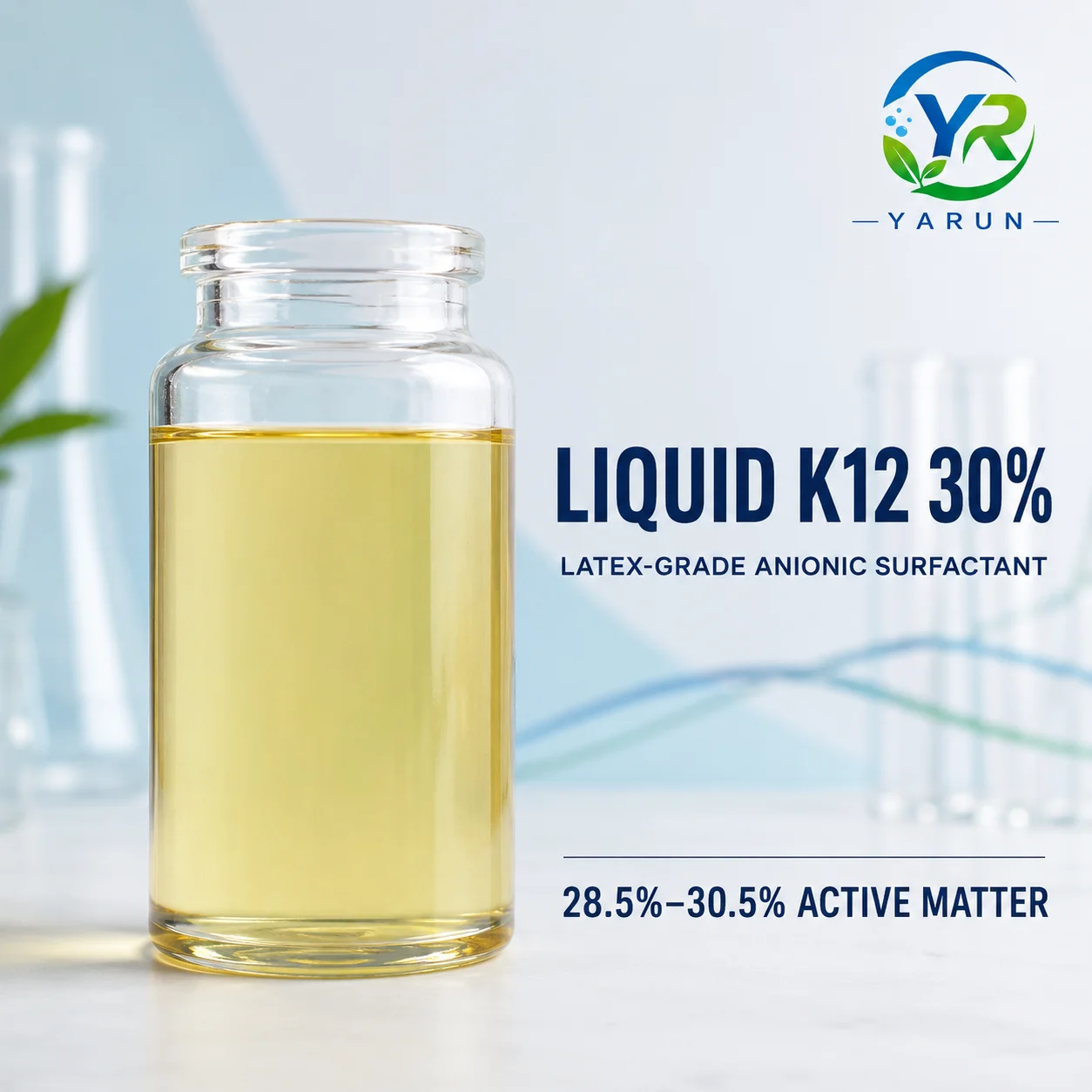
SLS Liquid 30% (Liquid K12) – Latex Grade
Liquid K12 30% is a latex-grade anionic surfactant supplied as a pale yellow transparent liquid with 28.5%–30.5% active matter. It is designed for liquid-phase dosing and may be evaluated as an emulsifier in selected synthetic latex, rubber and resin emulsion-polymerization systems. YARUN supplies the product in drums or IBC totes with a minimum order quantity of 1 MT. Final suitability depends on the applicable specification, processing conditions and completed formulation or polymerization trials.
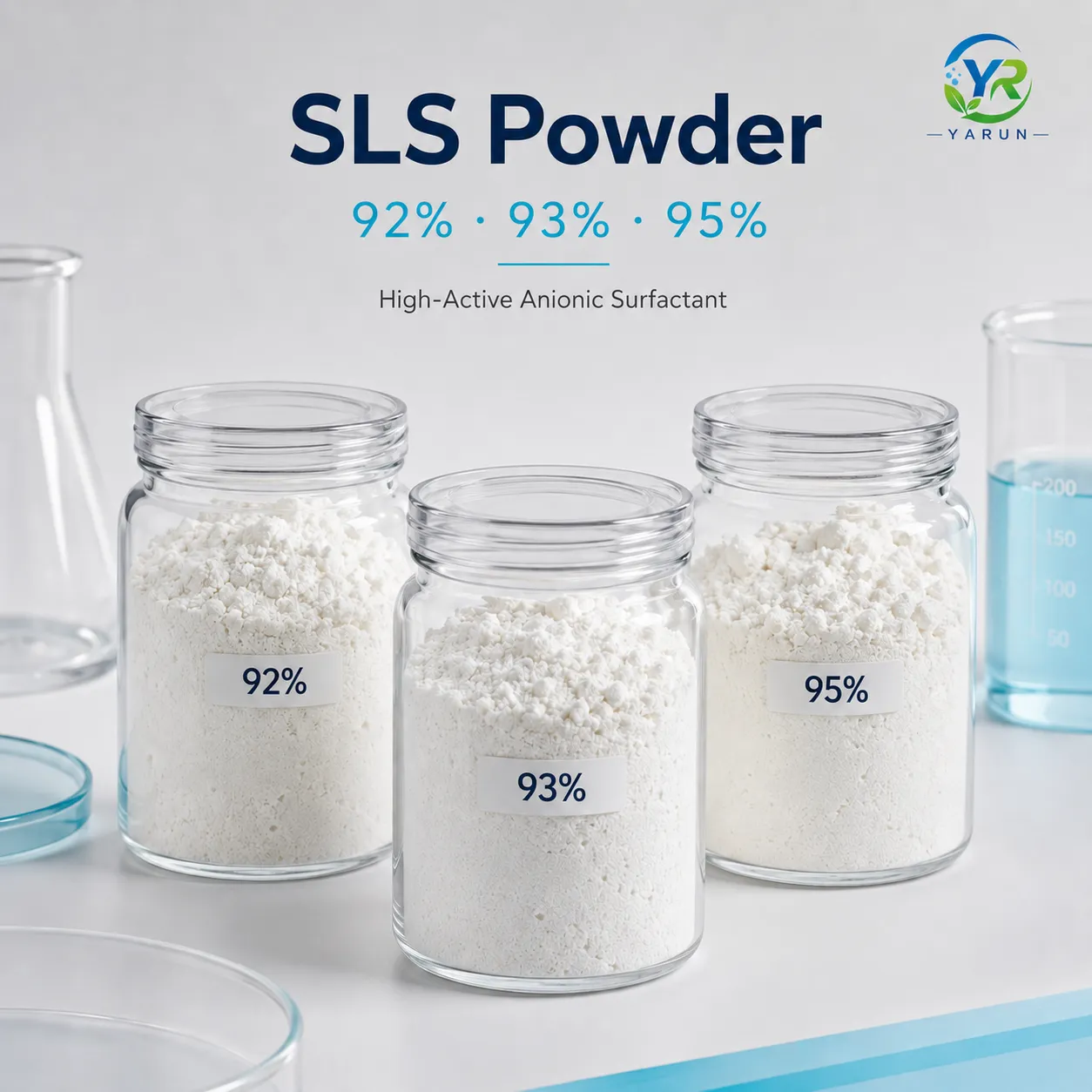
SLS Powder 92%, 93% and 95%
SLS Powder is a high-active anionic surfactant available in 92%, 93% and 95% grades. The three grades share the same powder form and fundamental surfactant mechanism but differ in active matter and sodium sulfate limits. YARUN helps detergent manufacturers compare grade concentration, inorganic-salt load, processing requirements and delivered cost per unit of active matter.
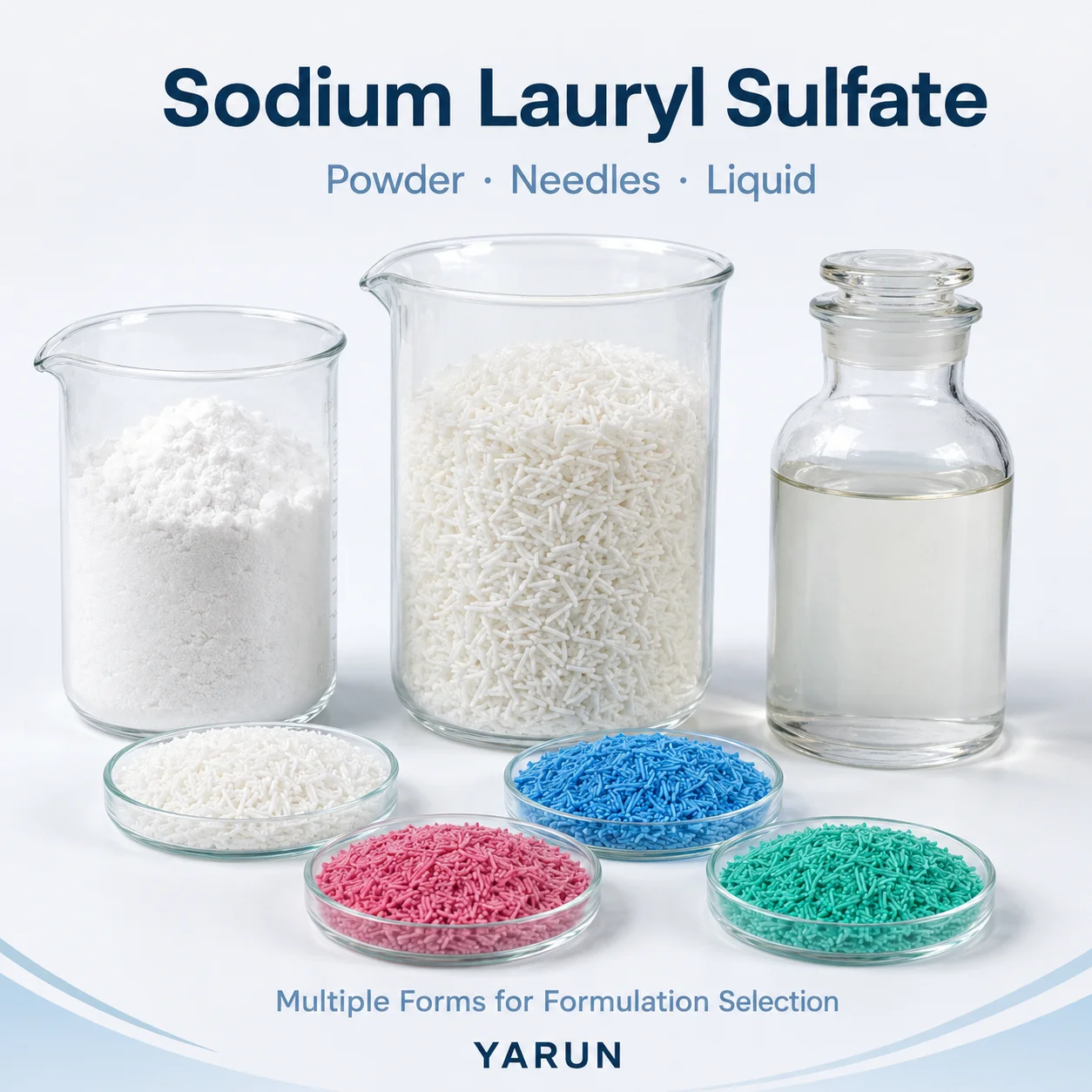
Sodium Lauryl Sulfate (SLS) – Forms, Grades and Selection
Sodium Lauryl Sulfate (SLS) is an anionic surfactant used for wetting, foaming, detergency and dispersion. YARUN offers SLS in powder, needle and liquid forms, including powder and needle grades at 92%, 93% and 95% active matter and SLS Liquid 30%. This page compares the available forms and helps buyers select an appropriate starting option according to product format, processing method and active-matter requirements.
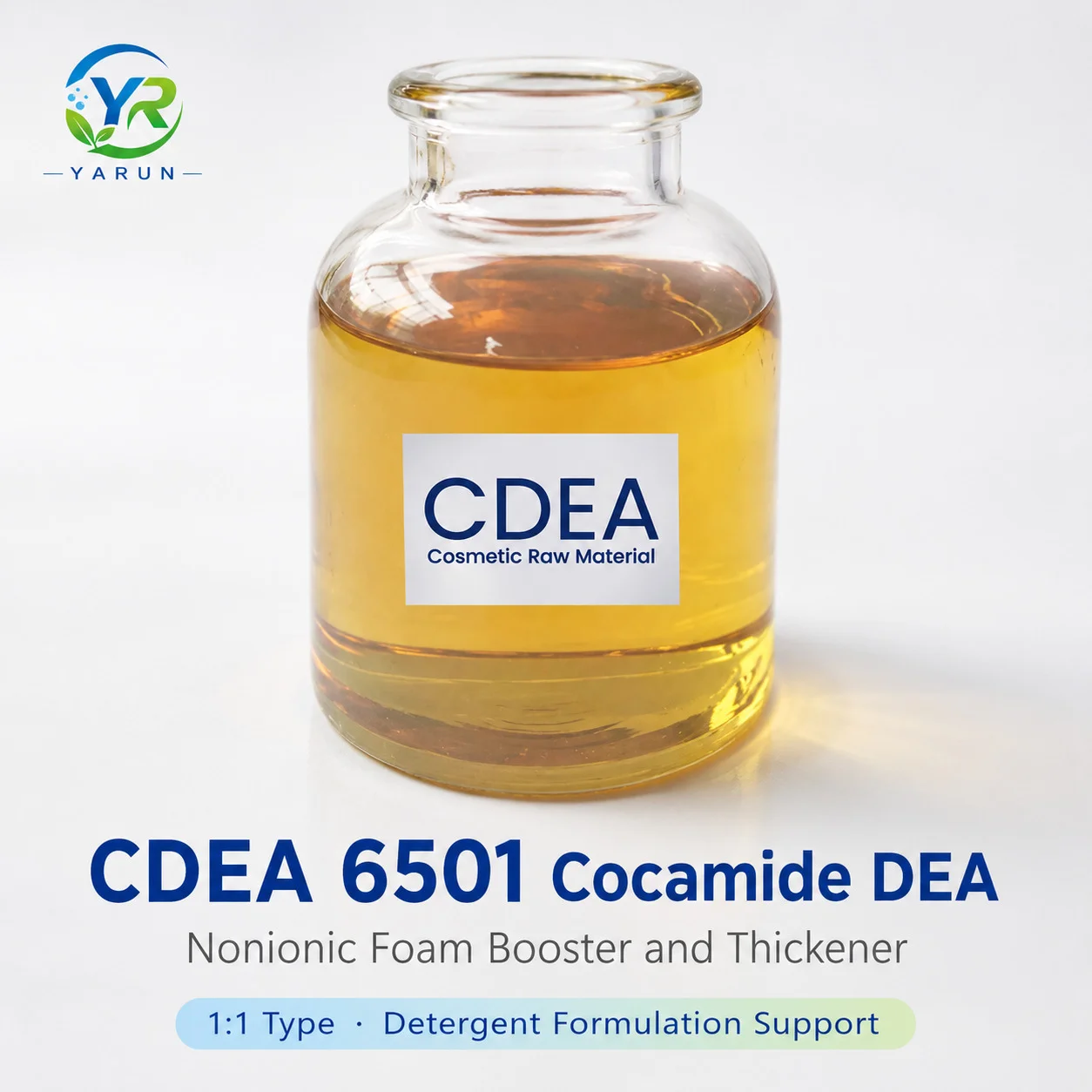
CDEA 6501 Cocamide DEA Foam Booster and Thickener
YARUN CDEA 6501 is a 1:1 type Cocamide DEA nonionic co-surfactant used to support foam stability, viscosity development and formulation compatibility in liquid detergent, dishwashing liquid, shampoo, hand wash and industrial cleaning products. It can be combined with SLES, LABSA, AOS, SLS and other suitable surfactants according to the target formulation.