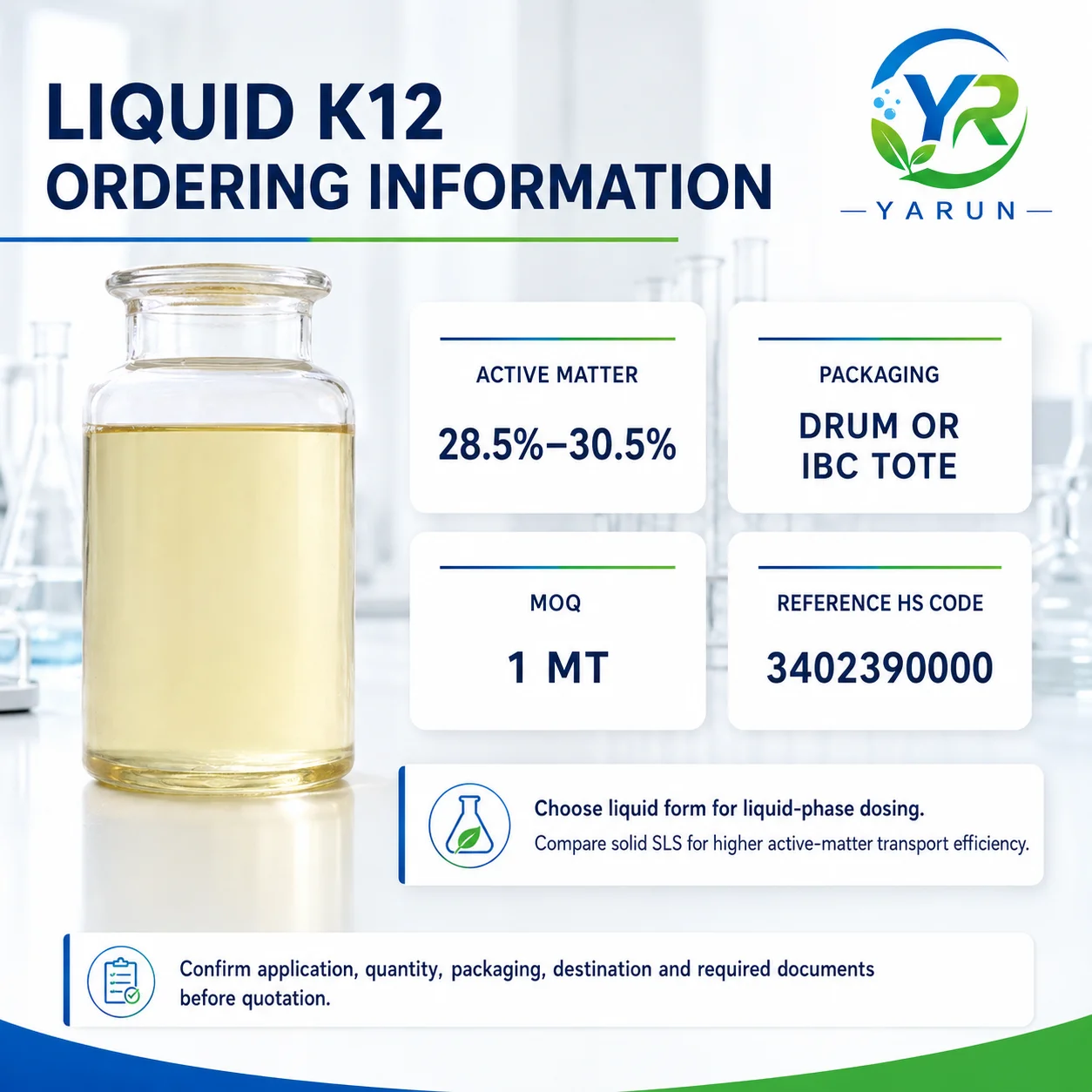
SLS Liquid 30% (Liquid K12) – Latex Grade
Liquid K12 30% is a latex-grade anionic surfactant supplied as a pale yellow transparent liquid with 28.5%–30.5% active matter. It is designed for liquid-phase dosing and may be evaluated as an emulsifier in selected synthetic latex, rubber and resin emulsion-polymerization systems. YARUN supplies the product in drums or IBC totes with a minimum order quantity of 1 MT. Final suitability depends on the applicable specification, processing conditions and completed formulation or polymerization trials.
| NAME | VALUE |
|---|---|
| Chemical Name | Sodium Lauryl Sulfate |
| CAS Number | 151-21-3 |
| Reference HS Code | 3402390000 |
| Product Grade | Latex Grade |
| Surfactant Class | Anionic Surfactant |
| Active Matter | 28.5%–30.5% |
| Appearance | Pale Yellow Transparent Liquid |
| Packaging | 200KG/Drum or IBC Tote |
| MOQ | 1 MT |
Product Description
Liquid K12 30% is a latex-grade liquid Sodium Lauryl Sulfate product containing 28.5%–30.5% active matter. It is supplied as a pale yellow transparent liquid for manufacturing processes that require liquid-phase dosing and an anionic surfactant or emulsifier.
The product may be evaluated in selected:
Synthetic latex systems;
Synthetic rubber emulsions;
Resin emulsions;
Emulsion-polymerization processes;
Industrial liquid formulations;
Detergent formulations requiring liquid surfactant incorporation.
Liquid K12 30% provides the same fundamental anionic surfactant mechanism associated with Sodium Lauryl Sulfate. Its practical difference from high-active powder and needle products lies primarily in its liquid form, lower active-matter concentration and liquid-processing characteristics.
The product should not be selected solely by comparing its delivered price per metric tonne with high-active solid SLS. A meaningful comparison also considers:
Active matter;
Water and non-active material introduced into the process;
Pumping and metering;
Mixing and dilution;
Storage;
Packaging;
Freight;
Processing time;
Cost per unit of active matter;
Finished-product or polymerization performance.
Liquid K12 30% at a Glance
Liquid K12 30% may be considered when a manufacturing process requires:
A nominal 30% liquid anionic surfactant;
28.5%–30.5% active matter;
Liquid-phase incorporation;
Pumped or metered dosing;
An emulsifier for selected latex or emulsion-polymerization systems;
Reduced handling of dry SLS particles;
Direct distribution into an aqueous processing stage;
Drum or IBC tote supply.
The product is not automatically suitable for every latex, polymerization or detergent system. Final selection requires specification review and testing under the intended process conditions.
Product Identification
| Identification Item | Product Information |
|---|---|
| Commercial Product Name | Liquid K12 30% |
| Chemical Name | Sodium Lauryl Sulfate |
| Alternative Name | Sodium Dodecyl Sulfate / Liquid K12 |
| Chemical Description | Sodium Alkyl Sulfate |
| CAS Number | 151-21-3 |
| Reference HS Code | 3402390000 |
| Product Grade | Latex Grade |
| Ionic Classification | Anionic Surfactant |
| Physical Form | Liquid |
| Packaging | Drum or IBC Tote |
| Minimum Order Quantity | 1 MT |
CAS No. 151-21-3 applies to the product identity confirmed for this liquid K12 grade. The applicable TDS, SDS, specification and shipment documents should be reviewed together before commercial use.
The reference HS code does not replace customs classification. Importers should confirm the applicable tariff code according to the final product composition, shipment documents and destination-country requirements.
Technical Specifications
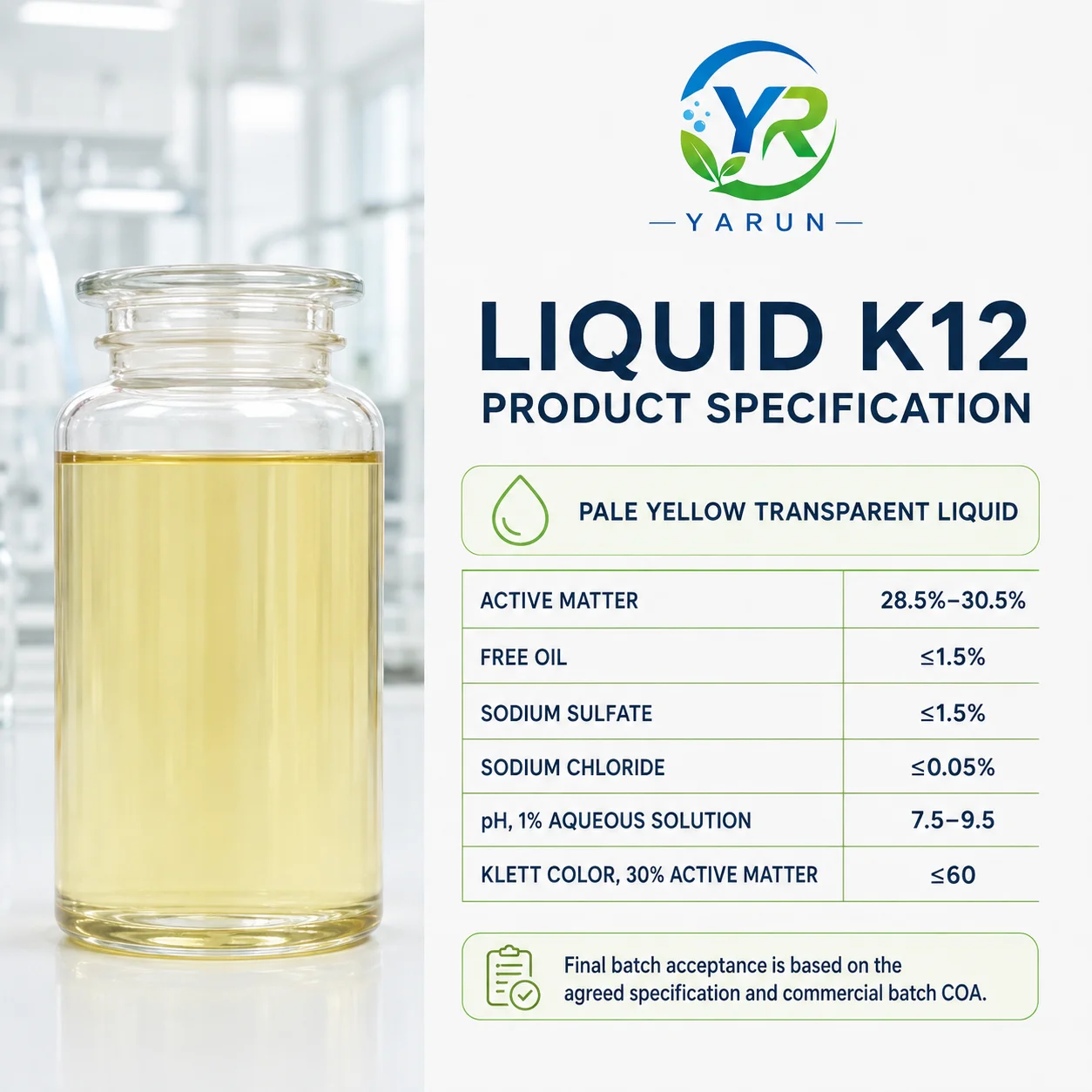
| Specification | Value |
|---|---|
| Appearance | Pale yellow transparent liquid |
| Active Matter, % | 28.5–30.5 |
| Free Oil, % ≤ | 1.5 |
| Sodium Sulfate, % ≤ | 1.5 |
| Sodium Chloride, % ≤ | 0.05 |
| pH, 1% Aqueous Solution | 7.5–9.5 |
| Klett Color, 30% Active Matter ≤ | 60 |
These values define the confirmed specification framework for Liquid K12 30%.
Final commercial-batch acceptance should be based on:
The agreed product specification;
Confirmed analytical terminology;
Applicable test methods;
Correct product identification;
Traceable batch information;
The Certificate of Analysis corresponding to the supplied batch.
A result reported for a representative sample does not replace the COA issued for the commercial batch.
Understanding the Active-Matter Range
Liquid K12 30% is a nominal 30% product with a confirmed active-matter range of:
It should not be represented as having a guaranteed minimum active matter of 30%.
The lower and upper limits define the acceptable active-matter range for the product. Actual commercial-batch results should be confirmed from the corresponding COA.
When calculating dosage, buyers should decide whether to use:
The nominal 30% value for preliminary formulation planning;
The minimum 28.5% value for conservative active-matter calculations;
The actual batch result for final manufacturing adjustment.
Active-Matter Calculation
The active SLS introduced by Liquid K12 can be calculated as:
For example, at the nominal 30% concentration:
| Liquid K12 Quantity | Nominal Active SLS |
|---|---|
| 100 kg | 30 kg |
| 500 kg | 150 kg |
| 1,000 kg | 300 kg |
At the confirmed specification limits, one metric tonne of Liquid K12 provides:
| Active-Matter Result | Active SLS per 1 MT Product |
|---|---|
| 28.5% | 285 kg |
| 30.0% nominal | 300 kg |
| 30.5% | 305 kg |
The final manufacturing dosage may need to be adjusted according to the actual batch result and the target active level in the formulation.
How Liquid K12 Works
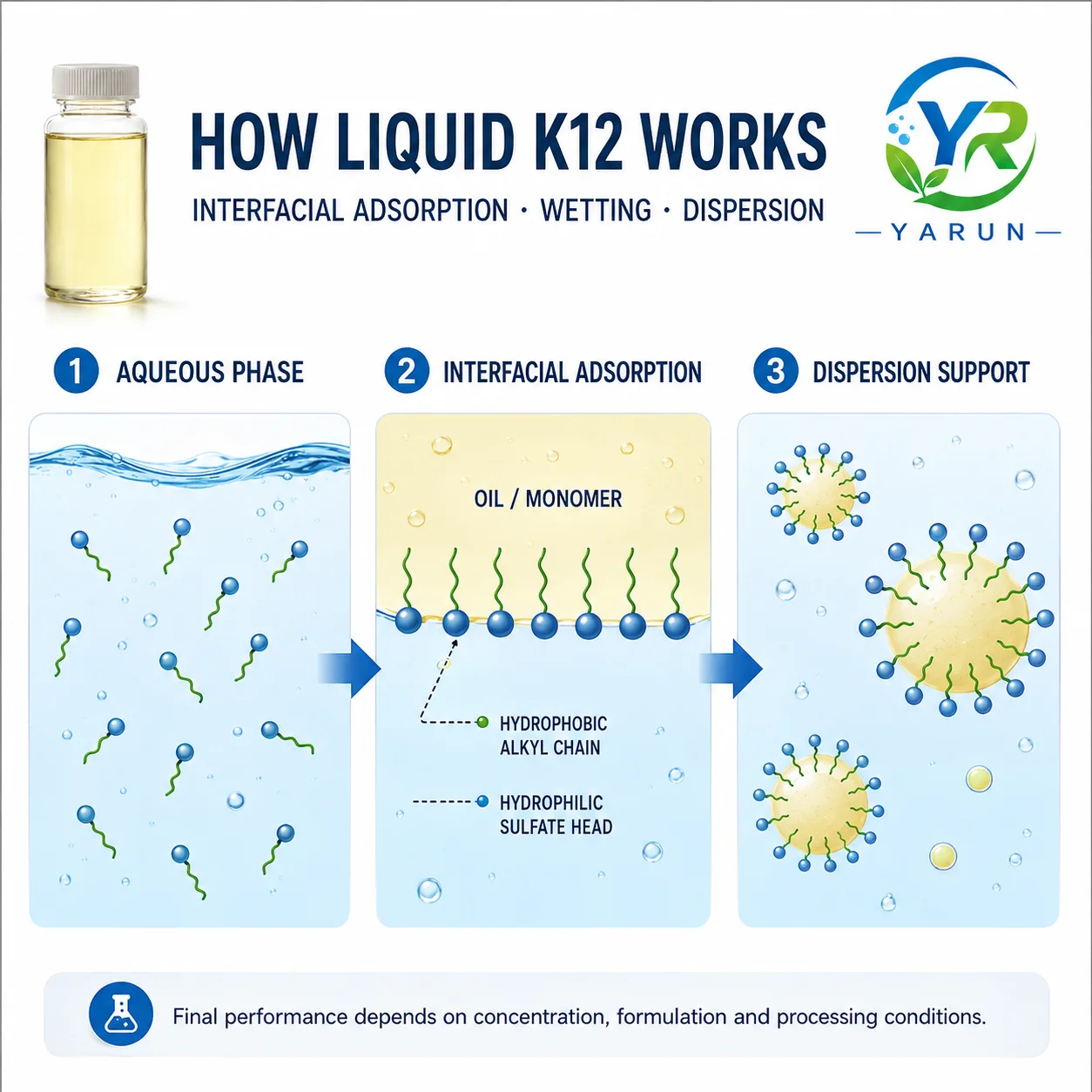
Sodium Lauryl Sulfate is an anionic surfactant with an amphiphilic molecular structure.
Each surfactant molecule contains:
A hydrophilic sulfate head that interacts with the aqueous phase;
A hydrophobic alkyl chain that interacts with oils, hydrophobic materials, monomers and non-polar interfaces.
This structure allows the surfactant molecules to concentrate at interfaces between phases rather than remaining randomly distributed throughout the aqueous medium.
Relevant interfaces may include:
Water and air;
Water and oil;
Water and monomer;
Water and polymer particles;
Water and solid surfaces;
Water and hydrophobic soil.
The function of Liquid K12 depends on its concentration, the complete formulation and the process conditions under which it is used.
Interfacial Adsorption
At a water–oil or water–monomer interface, the hydrophobic alkyl chains orient toward the non-polar phase while the sulfate heads remain associated with water.
This molecular arrangement reduces interfacial tension and can support:
Distribution of a hydrophobic phase in water;
Formation of smaller dispersed droplets under suitable mixing conditions;
Wetting of hydrophobic materials;
Contact between aqueous and non-aqueous phases;
Stabilization of selected dispersed systems.
Liquid K12 does not independently guarantee a stable emulsion. Emulsion performance also depends on composition, emulsifier dosage, mixing energy, temperature, electrolyte concentration and the characteristics of the dispersed phase.
Emulsion-Polymerization Function
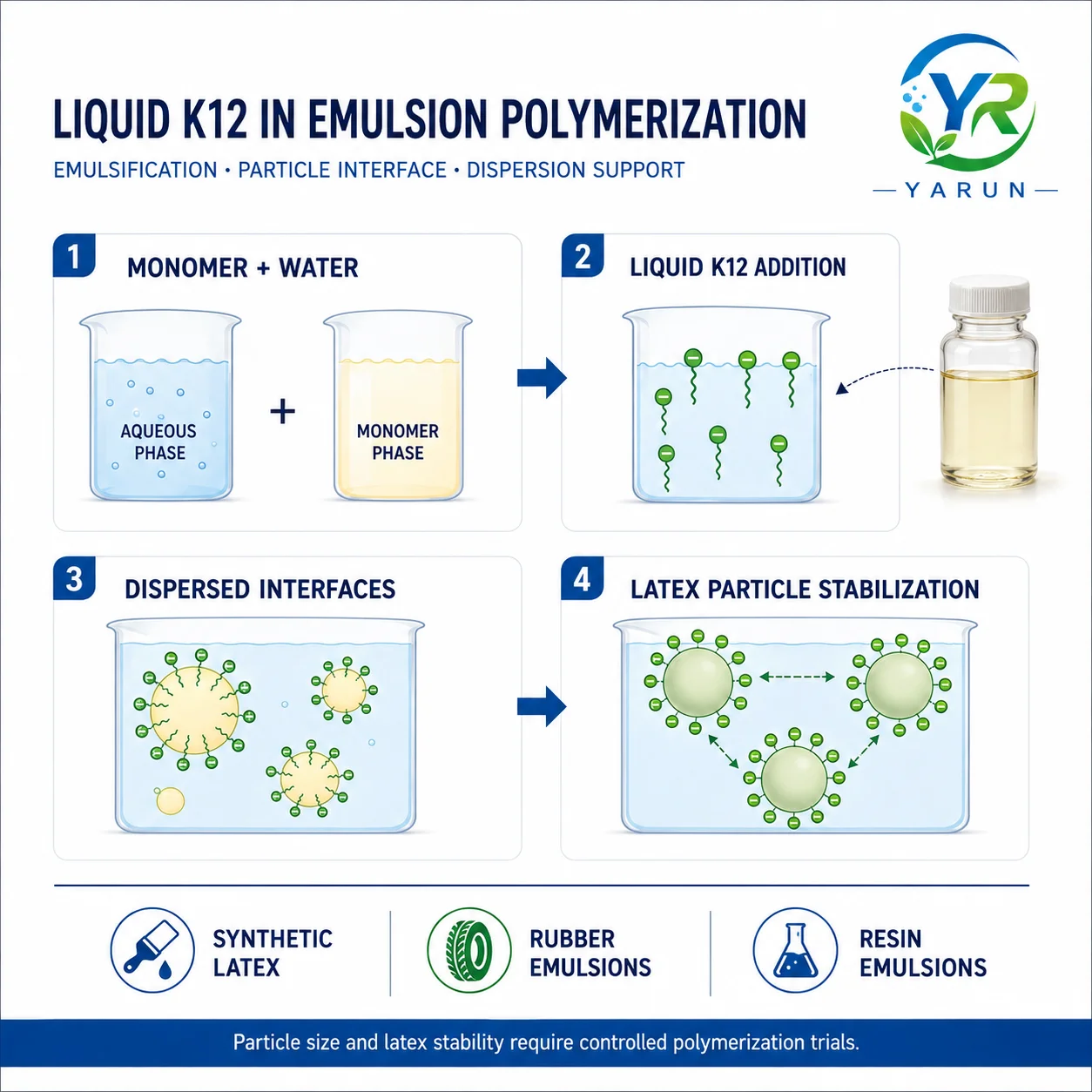
In an emulsion-polymerization system, an anionic surfactant may help create and stabilize interfaces between the aqueous phase and hydrophobic monomers.
During an appropriately designed process, Liquid K12 may contribute to:
Monomer emulsification;
Formation of dispersed monomer droplets;
Development of surfactant aggregates in the aqueous phase;
Stabilization of growing polymer particles;
Electrostatic repulsion between negatively charged particle surfaces;
Reduction of uncontrolled particle agglomeration.
The sulfate head groups can contribute negative surface charge at the particle–water interface. Under suitable conditions, electrostatic repulsion helps reduce the tendency of dispersed particles to approach and aggregate.
This mechanism is sensitive to the complete polymerization system.
Important variables include:
Monomer type;
Monomer-to-water ratio;
Surfactant dosage;
Initiator system;
Electrolyte concentration;
Water quality;
pH;
Temperature;
Mixing and shear;
Addition sequence;
Feed rate;
Target solids content;
Target particle size;
Polymerization conversion;
Post-addition conditions.
Liquid K12 should therefore be treated as one component of the emulsion-polymerization system rather than a standalone guarantee of latex stability or particle-size control.
Wetting and Dispersion
Liquid K12 can reduce surface and interfacial tension after it is distributed through the aqueous phase.
This may help the liquid phase:
Spread across surfaces;
Wet hydrophobic particles;
Improve contact between different formulation phases;
Assist the dispersion of oily or hydrophobic materials;
Reduce immediate redeposition under suitable cleaning conditions.
Wetting is an important interfacial function, but it does not independently establish final cleaning, dispersion or polymerization performance.
Micelle Formation
As the concentration of dissolved surfactant increases, aggregation can become favourable. SLS molecules may form micellar structures in the aqueous phase.
In a simplified micelle:
Hydrophobic chains are directed toward the interior;
Hydrophilic sulfate heads remain in contact with water.
In detergent systems, these structures can help accommodate hydrophobic soil in the aqueous phase.
In emulsion polymerization, surfactant aggregates and interfaces can participate in the formation and stabilization of polymer particles, depending on the process design.
The concentration required for aggregation is not a universal dosage value. It changes with:
Temperature;
Electrolytes;
Monomers;
Other surfactants;
Initiators;
Water hardness;
Solvents;
Formula pH;
Process composition.
A critical micelle concentration taken from a simplified laboratory system should not be copied directly into a commercial polymerization or detergent formula.
Foam Formation
At the air–water interface, SLS may support the formation of liquid films around air bubbles and contribute to foam generation.
Foam behaviour depends on:
Surfactant concentration;
Mixing energy;
Air incorporation;
Temperature;
Electrolytes;
Other surfactants;
Oils and monomers;
Polymer solids;
Soil loading;
Process equipment.
Foam may be useful in selected detergent applications but undesirable during polymerization, pumping, transfer or high-shear processing.
Foam volume does not independently measure emulsification, latex stability or cleaning performance.
Where foam interferes with production, the complete process should be reviewed rather than assuming that a lower or higher SLS dosage alone will solve the issue.
Why Liquid Form Matters
Liquid K12, SLS powder and SLS needles can share the same fundamental anionic surfactant mechanism after incorporation into the aqueous phase.
Their main differences relate to physical form and active-matter concentration.
| Selection Factor | Liquid K12 30% | High-Active Solid SLS |
|---|---|---|
| Physical Form | Liquid | Powder or needles |
| Active Matter | 28.5%–30.5% | According to selected solid grade |
| Dosing | Pumping or liquid metering may be evaluated | Dry-material dosing |
| Water Introduction | Higher | Lower |
| Dry-Particle Handling | Not required for the liquid product | Required |
| Mixing Route | Liquid-phase incorporation | Dissolution or dry incorporation |
| Packaging Efficiency per Unit of Active Matter | Lower | Higher |
| Main Selection Focus | Liquid-processing convenience | High active-matter delivery |
Liquid form can simplify selected dosing and incorporation processes, but it does not automatically reduce total manufacturing cost.
The buyer should compare:
Product price;
Active-matter delivery;
Pumping equipment;
Transfer losses;
Packaging;
Freight;
Storage;
Mixing time;
Water introduced into the formula;
Finished-product performance.
For high-active powder products, review SLS Powder 92%, 93% and 95%.
For defined or colored solid particles, review SLS Needles 92%, 93% and 95%.
Buyers comparing all three forms can compare all Sodium Lauryl Sulfate forms and grades.
Comparing Cost per Unit of Active Matter
Liquid K12 contains substantially less active surfactant per delivered metric tonne than high-active solid SLS.
The theoretical product requirement is calculated as:
Product Required = Required Active SLS ÷ Product Active Fraction
To provide one metric tonne of active SLS:
| Product Concentration | Theoretical Product Required |
|---|---|
| Liquid K12 at 28.5% | 3.509 MT |
| Liquid K12 at nominal 30.0% | 3.333 MT |
| Liquid K12 at 30.5% | 3.279 MT |
| Solid SLS at 92% | 1.087 MT |
| Solid SLS at 93% | 1.075 MT |
| Solid SLS at 95% | 1.053 MT |
This mathematical comparison does not establish which physical form is commercially preferable.
Liquid K12 may provide processing advantages where liquid pumping, metering or aqueous-phase addition is important. Solid grades provide higher active-matter transport efficiency and introduce less water into the process.
A complete comparison should include:
Delivered price;
Actual batch active matter;
Freight;
Packaging;
Storage;
Transfer equipment;
Labour;
Dosing accuracy;
Manufacturing loss;
Mixing time;
Process water;
Finished-product performance;
Cost per kilogram of usable active matter.
Primary Application: Latex and Emulsion Polymerization
Liquid K12 30% is primarily positioned for evaluation as an anionic emulsifier in selected latex and emulsion-polymerization systems.
Potential project areas include:
Synthetic rubber latex;
Synthetic resin emulsions;
Polymer dispersions;
Selected aqueous emulsion-polymerization systems.
Its possible process functions include:
Supporting monomer emulsification;
Reducing interfacial tension;
Supporting dispersed-droplet formation;
Contributing surface charge to polymer particles;
Supporting particle dispersion;
Reducing uncontrolled aggregation under suitable conditions.
Final suitability depends on the selected monomer system, formulation, process conditions and target polymer properties.
Liquid K12 must not be assumed to provide universal control over:
Particle size;
Molecular weight;
Conversion;
Coagulum;
Latex viscosity;
Mechanical stability;
Electrolyte stability;
Freeze–thaw stability;
Film properties;
Final polymer performance.
These outcomes must be established through controlled polymerization trials and commercial-batch validation.
Selected Detergent and Cleaning Formulations
Liquid K12 may also be evaluated in selected detergent and industrial-cleaning formulations requiring:
A liquid anionic surfactant;
Wetting;
Foam generation;
Soil interaction;
Dispersion;
Liquid-phase dosing.
Potential application types include:
Selected household liquid cleaners;
Selected industrial liquid cleaners;
High-foam cleaning systems;
Liquid surfactant concentrates;
Other formulations compatible with the applicable grade.
The latex-grade designation should be considered before using the product in a consumer cleaning formulation.
Suitability requires review of:
Product specification;
Impurity profile;
Complete formula;
Stability;
pH;
Viscosity;
Foam;
Cleaning performance;
Packaging;
Intended market requirements.
The product should not be described as personal-care, toothpaste, food, pharmaceutical or reagent grade without separate supporting specifications and quality documentation.
Formulation and Processing Considerations
Before using Liquid K12 30%, evaluate:
Target active SLS;
Required emulsifier concentration;
Actual batch active matter;
Formula water balance;
Addition sequence;
Dilution requirement;
Mixing energy;
Pump compatibility;
Transfer-line compatibility;
Metering accuracy;
Process temperature;
Formula pH;
Electrolyte concentration;
Water quality;
Other surfactants;
Monomer system;
Initiator system;
Target solids content;
Target particle size;
Foam generation;
Finished-product stability.
There is no universal addition level suitable for every latex, polymerization or detergent process.
Dosage and processing conditions should be established through controlled trials.
Addition Sequence
Liquid K12 may be:
Added to the initial aqueous phase;
Used in a pre-emulsion;
Divided between initial charge and feed stages;
Diluted before addition;
Metered during processing.
The correct sequence depends on process design. Changing the addition sequence can affect:
Interfacial area;
Nucleation;
Particle formation;
Foam;
Heat transfer;
Process stability;
Final product properties.
Dilution
If dilution is required, evaluate:
Water quality;
Water temperature;
Addition rate;
Mixing intensity;
Dilution ratio;
Foam generation;
Solution uniformity;
Holding time.
The buyer should establish a validated dilution procedure for the actual production system.
Pumping and Metering
Liquid form can support pumping and metered addition, but equipment suitability cannot be determined without confirmed density, viscosity and operating-temperature data.
Before commercial operation, verify:
Pump type;
Seal and gasket compatibility;
Hose and transfer-line compatibility;
Flow rate;
Metering accuracy;
Suction conditions;
Line cleaning;
Temperature conditions;
Spill control.
The product should not be described as universally pumpable without process-specific verification.
Temperature and Storage Behaviour
Liquid surfactant properties may change with temperature. Potential changes can include:
Viscosity variation;
Reduced flow;
Haze;
Separation;
Crystallization;
Changes in transfer behaviour.
No specific low-temperature or recovery claim should be assumed without product-specific test data.
If the product changes appearance during storage, confirm the approved handling procedure before heating, mixing or using the material.
Packaging
Available packaging formats:
The final packaging configuration should be confirmed according to:
Order quantity;
Destination;
Transport route;
Handling equipment;
Storage facilities;
Customer requirements.
Packaging net weight, container material, palletization and shipping marks should be stated in the commercial quotation and shipment documents.
Minimum order quantity:1MT
Storage and Handling
Recommended general practices include:
Keep the product in its original sealed container;
Store in a clean and suitable area;
Protect the product from contamination;
Keep containers closed when not in use;
Maintain clear batch identification;
Avoid mixing different products or batches without approval;
Use compatible pumps and transfer equipment;
Prevent uncontrolled release;
Follow the applicable SDS;
Follow the agreed storage and handling conditions;
Inspect appearance before use;
Confirm the handling procedure if haze, separation or crystallization is observed.
Shelf life and specific storage-temperature limits should be confirmed from the applicable commercial documentation.
Quality Control and Batch Acceptance
A technically appropriate purchasing process should distinguish between specification, safety information and batch quality results.
Product Specification
The specification defines the agreed limits for:
Appearance;
Active matter;
Free oil;
Sodium sulfate;
Sodium chloride;
pH;
Klett color.
Safety Data Sheet
An applicable general SLS SDS is available for safety review and covers the applicable supplied product forms.
The SDS provides information concerning:
Hazard identification;
Safe handling;
Personal protection;
First aid;
Accidental release;
Storage;
Transport and disposal, where applicable.
The SDS does not replace the liquid-product specification or batch COA.
Commercial Batch Certificate of Analysis
The commercial batch COA should identify the supplied batch and report the applicable test results.
Batch acceptance should confirm:
Correct product name;
Correct product grade;
Traceable batch number;
Agreed test items;
Applicable limits;
Reported results;
Packaging identification;
Shipment documentation.
Available Product Documents
Depending on the order stage, the available document package may include:
Technical Data Sheet;
Applicable general SLS Safety Data Sheet;
Agreed product specification;
Representative sample report;
Commercial batch Certificate of Analysis;
Packaging information;
Commercial invoice;
Packing list;
Certificate of Origin, where required;
Other available export documents.
Document title, version, product identity and applicability should be checked before use.
Liquid K12 30% Selection Guide
| Project Requirement | Evaluation Direction |
|---|---|
| Liquid-phase surfactant dosing | Evaluate Liquid K12 30% |
| Anionic emulsifier for a latex trial | Review grade and conduct polymerization testing |
| Pumped or metered addition | Verify equipment and operating conditions |
| Synthetic rubber or resin emulsion | Review monomer system and target properties |
| High-active dry formulation | Compare with SLS Powder |
| Defined or colored solid particles | Compare with SLS Needles |
| Lower freight per unit of active matter | Compare high-active solid grades |
| Personal-care or oral-care application | Require a separately supported applicable grade |
This guide provides an initial direction. Final selection requires specification review and completed process or formulation testing.
Frequently Asked Questions
What is Liquid K12 30%?
Liquid K12 30% is a latex-grade liquid Sodium Lauryl Sulfate product containing 28.5%–30.5% active matter.
Is the active matter guaranteed at a minimum of 30%?
No. The confirmed specification range is 28.5%–30.5%. Thirty percent is the nominal product concentration.
What is the appearance of Liquid K12?
The product is supplied as a pale yellow transparent liquid.
What is the CAS number?
The CAS number is 151-21-3.
What is the difference between Liquid K12 and solid SLS?
They share the same fundamental anionic surfactant mechanism but differ in physical form, active-matter concentration, water introduction, dosing, handling, packaging and freight per unit of active matter.
Is Liquid K12 intended for emulsion polymerization?
It may be evaluated as an anionic emulsifier in selected synthetic latex, rubber and resin emulsion-polymerization systems. Final suitability must be established through controlled process trials.
Does Liquid K12 guarantee latex stability?
No. Latex stability depends on the complete formulation, monomer system, emulsifier dosage, electrolytes, initiator, temperature, mixing and processing conditions.
Can Liquid K12 control polymer particle size?
Surfactant concentration and process design can influence particle formation, but no fixed particle-size result should be guaranteed without product-specific polymerization trials.
Can Liquid K12 be pumped directly?
Liquid form supports evaluation for pumping and metering. Pump suitability must be confirmed using applicable density, viscosity, temperature and equipment information.
Can the product be diluted?
It may be diluted where required, but the dilution ratio, water quality, temperature, mixing and foam must be validated for the intended process.
Can Liquid K12 be used in detergent formulations?
It may be evaluated in selected detergent and industrial-cleaning formulations. The latex-grade specification and complete formulation must be reviewed before use.
Is Liquid K12 suitable for shampoo, toothpaste or personal care?
Suitability cannot be established from active matter alone. A separately supported grade and appropriate quality documentation are required for personal-care or oral-care applications.
What packaging is available?
The product is available in drums or IBC totes.
What is the minimum order quantity?
The minimum order quantity is 1 MT.
Which documents are available?
Depending on the order stage, available documents may include a TDS, applicable general SLS SDS, agreed specification and commercial batch COA.
What information is needed for a quotation?
Provide:
Intended application;
Required quantity;
Preferred packaging;
Destination country and port;
Incoterm;
Required documents;
Sample requirement;
Target delivery schedule.
Request Liquid K12 Specifications and Quote
Selecting Liquid K12 by nominal concentration alone may result in an unsuitable active dosage, processing method or emulsifier system.
Please provide:
Intended latex, polymerization, detergent or industrial application;
Target active SLS;
Required quantity;
Preferred drum or IBC tote packaging;
Destination country and port;
Required Incoterm;
Required documents;
Sample requirement;
Target delivery schedule.
YARUN will review the request and confirm the applicable product specification, packaging, documentation and commercial quotation.
Related Products
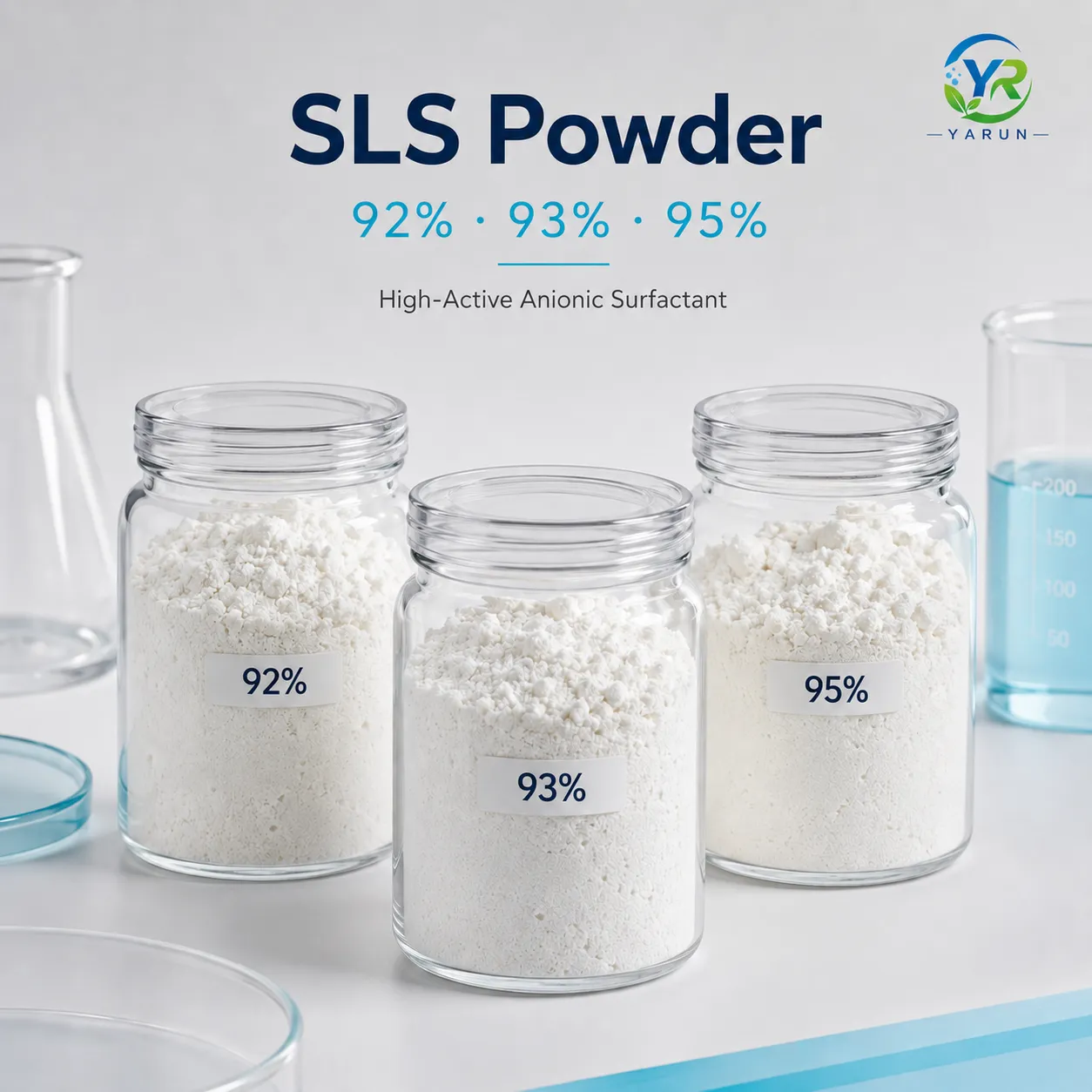
SLS Powder 92%, 93% and 95%
SLS Powder is a high-active anionic surfactant available in 92%, 93% and 95% grades. The three grades share the same powder form and fundamental surfactant mechanism but differ in active matter and sodium sulfate limits. YARUN helps detergent manufacturers compare grade concentration, inorganic-salt load, processing requirements and delivered cost per unit of active matter.
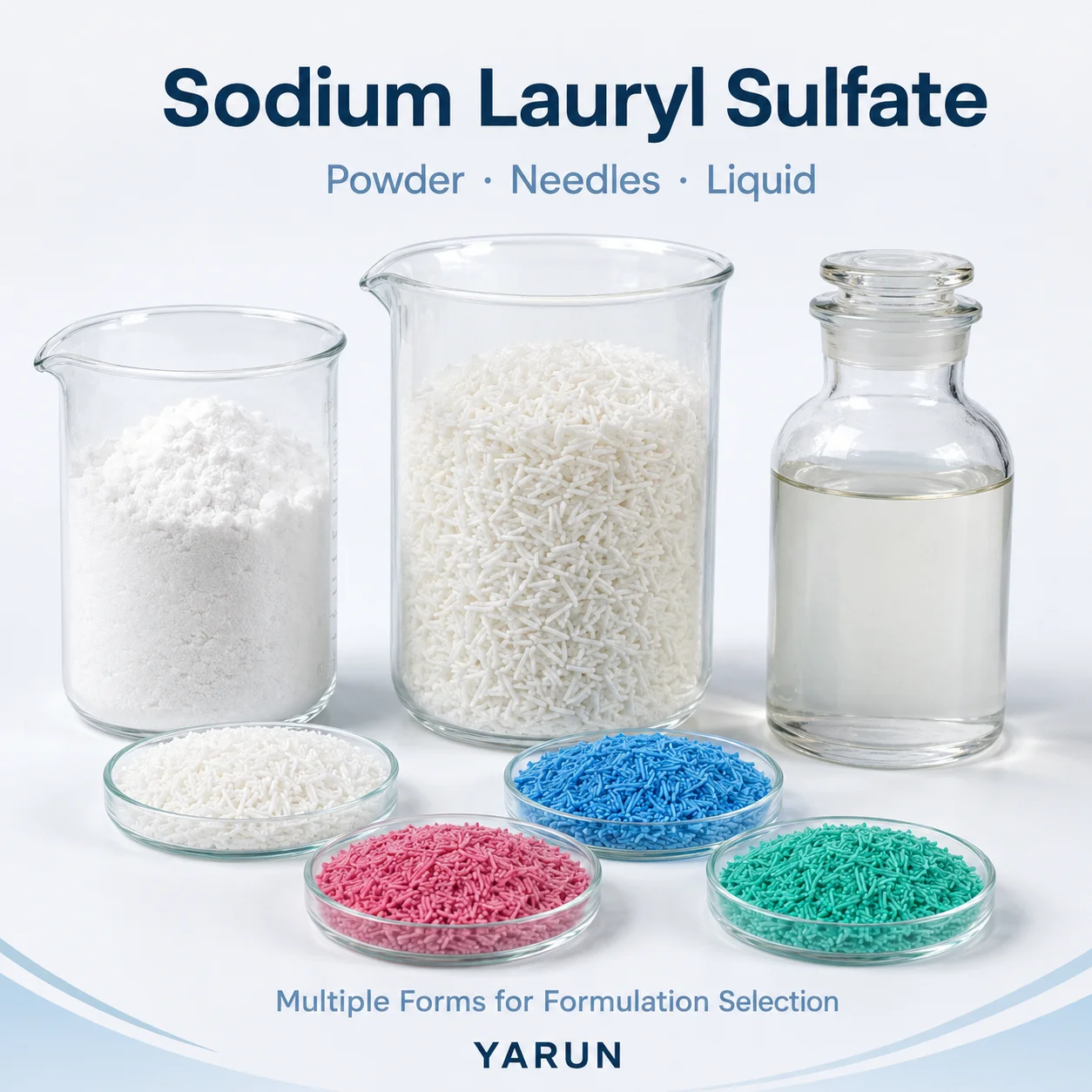
Sodium Lauryl Sulfate (SLS) – Forms, Grades and Selection
Sodium Lauryl Sulfate (SLS) is an anionic surfactant used for wetting, foaming, detergency and dispersion. YARUN offers SLS in powder, needle and liquid forms, including powder and needle grades at 92%, 93% and 95% active matter and SLS Liquid 30%. This page compares the available forms and helps buyers select an appropriate starting option according to product format, processing method and active-matter requirements.
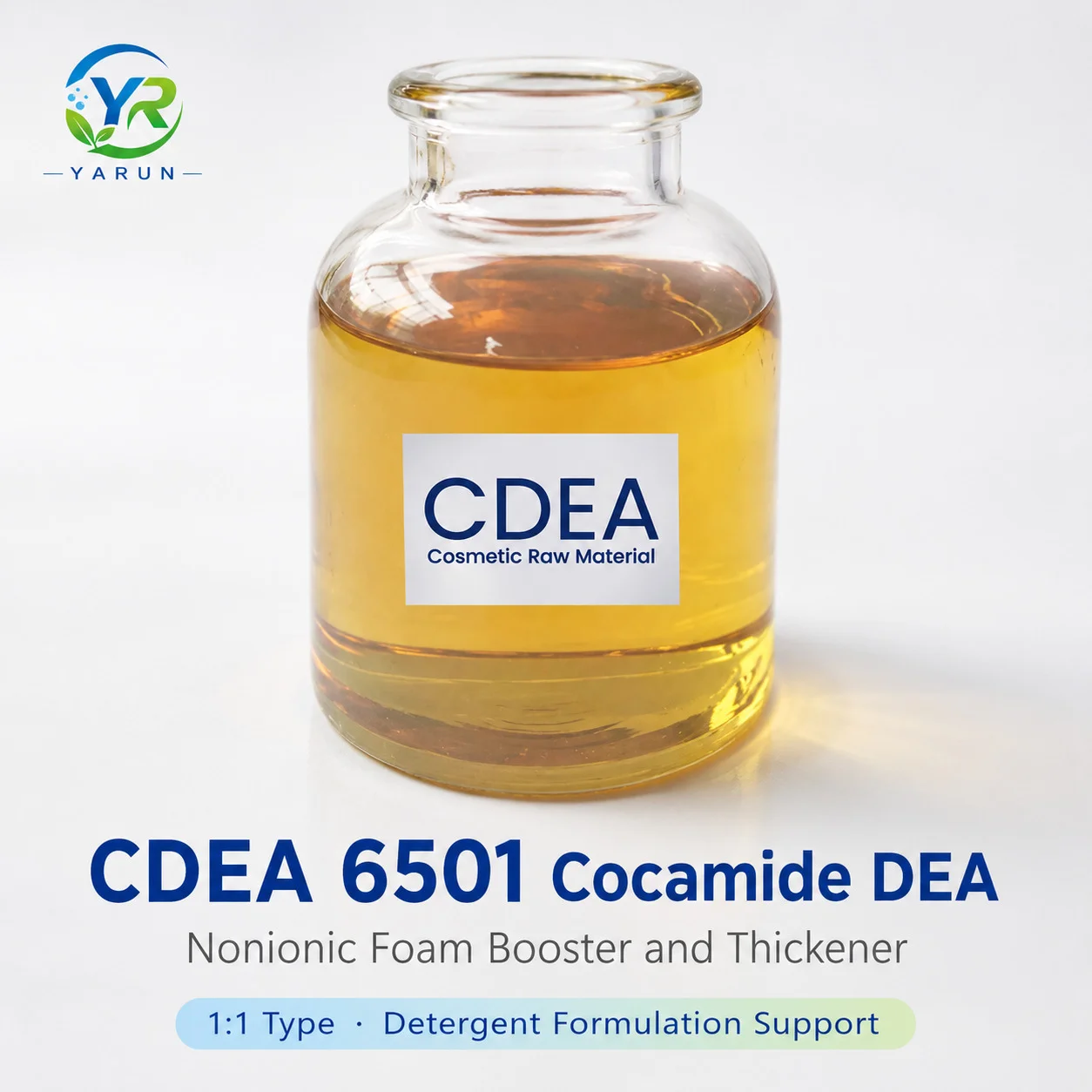
CDEA 6501 Cocamide DEA Foam Booster and Thickener
YARUN CDEA 6501 is a 1:1 type Cocamide DEA nonionic co-surfactant used to support foam stability, viscosity development and formulation compatibility in liquid detergent, dishwashing liquid, shampoo, hand wash and industrial cleaning products. It can be combined with SLES, LABSA, AOS, SLS and other suitable surfactants according to the target formulation.
CAPB 35% Cocamidopropyl Betaine Amphoteric Surfactant
YARUN CAPB 35% is a versatile amphoteric surfactant used to improve foam stability, formulation mildness and viscosity in shampoo, hand wash, body wash, liquid soap, dishwashing liquid and household cleaning products. It is compatible with common anionic, nonionic and cationic surfactants and is especially suitable for combination with SLES, AOS and SLS.