Sodium Laureth Sulfate SLES 70% Supplier
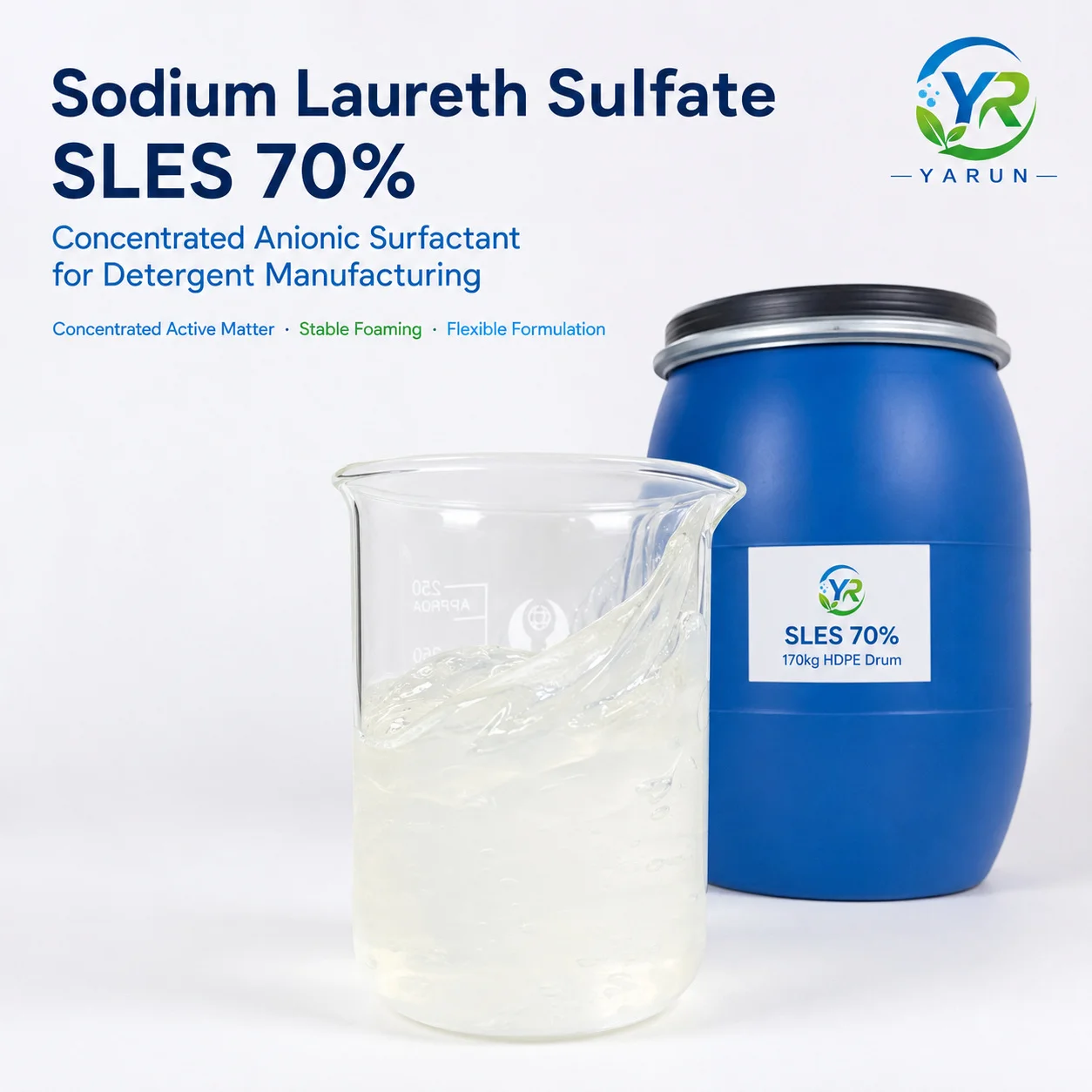
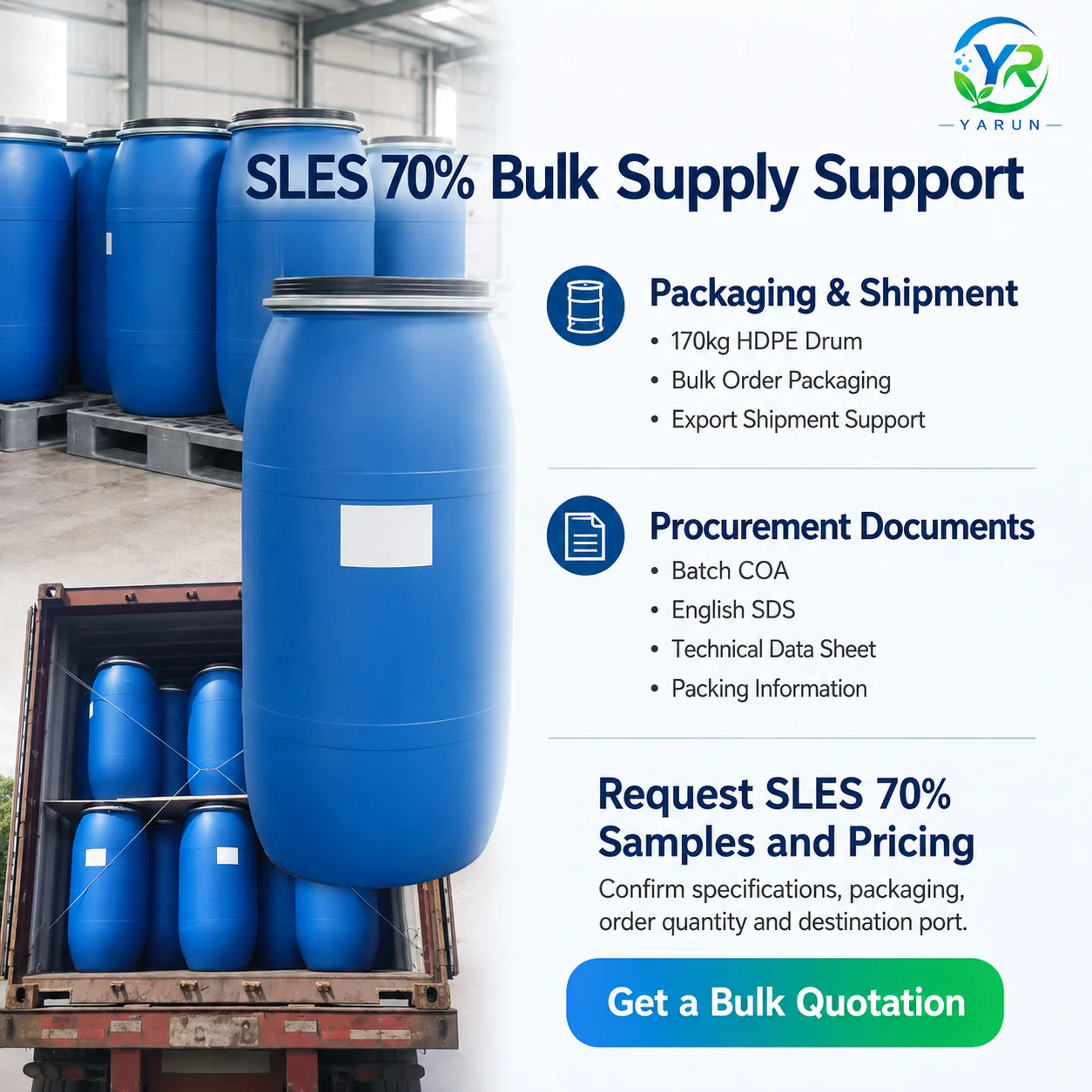
Sodium Laureth Sulfate SLES 70% is a concentrated anionic surfactant for liquid laundry detergents, dishwashing liquids, liquid soaps and household cleaners. Batch COA, English SDS, TDS, samples and bulk packaging support are available.
| NAME | VALUE |
|---|---|
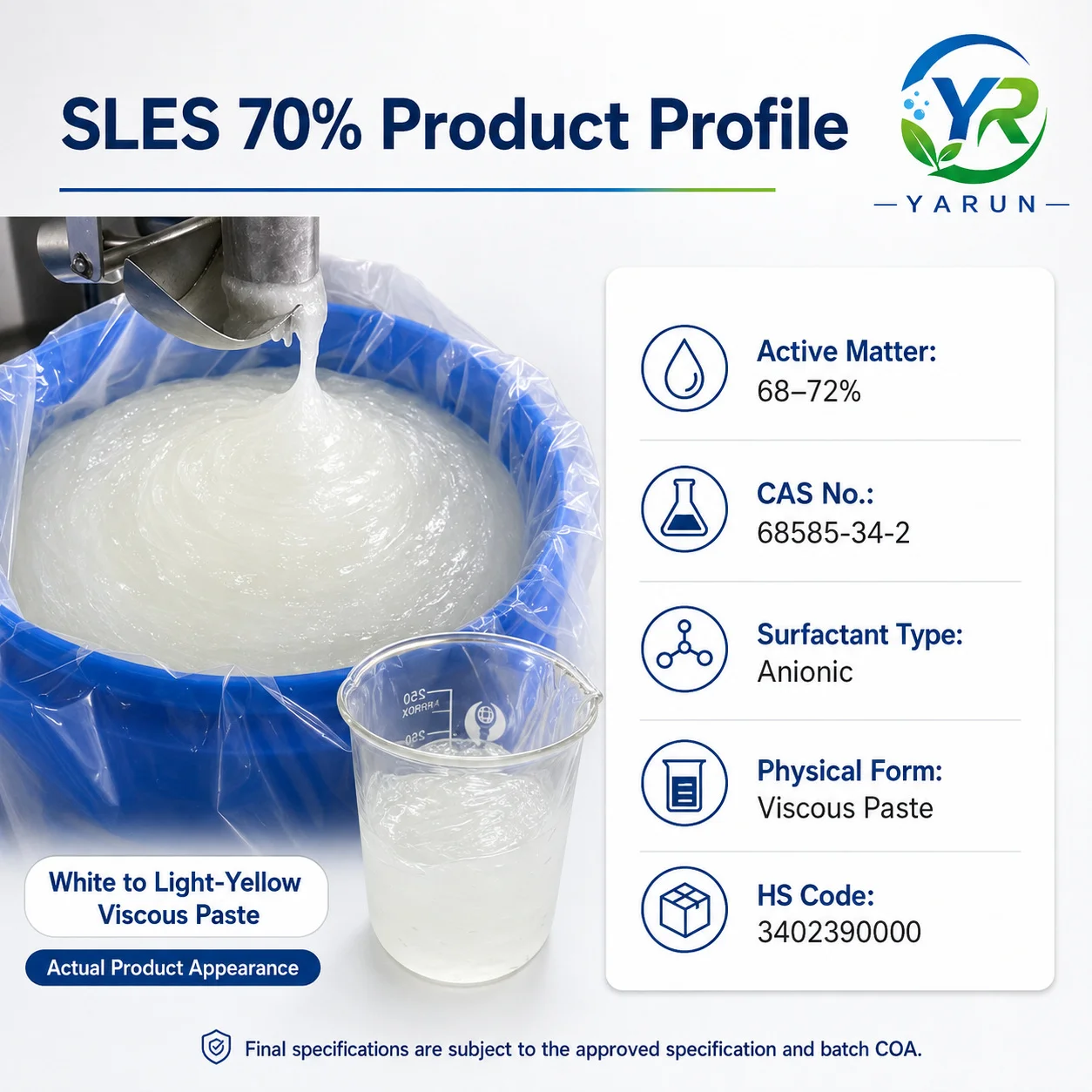
| Appearance at 25°C | White to light-yellow viscous paste |
| Active Matter | 68–72% |
| pH Value | 7.0–9.5 |
| Unsulfated Matter | Maximum 2.0% |
| Sodium Sulfate | Maximum 1.0% |
| Color | Maximum 10 Hazen |
| Odor | No abnormal odor |
| CAS Number | 68585-34-2 |
| HS Code | 3402390000 |
| Packaging | 210KG/ drum, IBC tank or customized packaging |
Product Description
Concentrated Anionic Surfactant for Detergent Manufacturing
Sodium Laureth Sulfate SLES 70% is a concentrated anionic surfactant used in liquid laundry detergents, dishwashing liquids, liquid soaps and household cleaning formulations.
It combines effective cleansing, stable foaming and flexible formulation compatibility. The concentrated paste form allows detergent manufacturers to control active matter, water content and surfactant combinations according to the target product.
YARUN supplies SLES 70% with batch COA, English SDS, TDS, sample support and bulk packaging options. Final specifications are subject to the approved product specification and batch documentation.
Concentrated Active Matter · Stable Foaming · Flexible Formulation
Quick Buyer Information
| Product Name | Sodium Laureth Sulfate |
| Common Names | SLES 70%, SLES N70, Sodium Lauryl Ether Sulfate, AES 70% |
| CAS Number | 68585-34-2 |
| Surfactant Type | Anionic Surfactant |
| Appearance | White to light-yellow viscous paste |
| Active Matter | 68–72% |
| Primary Applications | Liquid detergents, dishwashing liquids, liquid soaps and household cleaners |
| Packaging | 210KG/ drum, IBC tank or customized packaging |
| HS Code | 3402390000 |
| Available Documents | Batch COA, English SDS and TDS |
HS Code 3402390000 is provided as a China export reference. Buyers should confirm the final customs classification according to local import requirements.
Key Benefits of SLES 70%
Concentrated Active Matter
With 68–72% active matter, SLES 70% provides a concentrated surfactant option for industrial detergent production and formulations requiring controlled water addition.
Stable Foaming Performance
SLES contributes rich and stable foam in laundry detergents, dishwashing liquids, liquid soaps and household cleaning products.
Effective Cleansing
It supports the removal and dispersion of everyday dirt and oily soils when used in an appropriately designed detergent formulation.
Flexible Formulation Compatibility
SLES can be combined with anionic, nonionic and amphoteric surfactants to adjust detergency, foam profile, viscosity and formulation cost.
Convenient for Liquid Products
Its water solubility and compatibility make SLES 70% suitable for many liquid detergent and cleaning systems.
Recommended Applications
| Application | Formulation Value |
|---|---|
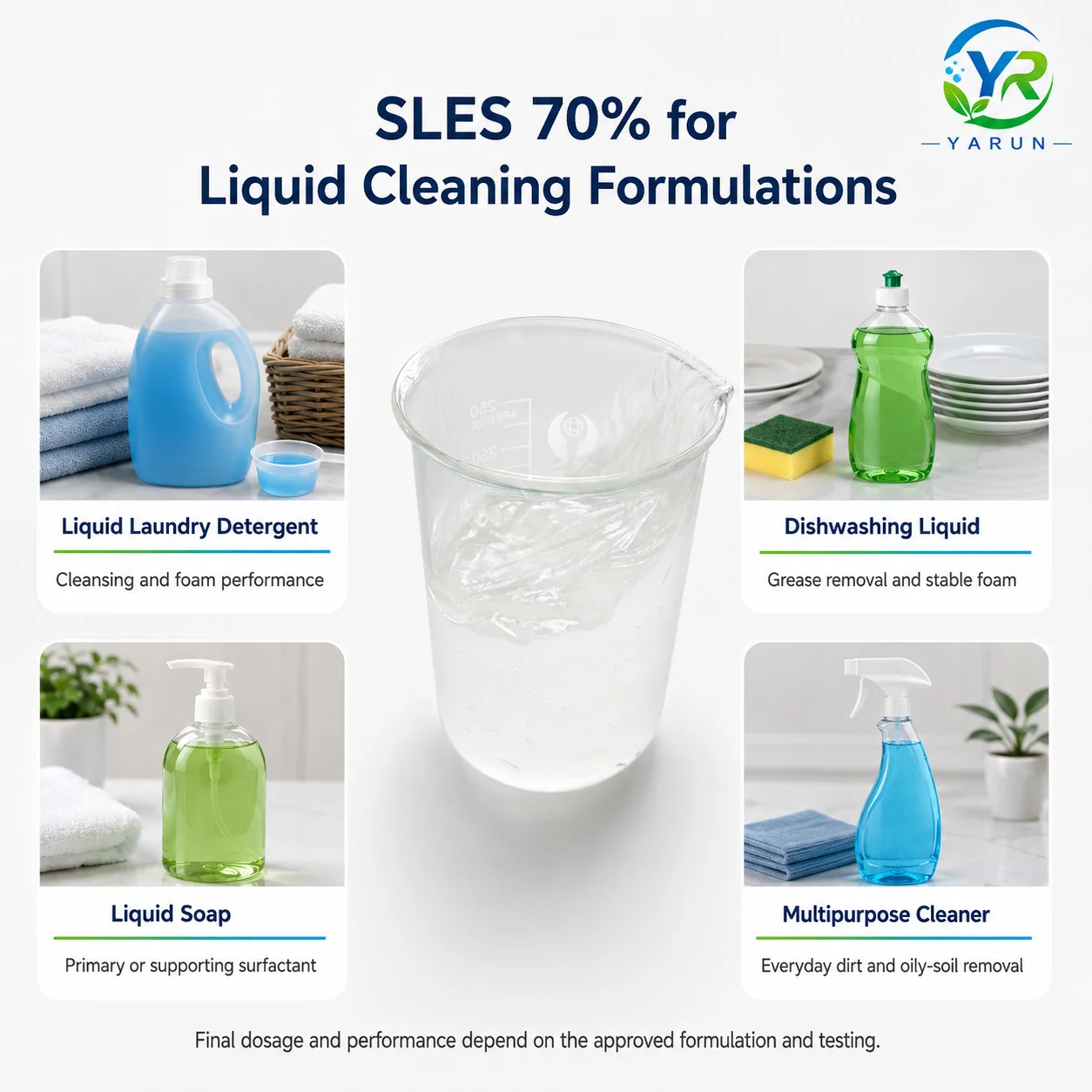
| Liquid Laundry Detergent | Provides cleansing, soil dispersion and foam performance |
| Dishwashing Liquid | Supports grease removal and consumer-preferred foam |
| Liquid Soap | Functions as a primary or supporting cleansing surfactant |
| Multipurpose Cleaner | Supports everyday dirt and oily-soil removal |
| Hand Wash | Provides cleansing and foaming in suitable formulations |
| Personal Care Products | Can be considered when the approved grade and specification meet the target application requirements |
Recommended dosage and compatibility depend on the target product, total active matter, water quality and complete formulation system. Formulation testing should be completed before commercial production.
SLES 70% vs SLES 28%
| Selection Point | SLES 70% | SLES 28% |
|---|---|---|
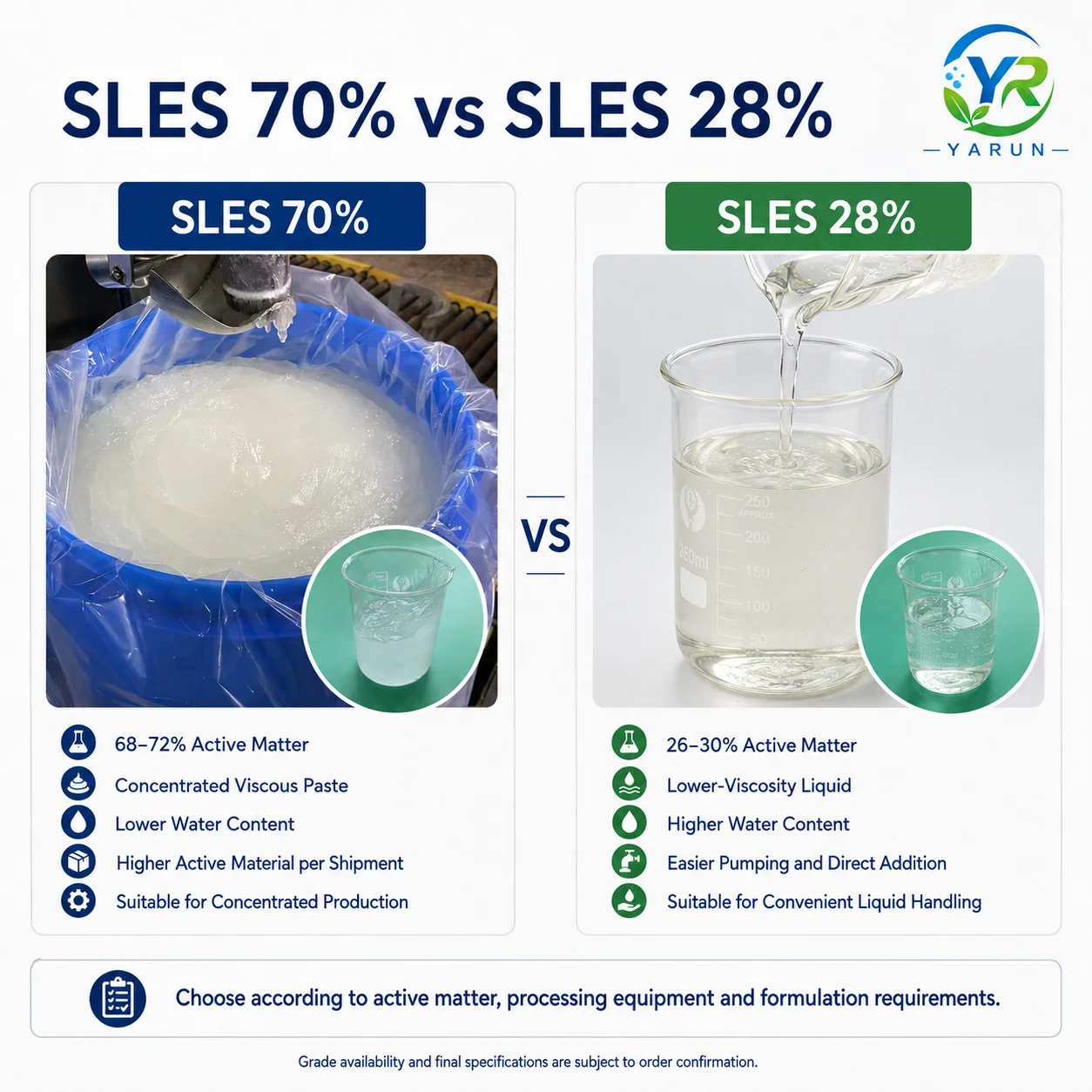
| Active Matter | Approximately 68–72% | Approximately 26–30% |
| Physical Form | Concentrated viscous paste | Lower-viscosity liquid |
| Water Content | Lower | Higher |
| Processing | Requires suitable transfer, dilution and mixing conditions | Generally easier to pump and add to liquid formulations |
| Recommended Scenario | Concentrated production and bulk industrial formulations | Formulations prioritizing convenient liquid handling |
| Transport Efficiency | More active material per unit of product weight | Higher water content per unit of product weight |
Choose SLES 70% when concentrated active matter and transport efficiency are priorities. Consider SLES 28% when easier liquid handling is more important for the production process.
Availability of SLES 28% should be confirmed according to the required specification, packaging and order quantity.
Technical Specifications
| Parameter | SLES 70% Specification |
|---|---|
| Appearance at 25°C | White to light-yellow viscous paste |
| Active Matter | 68–72% |
| pH Value | 7.0–9.5 |
| Unsulfated Matter | Maximum 2.0% |
| Sodium Sulfate | Maximum 1.0% |
| Color | Maximum 10 Hazen |
| Odor | No abnormal odor |
| CAS Number | 68585-34-2 |
| HS Code | 3402390000 |
| Packaging | HDPE drum, IBC tank or customized packaging |
Important: The table represents the standard product control range. Final acceptance criteria, test methods and results should follow the approved specification and corresponding batch COA.
SLES vs LABSA vs AOS
| Surfactant | Product Form | Primary Selection Value | Recommended Scenario |
|---|---|---|---|
| SLES 70% | Concentrated viscous paste | Balanced cleansing, foaming and formulation compatibility | Liquid detergents, dishwashing liquids and liquid soaps |
| LABSA 96% | Brown viscous acidic liquid | Strong detergency and cost-efficient formulation positioning | Laundry detergents, dishwashing liquids and industrial cleaners |
| AOS 92% | White or off-white powder | Good detergency and foam stability in powder or concentrated systems | Powder detergents and differentiated cleaning formulations |
SLES is commonly selected for liquid formulations requiring balanced cleansing and foam. LABSA 96% is suitable for detergent systems prioritizing detergency and formulation cost, while AOS 92% can support powder and concentrated product development.
The final selection should be based on product form, processing equipment, foam target, water quality, cost structure and formulation testing.
Formulation Compatibility
SLES 70% may be combined with other surfactants to achieve the required cleaning and processing profile:
- LABSA 96% for detergency and cost-oriented detergent formulations;
- AOS 92% for foam stability and powder or concentrated systems;
- SLS 92% for high-foaming applications and solid formulations;
- amphoteric surfactants for foam and formulation adjustment;
- nonionic surfactants for oily-soil removal and low-foam performance.
Compatibility, dosage and addition sequence should be confirmed through laboratory testing. Because SLES is an anionic surfactant, compatibility should be evaluated carefully before combining it with cationic ingredients.
Quality Points for Bulk Buyers
Before purchasing SLES 70%, buyers should confirm the following information:
- active matter range;
- appearance and physical consistency;
- pH value and corresponding test method;
- unsulfated matter;
- sodium sulfate content;
- color specification;
- packaging type and net weight;
- batch COA availability;
- SDS and TDS availability;
- sample and pre-shipment specification confirmation.
If the product will be used in personal care formulations, buyers should also communicate the target application and any additional specification or regulatory requirements before ordering.
Packaging, Handling and Storage
Packaging Options
- HDPE drum;
- IBC tank, subject to order confirmation;
- customized packaging according to order requirements.
Final packaging type, net weight and container-loading quantity should be confirmed in the formal quotation.
Handling Guidance
Use clean and compatible transfer equipment. Avoid contamination during pumping, dilution and production. Operators should review the SDS and use appropriate personal protective equipment.
Storage Guidance
Store SLES 70% in tightly closed compatible containers in a cool, dry and ventilated area. Protect the product from contamination, excessive heat and strongly acidic materials.
SLES 70% is a concentrated viscous paste. Its viscosity and physical condition may change with temperature. Suitable warming and mixing procedures should be confirmed before handling material affected by low-temperature storage.
Bulk Supply and Documentation
YARUN supports detergent manufacturers, chemical distributors and formulation companies with:
- SLES 70% sample confirmation;
- batch COA;
- English SDS;
- technical data sheet;
- packaging confirmation;
- bulk order quotation;
- export documentation support;
- long-term supply coordination.
For an accurate quotation, please provide the required specification, packaging, order quantity and destination port.
Frequently Asked Questions
1. What is SLES 70% used for?
SLES 70% is mainly used as an anionic cleansing and foaming surfactant in liquid laundry detergents, dishwashing liquids, liquid soaps and household cleaning products.
2. SLES 70% vs SLES 28%: which grade should manufacturers choose?
Choose SLES 70% for concentrated active matter and transport efficiency. Consider SLES 28% when easier pumping and direct liquid handling are more important. The final choice depends on the formulation and production process.
3. What specifications should buyers check before purchasing SLES 70%?
Buyers should check active matter, appearance, pH, unsulfated matter, sodium sulfate, color, packaging and batch consistency. The approved specification and batch COA should be confirmed before shipment.
4. Can SLES 70% be used in liquid laundry detergent and dishwashing liquid?
Yes. SLES 70% is commonly used in both applications to provide cleansing and foam. Dosage and surfactant combinations should be determined through formulation testing.
5. How is SLES combined with LABSA in detergent formulations?
SLES can provide balanced foam and formulation compatibility, while neutralized LABSA 96% can support detergency and cost control. The ratio and neutralization process depend on the target formula.
6. SLES vs LABSA vs AOS: how should buyers choose?
Choose SLES for balanced liquid cleaning and foaming, LABSA for strong detergency and cost-oriented formulations, and AOS for powder, concentrated or foam-stability-focused systems. Many formulations use a combination rather than one surfactant alone.
7. What documents and packaging are available for bulk SLES 70% orders?
Batch COA, English SDS, TDS and packing information can be provided. HDPE drums, IBC tanks and customized packaging can be discussed according to the confirmed order.
Request SLES 70% Samples and Pricing
Build a stable surfactant supply plan for your detergent production.
Send us your required specification, application, packaging, order quantity and destination port to receive:
- product specification confirmation;
- sample availability;
- batch document support;
- bulk packaging options;
- export quotation.
Request SLES 70% Samples and Bulk Pricing
Related Products
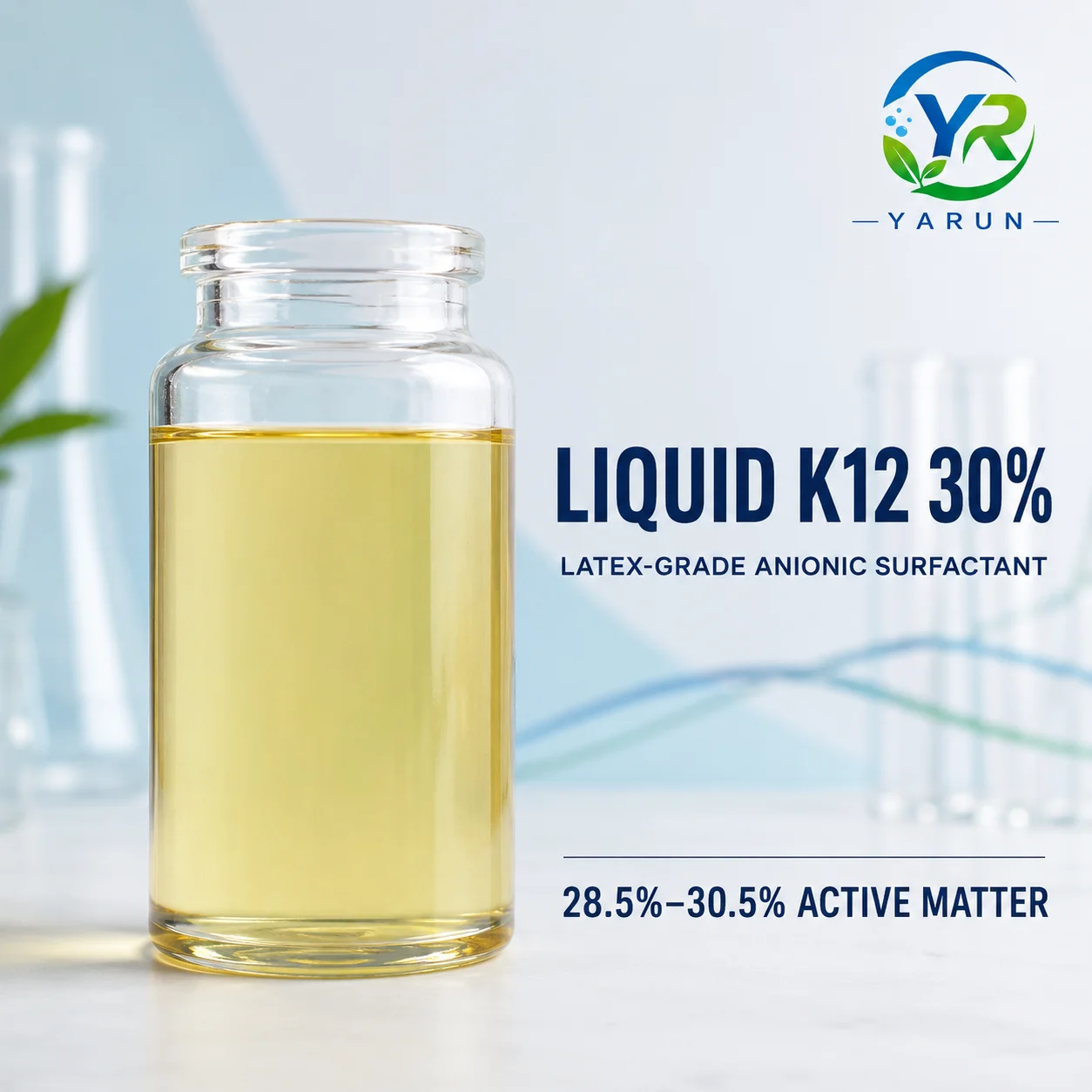
SLS Liquid 30% (Liquid K12) – Latex Grade
Liquid K12 30% is a latex-grade anionic surfactant supplied as a pale yellow transparent liquid with 28.5%–30.5% active matter. It is designed for liquid-phase dosing and may be evaluated as an emulsifier in selected synthetic latex, rubber and resin emulsion-polymerization systems. YARUN supplies the product in drums or IBC totes with a minimum order quantity of 1 MT. Final suitability depends on the applicable specification, processing conditions and completed formulation or polymerization trials.
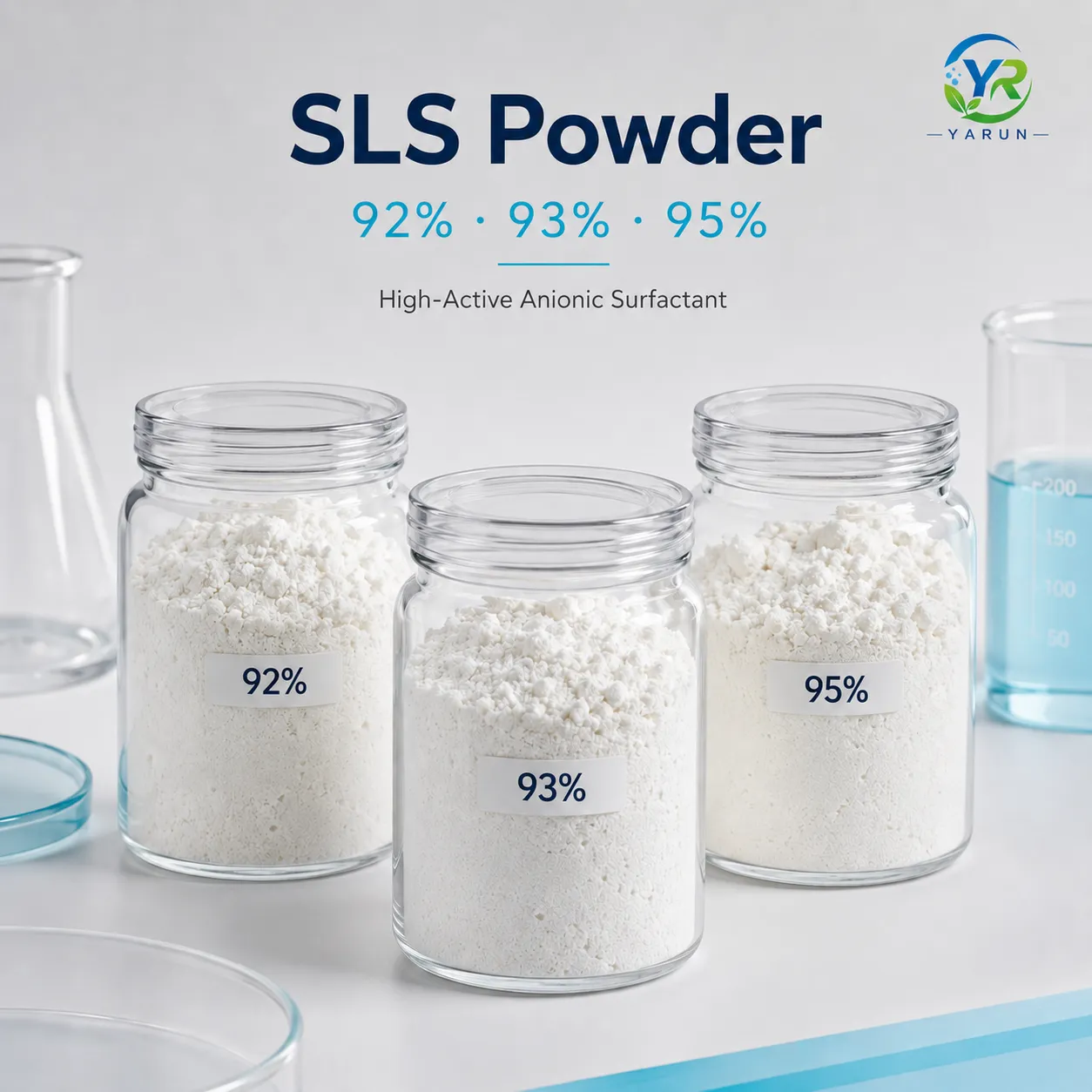
SLS Powder 92%, 93% and 95%
SLS Powder is a high-active anionic surfactant available in 92%, 93% and 95% grades. The three grades share the same powder form and fundamental surfactant mechanism but differ in active matter and sodium sulfate limits. YARUN helps detergent manufacturers compare grade concentration, inorganic-salt load, processing requirements and delivered cost per unit of active matter.
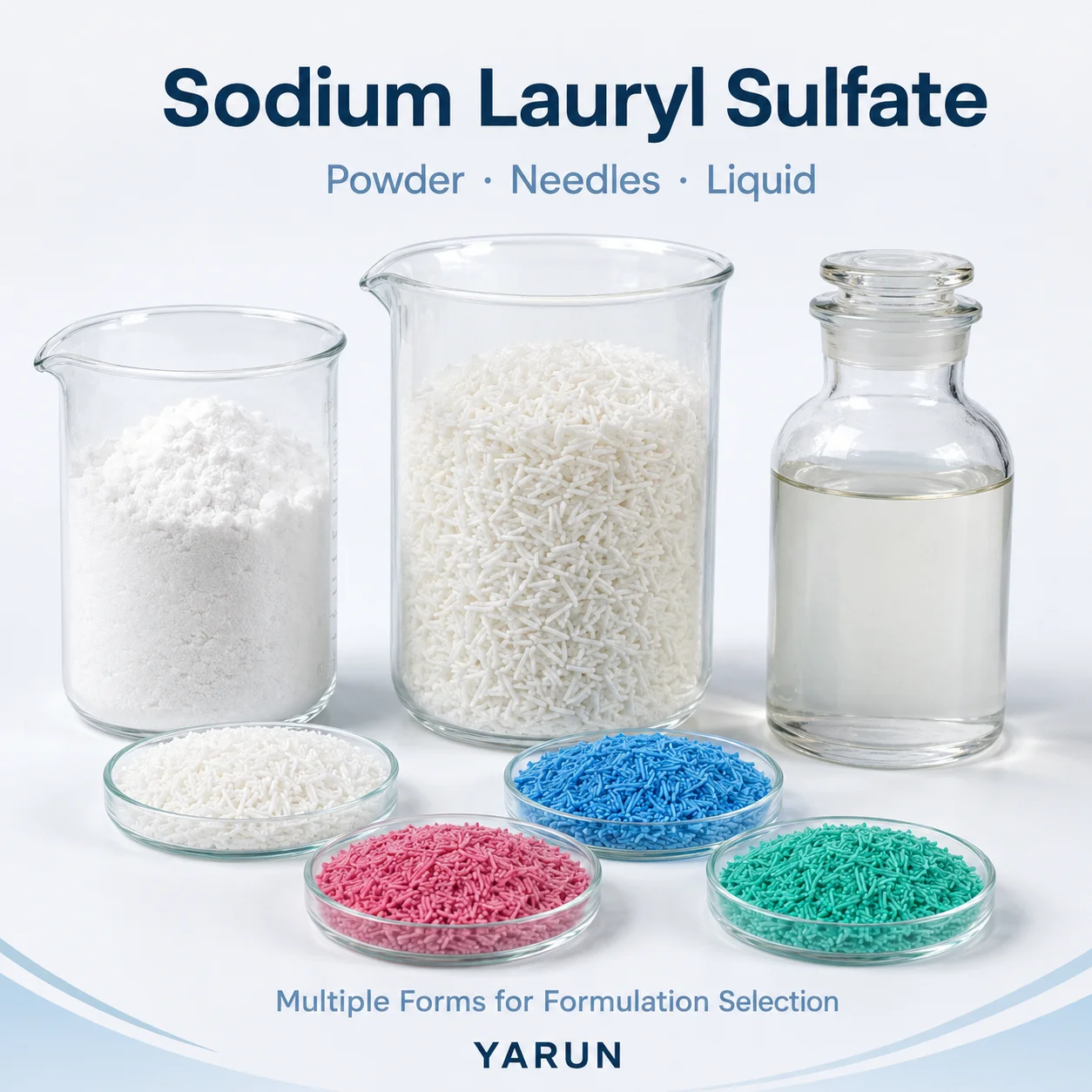
Sodium Lauryl Sulfate (SLS) – Forms, Grades and Selection
Sodium Lauryl Sulfate (SLS) is an anionic surfactant used for wetting, foaming, detergency and dispersion. YARUN offers SLS in powder, needle and liquid forms, including powder and needle grades at 92%, 93% and 95% active matter and SLS Liquid 30%. This page compares the available forms and helps buyers select an appropriate starting option according to product format, processing method and active-matter requirements.
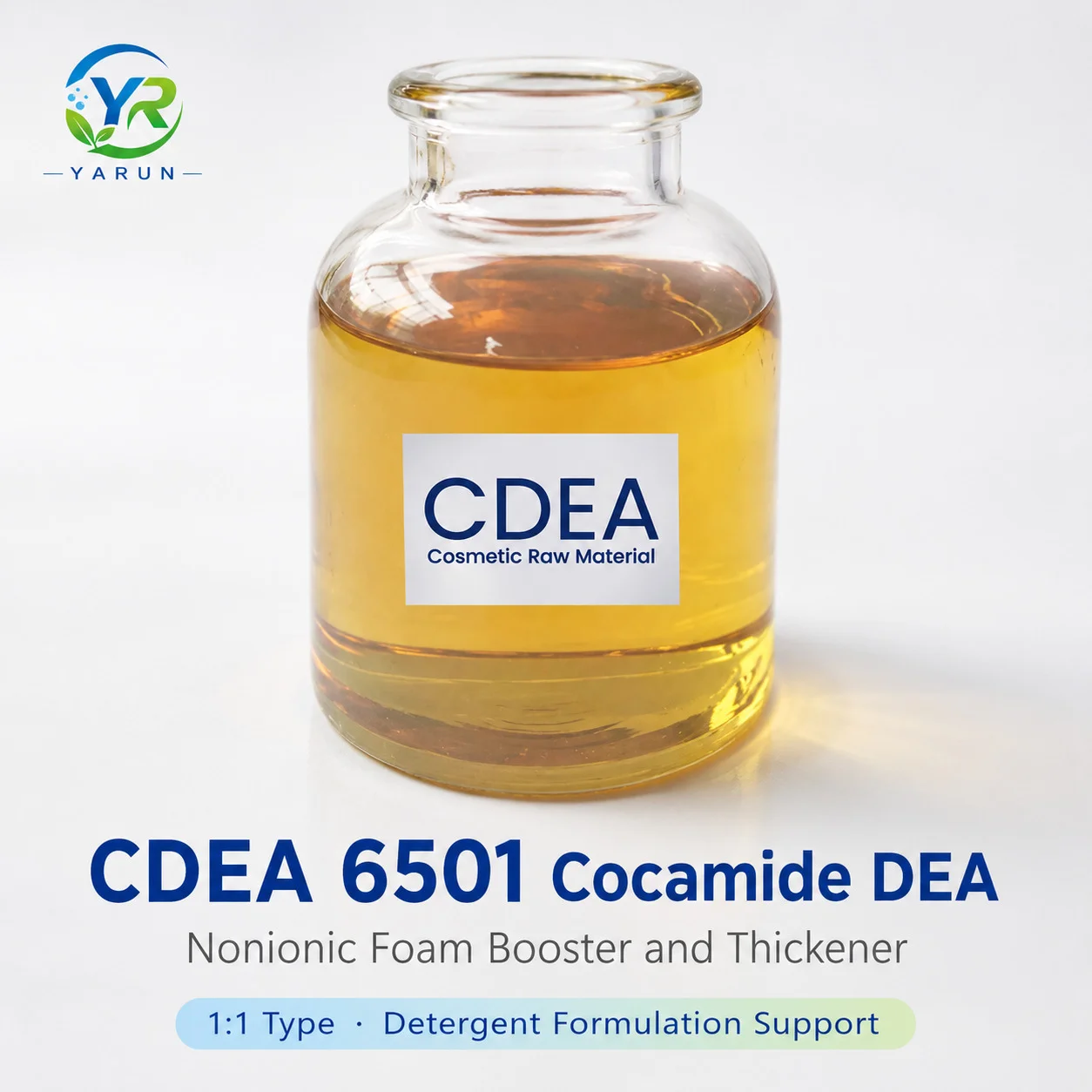
CDEA 6501 Cocamide DEA Foam Booster and Thickener
YARUN CDEA 6501 is a 1:1 type Cocamide DEA nonionic co-surfactant used to support foam stability, viscosity development and formulation compatibility in liquid detergent, dishwashing liquid, shampoo, hand wash and industrial cleaning products. It can be combined with SLES, LABSA, AOS, SLS and other suitable surfactants according to the target formulation.