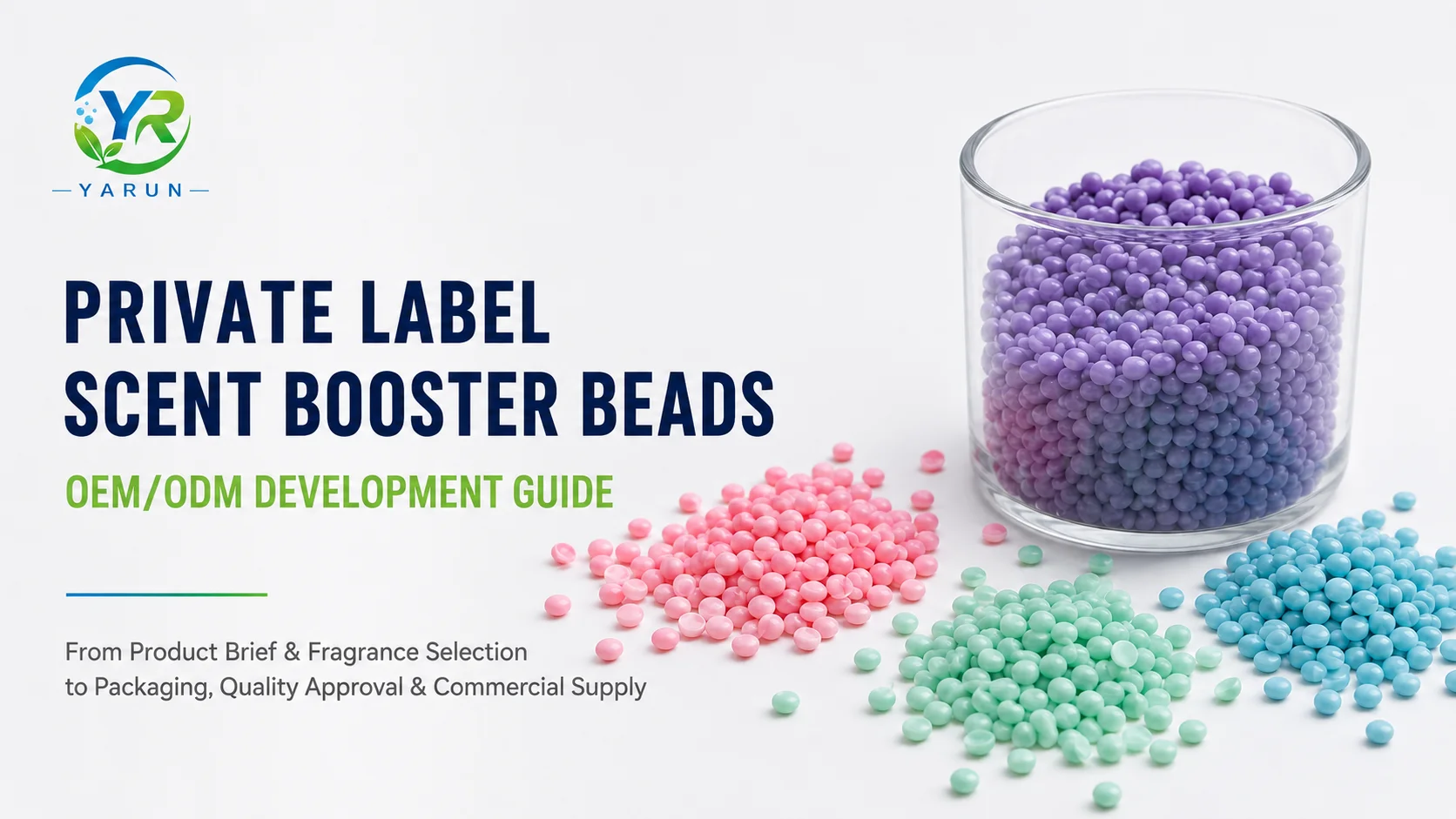
Launching private label scent booster beads requires more than selecting a fragrance and adding a logo to a package.
A commercially successful product must connect:
Target-market expectations
Fragrance direction
Product-performance level
Consumer dosage
Packaging protection
Target retail price
Quality specifications
Minimum order requirements
Production and delivery planning
Without a structured development process, buyers may receive attractive samples that cannot be reproduced economically or consistently during commercial supply.
YARUN supports laundry brands, distributors and retailers with formulation-led product development, sample coordination, packaging selection, quality requirements and export supply.
This guide explains how to move a private label scent booster bead project from concept to commercial order.
OEM, ODM and Private Label: What Is the Difference?
These terms are often used interchangeably, but they can represent different levels of product development.
Private Label
Private label normally begins with an existing or established product specification that is sold under the buyer’s brand.
Customization may include:
Label
Brand name
Package size
Packaging format
Selected fragrance
Bead color
This route can be appropriate for distributors and new brands that want to enter the market with lower development complexity.
OEM
Under an OEM project, the product is manufactured according to an agreed buyer specification.
The buyer may define:
Fragrance
Scent intensity
Performance requirements
Bead appearance
Packaging
Labeling
Quality standards
The buyer should provide a clear specification or work with the supplier to create one.
ODM
ODM involves a broader product-development role.
The solution provider may support:
Market-positioning analysis
Product concept
Performance-tier selection
Fragrance direction
Sample development
Packaging recommendations
Product specification
Commercial supply planning
ODM is useful when the buyer understands the target market but does not yet have a complete technical product specification.
The correct route depends on the buyer’s experience, budget, order volume and required level of differentiation.
Step 1: Prepare the Product Brief
Every project should begin with a written product brief.
The brief converts a general idea into information that can be used for sampling and quotation.
At minimum, define:
| Project factor | Information required |
|---|---|
| Target market | Country, region and sales channel |
| Customer | Consumer retail, wholesale, hospitality or another segment |
| Market position | Economy, mainstream or premium |
| Brand route | Private label, OEM, ODM or YARUN-branded distribution |
| Fragrance | Preferred family, intensity and reference products |
| Performance | Everyday, upgraded or premium positioning |
| Product appearance | Bead size, color and visual style |
| Packaging | Bottle, pouch, refill pack or bulk supply |
| Net weight | Required retail or wholesale size |
| Target cost | Target purchase cost or retail-price range |
| Volume | Trial order and expected repeat volume |
| Schedule | Intended sample, approval and launch dates |
A project without a target price may result in a technically attractive sample that is not commercially viable.
A project without defined performance requirements may produce repeated sample revisions because “strong” and “long-lasting” mean different things to different buyers.
Step 2: Select a Product-Development Route
YARUN provides three starting routes for private label projects.
Route A: Existing Product With Custom Label
This route may include:
Existing product specification
Available fragrance
Standard bead color
Existing packaging
Customized label or sticker
Standard export carton
It is suitable for:
Initial market testing
New distributors
Smaller launch programs
Buyers requiring faster project execution
Customers that do not yet need a unique formula
This route generally has fewer development variables.
Route B: Customized Fragrance and Appearance
This route may include:
Selected fragrance family
Adjusted fragrance direction
Scent intensity selection
Custom bead color
Selected performance tier
Customized label and packaging
It is suitable for brands requiring greater differentiation without developing every product component from the beginning.
Route C: Full ODM Development
This route may include:
Market and competitor brief
Customized fragrance direction
Performance-target development
Comparative samples
Packaging evaluation
Product specification
Pilot-order planning
Quality-approval system
Long-term supply planning
It is suitable for established brands, retailers and distributors building a distinctive product collection.
Step 3: Select the Performance Tier
The longest advertised fragrance duration is not automatically the best option for every brand.
Product selection should consider:
Target retail price
Consumer dosage
Cost per wash
Fragrance intensity
Sales channel
Competitive products
Package size
Repeat-purchase expectations
YARUN offers three performance-positioning routes:
3–7 Days Laundry Fragrance Beads for everyday and value-oriented ranges
7–15 Days Laundry Scent Beads for mainstream and upgraded collections
30–35 Days Laundry Scent Booster Beads for premium positioning
Duration ranges should be understood as product-positioning targets evaluated under defined conditions.
Actual fragrance perception depends on:
Fragrance composition
Dosage
Detergent
Fabric
Washing method
Drying method
Storage
Sensory evaluation
Private label buyers should compare samples using the same testing conditions before approving a product tier.
Step 4: Develop the Fragrance Direction
Fragrance selection should begin with the target consumer rather than the supplier’s existing fragrance catalogue.
Useful fragrance directions may include:
Fresh and clean
Floral
Fruity
Citrus
Marine
Powdery
Woody
Luxury perfume-inspired
Regional or market-specific profiles
The buyer should provide:
Preferred fragrance family
Fragrances to avoid
Target intensity
Reference products where available
Expected retail positioning
Reference products help communicate direction, but they should not be used to request an exact copy of another brand’s proprietary fragrance.
Evaluate Fragrance at Multiple Stages
A fragrance should not be approved only by smelling the concentrated product.
Evaluate:
Fragrance from the package
Fragrance during dosing
Wet fabric after washing
Fabric after drying
Fabric after defined storage intervals
Fabric before and after handling
Use the same detergent, dosage, fabric, washing program and drying method for every sample.
For more technical detail, read YARUN’s guide to laundry fragrance encapsulation and performance evaluation.
Step 5: Confirm Bead Appearance
Product appearance influences brand recognition and shelf impact.
Customizable elements may include:
Single or mixed colors
Transparent or opaque appearance
Visual intensity
Bead-size range
Coordination with fragrance and packaging
Color should be evaluated for:
Batch consistency
Storage stability
Packaging presentation
Compatibility with the intended product
Target-market preferences
The approved sample should become the reference for commercial production.
Step 6: Select Packaging
Packaging protects the product and communicates its market position.
Possible formats include:
Plastic bottle
Resealable pouch
Refill pack
Trial-size package
Bulk container
Packaging selection should consider:
Moisture barrier
Fragrance barrier
Seal integrity
Closure performance
Consumer dosing
Label area
Shipping efficiency
Carton strength
Target retail price
Local recycling or labeling requirements
For Thailand and other warm or humid markets, packaging should be tested with the actual product under relevant storage and transportation conditions.
An attractive package that cannot protect the beads is not a commercially successful packaging solution.
Step 7: Understand What Determines MOQ
There is no single universal MOQ for every private label project.
MOQ can be influenced by:
Existing versus custom fragrance
Existing versus custom bead color
Standard versus custom bottle
Label quantity
Printed pouch or packaging-film quantity
Carton printing
Production scheduling
Packing-line requirements
Testing and documentation
Destination and shipment method
A standard product with an existing package and custom label may require a different MOQ from a fully customized product with printed flexible packaging.
Buyers should ask for MOQ by component:
| Project component | Questions to ask |
|---|---|
| Finished beads | What is the production MOQ? |
| Fragrance | Is there a separate fragrance-development MOQ? |
| Bottle | Is it a standard or custom mold? |
| Label | What is the printer’s minimum quantity? |
| Pouch | What is the printed-film minimum quantity? |
| Carton | Is standard or custom printing available? |
| Shipment | What quantity provides efficient freight utilization? |
This helps the buyer understand whether the MOQ comes from product production, packaging or printing.
Step 8: Use a Controlled Sampling Process
Repeated sampling without version control creates confusion.
Each sample should have:
Unique sample code
Development date
Fragrance code
Product tier
Color reference
Dosage recommendation
Packaging status
Revision notes
A structured sampling process may include:
Sample Round 1: Direction Selection
Purpose:
Compare fragrance families
Compare performance tiers
Select the preferred commercial direction
Sample Round 2: Optimization
Purpose:
Adjust fragrance intensity
Adjust color
Confirm product appearance
Review target cost
Sample Round 3: Final Approval
Purpose:
Confirm the final product
Establish the approved reference
Finalize the specification
Begin packaging approval
Not every project requires three rounds, but every project should have a clear approval point.
Step 9: Approve the Product Specification
Before commercial production, confirm the agreed specification.
It may include:
Product name
Product code
Appearance
Color reference
Fragrance reference
Performance positioning
Recommended dosage
Net weight
Packaging
Label version
Carton specification
Storage requirements
Shelf-life target
Inspection standards
Avoid relying only on messages such as “use the second blue sample.”
The approved product code and written specification should be used in the purchase order and production documents.
Step 10: Validate Packaging and Labeling
Before printing commercial packaging, review:
Brand name
Product name
Net contents
Directions for use
Warnings
Ingredient or content information where required
Country-of-origin statement
Importer or responsible-party information
Batch-code position
Barcode
Language
Printing colors
Artwork dimensions
Requirements vary by destination market. The importer or responsible market operator should confirm final regulatory and labeling compliance unless another arrangement has been agreed.
A packaging mockup should be reviewed before mass printing.
Step 11: Confirm Quality-Control Requirements
Quality should be defined before production, not negotiated after shipment.
Depending on the product specification, controls may include:
Appearance
Color
Odor comparison
Bead-size consistency
Flowability
Moisture-related observations
Net weight
Seal integrity
Label and carton inspection
Batch identification
Retained samples
For customized fragrance products, an approved reference sample is particularly important.
To evaluate overall supplier capability, use YARUN’s scent booster beads supplier audit guide.
Step 12: Move From Sample to Commercial Order
Before order confirmation, both parties should agree on:
Final product code
Final specification
Quantity
Unit price
Packaging
Artwork
MOQ
Production lead time
Incoterms
Destination
Export documentation
Inspection requirements
Payment terms
Shipment plan
Changes made after packaging printing or production scheduling may affect cost and delivery time.
A structured approval process reduces last-minute changes.
How Long Does a Private Label Project Take?
There is no universal timeline because project complexity varies.
The development schedule may include:
Product-brief confirmation
Initial sample preparation
Sample shipping
Buyer testing
Revision
Final approval
Packaging development
Printing
Commercial production
Inspection and shipment
A standard product with existing packaging can normally move faster than a fully customized fragrance, color and printed-package project.
Buyers should communicate the target launch date at the beginning so the project can be planned backward from the required delivery date.
Common Private Label Development Mistakes
Beginning Without a Target Cost
Without a target cost, development may move toward a product that cannot support the intended retail price.
Approving Fragrance Only From the Bottle
Fragrance should be evaluated on washed and dried fabric under controlled conditions.
Changing Several Variables at Once
Changing fragrance, color, dosage and packaging simultaneously makes test results difficult to interpret.
Printing Packaging Before Product Approval
Product, dosage and required label information should be confirmed before mass printing.
Selecting Only by Unit Price
The buyer should also evaluate packaging, batch consistency, shipment efficiency, rework risk and commercial support.
Making Unconditional Performance Claims
Fragrance duration varies with test and use conditions. Claims should be supported by an appropriate method.
Ignoring Destination-Market Requirements
Packaging and labeling should be reviewed for the intended country before production.
How YARUN Supports Private Label Projects
YARUN is a formulation-led laundry care solution provider supporting brands, distributors and retailers.
Our private label process can include:
Product-brief development
Performance-tier selection
Fragrance direction
Sample comparison
Color selection
Packaging recommendations
Specification confirmation
Quality coordination
Commercial-order planning
Export supply
YARUN can also support customers who want to begin with YARUN-branded products before investing in a fully customized private label range.
This provides a practical path:
Test market demand
Identify the preferred fragrance and price level
Build repeat sales
Develop a differentiated private label product
Expand the product collection
Start Your Private Label Scent Booster Project
To prepare an initial proposal, send YARUN:
Company and customer type
Target country
Sales channel
Preferred fragrance family
Product positioning
Packaging format
Net weight
Target price
Trial-order quantity
Expected repeat volume
Target launch date
Private label, OEM or ODM requirement
Based on this information, YARUN can recommend a suitable product tier, sample plan, customization route and packaging direction.
Start Your Private Label Scent Booster Project
Frequently Asked Questions
Can I start a private label project using an existing YARUN product?
Yes. Beginning with an existing specification and customized label can reduce development complexity and help test market demand.
Can fragrance and bead color be customized?
Yes. Available customization depends on the project requirements, target volume, MOQ and approval process.
What causes the private label MOQ?
MOQ may come from product production, fragrance, bottle supply, label printing, printed packaging film, cartons or packing-line requirements.
Can I request an exact copy of another brand’s fragrance?
Reference products can communicate the desired direction, but the objective should be to develop an appropriate fragrance profile rather than copy another brand’s proprietary product.
How should samples be evaluated?
Use the same dosage, detergent, fabric, washing method, drying method and evaluation intervals for every sample.
Does YARUN provide packaging support?
Yes. Support can include packaging-format selection, specification coordination and artwork review. Final market compliance should be confirmed for the destination country.
What information is needed for a quotation?
Provide the product tier, fragrance requirement, packaging, net weight, order quantity, destination and customization level.
Can YARUN support distributors as well as brand owners?
Yes. YARUN supports distributors, traders, retailers and brands through YARUN-branded products, private label supply and customized development.
Conclusion
A private label scent booster bead project succeeds when the commercial concept is converted into a clear, testable and repeatable product specification.
The development process should connect:
Target market
Product positioning
Fragrance
Performance
Appearance
Packaging
MOQ
Quality
Production
Export supply
The right solution is not always the most customized or highest-performance product. It is the product that matches the target customer, retail price, sales channel and purchasing plan.
YARUN helps buyers move from product concept and sample comparison to packaging and commercial supply through a structured OEM and ODM development process.
Contact YARUN to Start Your Private Label Scent Booster Bead Project