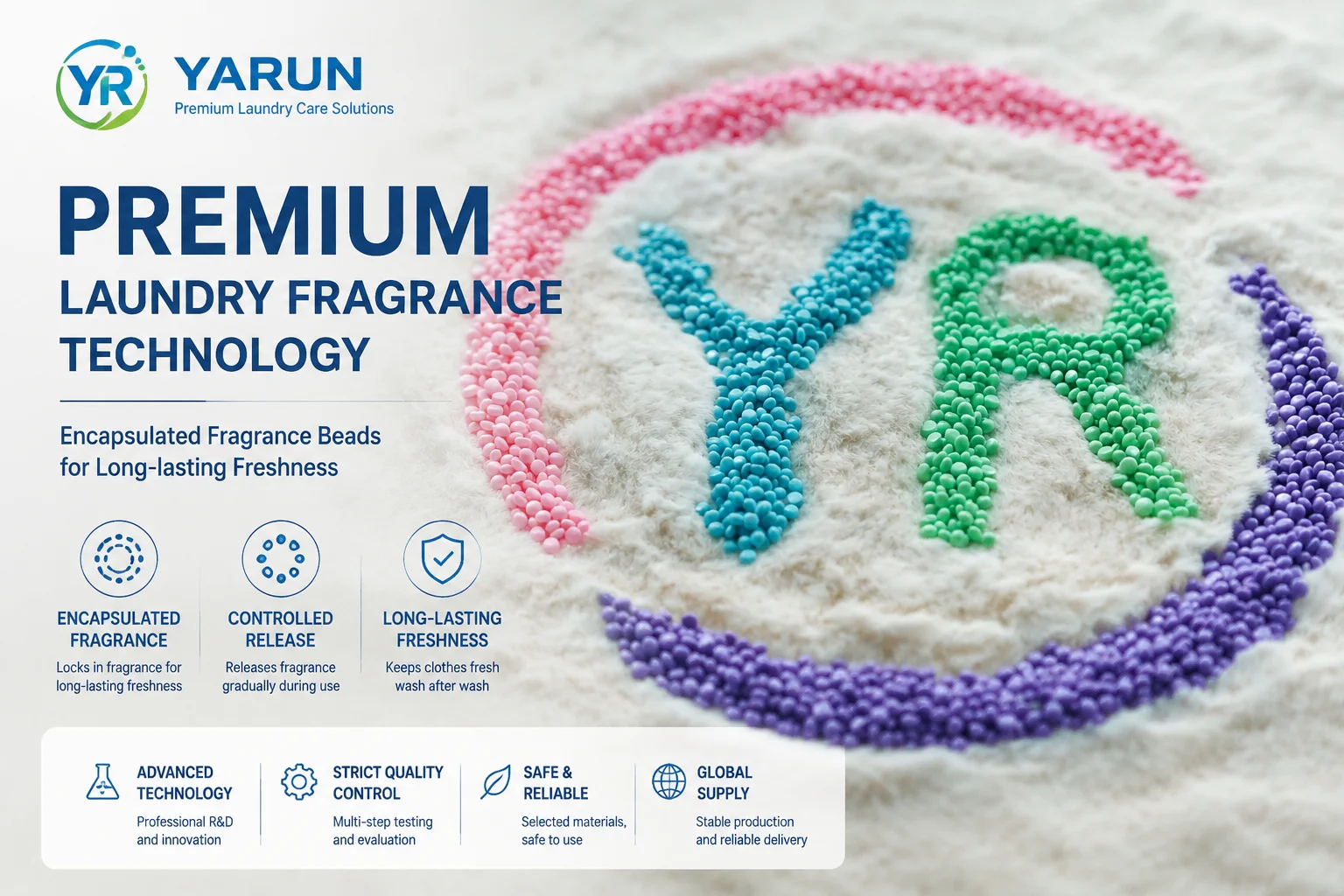
Laundry scent booster beads are in-wash fragrance products designed to add a more noticeable and differentiated scent experience to laundered fabrics.
Unlike detergents, their primary purpose is not soil removal. Unlike conventional liquid fabric softeners, they do not necessarily rely on a softening system. Their main function is to introduce fragrance during the wash and support the desired scent experience after washing and drying.
However, not all scent booster beads perform in the same way.
Fragrance intensity, dissolution, fabric interaction and perceived fragrance duration can vary according to:
Product structure
Fragrance composition
Fragrance delivery method
Dosage
Detergent compatibility
Washing conditions
Fabric type
Drying method
Storage environment
Packaging protection
For brands, distributors and private-label buyers, understanding these factors is essential when comparing products or developing a new scent booster bead collection.
What Are Laundry Scent Booster Beads?
Laundry scent booster beads are solid or semi-solid fragrance-delivery particles added directly to the washing machine, normally before the laundry and detergent.
During the wash, the bead structure disperses or dissolves and releases fragrance into the wash environment.
Depending on the product design, the fragrance system may include:
Fragrance incorporated into a soluble carrier
Depositing or retention-supporting components
Encapsulated fragrance components
A combination of free fragrance and controlled-release systems
Colorants and processing aids
Stabilizing components
Not every scent booster bead uses the same technology. Buyers should therefore avoid assuming that all products described as “fragrance beads” or “scent beads” have identical structures or performance.
The final product should be evaluated according to its actual specification and test results.
How Do Scent Booster Beads Work?
The consumer sees a simple bead, but the complete fragrance experience involves several stages.
Stage 1: Storage in the Package
Before use, the product must protect its appearance, flowability and fragrance during transportation and storage.
Moisture exposure, packaging permeability and temperature may influence:
Bead agglomeration
Surface condition
Fragrance loss
Color stability
Pouring performance
Packaging is therefore part of the product system rather than a separate decorative component.
Stage 2: Dispersion or Dissolution During Washing
After the beads are added to the washing machine, their carrier system must disperse or dissolve under the intended washing conditions.
Performance may be affected by:
Water temperature
Water volume
Washing-cycle length
Bead dosage
Machine type
Detergent composition
Overloading of the washing machine
Incorrect placement of the beads
A product developed for one washing condition should not automatically be assumed to behave identically in every machine or cycle.
Stage 3: Fragrance Interaction With Fabric
During washing and rinsing, fragrance materials interact with water, detergent ingredients and fabric surfaces.
Different fragrance components vary in:
Water solubility
Volatility
affinity for different materials
Stability
Perception threshold
Release behavior
The amount of fragrance added to a formula is therefore not the only factor determining finished-product performance.
A higher fragrance loading does not automatically guarantee a better consumer experience. The fragrance composition and delivery system must also be appropriate for the application.
Stage 4: Fragrance Perception After Drying
Some fragrance components are perceived strongly soon after the fabric dries. Others may be noticed later during storage, handling or wearing.
The final experience can be influenced by:
Line drying versus tumble drying
Drying temperature
Fabric construction
Storage time
Wardrobe conditions
Movement and friction
Individual sensory perception
For this reason, fragrance performance should be tested at several stages rather than evaluated only by smelling the product inside its package.
Free Fragrance and Encapsulated Fragrance
Two concepts frequently discussed in laundry fragrance development are free fragrance and encapsulated fragrance.
Free Fragrance
Free fragrance can provide an immediate scent impression during product use and after washing.
Its advantages may include:
Rapid fragrance perception
Strong opening impact
Flexible fragrance development
A direct connection between product odor and use experience
However, more volatile components may be lost more quickly during washing, drying or storage.
Encapsulated Fragrance
Encapsulation places selected fragrance materials inside a protective delivery structure.
Depending on the system, encapsulation may help:
Protect selected fragrance components
Alter the release profile
Support fragrance perception at later stages
Reduce premature loss during part of the washing process
Encapsulation should not be treated as a universal guarantee of performance. Results depend on capsule design, fragrance composition, product compatibility, fabric interaction and the washing process.
A product containing encapsulated fragrance should still be tested under relevant application conditions.
Combined Fragrance Systems
Some products use a combination of free and encapsulated fragrance.
The purpose is to create multiple stages of fragrance perception:
Scent from the package
Scent during dosing
Scent after washing
Scent after drying
Scent during fabric handling or wearing
The correct balance depends on the target market, product positioning and cost structure.
What Determines Fragrance Intensity?
Fragrance intensity is affected by more than fragrance percentage.
Important variables include:
Fragrance Composition
Different fragrance materials have different volatility, stability and sensory strength.
Two formulas using the same fragrance percentage may produce noticeably different results.
Product Dosage
Increasing dosage generally introduces more fragrance into the wash, but performance may not increase in a perfectly linear way.
The recommended dosage should balance:
Consumer experience
Cost per wash
Dissolution
Packaging size
Product positioning
Detergent Compatibility
The detergent used in the same wash can affect fragrance behavior.
Surfactants, enzymes, builders, bleaching systems and other components may influence fragrance stability or perception. Compatibility should be evaluated with representative detergents from the target market.
Fabric Type
Cotton, polyester and blended fabrics may retain and release fragrance differently.
A test based on one fabric type should not automatically be applied to every textile.
Drying Method
Tumble drying, line drying and indoor drying can produce different fragrance results because of differences in heat, airflow and drying time.
Fragrance Intensity and Fragrance Duration Are Different
Fragrance intensity describes how strong the scent is at a particular moment.
Fragrance duration describes how the scent changes and remains perceptible over a defined period.
A product can have:
High initial intensity but faster decline
Moderate initial intensity with a more balanced profile
Lower initial intensity but detectable fragrance at later evaluations
Buyers should therefore decide whether their target consumer values:
Immediate fragrance impact
Balanced freshness
Fragrance after wardrobe storage
Fragrance released during fabric handling
A premium layered scent experience
“Stronger” and “longer-lasting” are not always the same product objective.
How to Evaluate Scent Booster Bead Performance
A reliable comparison requires a defined test protocol.
At minimum, record:
Product code
Batch number
Dosage
Detergent used
Fabric type and weight
Washing-machine type
Wash cycle
Water temperature
Drying method
Evaluation intervals
Storage conditions
Number of evaluators
Recommended Evaluation Stages
Product Evaluation
Check:
Appearance
Color
Odor from the package
Flowability
Visible agglomeration
Packaging condition
Wash Evaluation
Observe:
Dispersion or dissolution
Visible residue
Fragrance during washing
Compatibility with the detergent
Unexpected color transfer or deposits
Wet-Fabric Evaluation
Evaluate fragrance after the wash cycle using a consistent scoring method.
Dry-Fabric Evaluation
Evaluate after drying under a defined method and time interval.
Retained-Fragrance Evaluation
Store the fabric under controlled or recorded conditions and evaluate it at predetermined intervals.
The same procedure should be used for every sample. Otherwise, the comparison is not reliable.
How to Interpret Fragrance-Duration Claims
Product pages sometimes use fragrance-duration ranges to distinguish commercial performance levels.
These ranges should be interpreted as product-positioning targets evaluated under defined conditions—not as unconditional results for every consumer.
YARUN offers three product routes for different market positions:
3–7 Days Laundry Fragrance Beads for everyday and value-oriented fragrance collections
7–15 Days Laundry Scent Beads for mainstream and upgraded product ranges
30–35 Days Laundry Scent Booster Beads for premium performance positioning
Actual fragrance perception depends on the agreed test method, fragrance, dosage, washing conditions, drying method, fabric and storage environment.
Buyers should compare physical samples under the conditions relevant to their target market before selecting a product tier.
Dissolution and Residue Control
A scent booster bead should perform consistently under its intended washing conditions.
Incomplete dissolution or visible residue may be associated with:
Excessive dosage
Short washing cycles
Low water volume
Very low wash temperature
Overloaded washing machines
Incorrect bead placement
Product moisture damage
Incompatibility with the intended use conditions
Buyers should test the product in the washing-machine types and cycles common in the destination market.
Instructions for use should also explain where and when the product should be added.
Moisture and Packaging Stability
Many solid fragrance products are sensitive to their storage environment.
Excessive moisture exposure may affect:
Flowability
Bead separation
Surface texture
Agglomeration
Dosing convenience
Fragrance stability
Packaging selection should consider:
Moisture barrier
Fragrance barrier
Seal integrity
Closure performance
Headspace
Packaging compatibility
Warehouse conditions
Transportation time
Consumer opening and closing behavior
For Thailand and other tropical markets, the filled package should be evaluated under conditions relevant to the intended supply chain.
Testing an unpackaged sample is not sufficient to demonstrate commercial stability.
Common Quality Problems and Their Possible Causes
| Observed problem | Possible factors to investigate |
|---|---|
| Beads stick together | Moisture exposure, packaging barrier or storage conditions |
| Fragrance becomes weaker | Packaging permeability, fragrance volatility, storage time or temperature |
| Visible wash residue | Dosage, water temperature, wash cycle, machine loading or bead structure |
| Uneven bead color | Mixing, color distribution or batch-control variation |
| Fragrance differs between batches | Fragrance raw material, dosing control or reference-sample management |
| Package odor leakage | Closure, seal or packaging-barrier performance |
| Product is difficult to pour | Agglomeration, moisture or unsuitable package opening |
| Fabric fragrance is too weak | Dosage, fragrance composition, detergent interaction, fabric or drying method |
These observations do not identify the cause automatically. A controlled investigation is required before changing the formula.
How B2B Buyers Should Compare Products
Before selecting a scent booster bead product, request:
Product specification
Representative sample
Batch identification
Recommended dosage
Intended washing conditions
Packaging options
Shelf-life target
Storage requirements
Sample evaluation method
Customization options
MOQ
Production lead time
Export packing details
Buyers should also assess the supplier’s ability to convert market requirements into a repeatable specification.
For a complete supplier assessment, read YARUN’s B2B guide to choosing a reliable scent booster beads manufacturer.
Product Development Options
A scent booster bead project can be developed through several routes.
Existing Product Selection
Suitable for buyers who want:
Faster sampling
Lower development complexity
Established performance tiers
Market testing
YARUN-branded or straightforward private-label supply
Fragrance and Color Customization
Suitable for brands that require:
A differentiated fragrance direction
Market-specific color
Defined scent intensity
Coordinated packaging design
Full Private-Label Development
Suitable for established brands, retailers and distributors requiring:
Product brief development
Sample comparison
Approved reference sample
Customized fragrance and appearance
Packaging and label coordination
Commercial production planning
Export supply support
The depth of customization affects MOQ, development time, testing requirements and project cost.
How YARUN Supports Scent Booster Bead Projects
YARUN is a formulation-led laundry care solution provider supporting distributors, brands and private-label buyers.
Our role is to connect:
Target-market requirements
Product positioning
Fragrance selection
Performance level
Sample testing
Packaging
Quality requirements
Commercial supply
YARUN can support customers that need finished products for distribution, customized products for private labels or structured product comparisons before purchasing.
We do not automatically recommend the highest performance tier. The appropriate product should match the customer’s price level, distribution channel, consumer expectations and test requirements.
Request a Scent Booster Bead Sample Comparison
To receive a suitable product recommendation, provide:
Target country
Customer type
Preferred fragrance family
Target product positioning
Required packaging
Expected order quantity
Target launch date
Private-label or YARUN-brand requirement
YARUN can then prepare a sample route covering the appropriate performance level, fragrance direction and packaging options.
Request a Scent Booster Bead Sample Comparison
Frequently Asked Questions
Are scent booster beads the same as fabric softener?
No. Scent booster beads primarily add fragrance during the wash. Fabric softeners are generally designed around fabric-conditioning functions. Product functions depend on their actual formulations.
Do all scent booster beads contain encapsulated fragrance?
No. Product structures vary. Some use free fragrance, some use encapsulated components, and others use combined delivery systems.
Does a higher fragrance percentage always mean better performance?
No. Fragrance composition, delivery method, dosage, detergent compatibility, fabric and drying conditions also affect performance.
Can scent booster beads be used with laundry detergent pods?
They may be used in the same wash when both products are designed and instructed for that application. Compatibility and dosage should be evaluated.
Why do fragrance results differ between fabrics?
Textile composition, construction, washing, drying and storage can affect fragrance retention and release.
How should two scent booster bead samples be compared?
Use the same dosage, detergent, fabric, machine, wash cycle, drying method and evaluation intervals.
Can fragrance, color and packaging be customized?
Yes. Available customization depends on the project brief, MOQ, performance target and packaging requirements.
Are fragrance-duration claims guaranteed?
Duration ranges should be connected to defined test conditions. Actual consumer results may vary with use conditions and sensory perception.
Conclusion
Laundry scent booster bead performance depends on a complete system rather than one ingredient or one marketing claim.
The buyer should evaluate:
Fragrance composition
Delivery method
Dissolution
Dosage
Detergent compatibility
Fabric interaction
Drying conditions
Packaging
Storage stability
Test methods
Batch consistency
A reliable product is one that delivers the intended experience under defined conditions and can be reproduced consistently during commercial supply.
Whether you need an existing product for distribution, a customized fragrance collection or a private-label development project, YARUN can help define the product specification, compare samples and coordinate packaging and supply.
Contact YARUN to Start Your Scent Booster Bead Project