Laundry scent booster beads are often differentiated using fragrance-performance ranges such as 3–7 days, 7–15 days and 30–35 days.
For B2B buyers, these ranges should not be treated as universal technical standards or unconditional consumer guarantees.
They are more useful as commercial performance routes that help brands, distributors, retailers and private-label buyers compare different product-positioning options under defined evaluation conditions.
Actual fragrance perception depends on the complete product and use system, including:
Fragrance composition
Fragrance-delivery system
Product dosage
Detergent used in the same wash
Fabric type
Washing-machine conditions
Drying method
Storage environment
Packaging protection
Sensory evaluation method
A higher fragrance-duration target can also increase formulation complexity, validation requirements, packaging requirements and commercial cost without necessarily creating additional value for every market.
The correct question is therefore not:
“Which scent booster lasts the longest?”
It is:
“Which fragrance-performance route delivers the right consumer experience, commercial cost and market positioning for my business?”
For a broader explanation of bead structure, fragrance delivery, dissolution, fabric interaction, packaging and complete product performance, see YARUN’s Laundry Scent Booster Beads: How They Work, Formulation and Performance Guide.
This guide focuses specifically on how B2B buyers should compare 3–7, 7–15 and 30–35 day performance routes before approving samples or placing a commercial order.
1. What Does a Fragrance-Duration Range Actually Mean?
Fragrance duration describes how fragrance perception changes over a defined period after washing and drying.
It does not mean that every consumer will perceive exactly the same fragrance strength for the stated number of days.
A meaningful duration range should be connected to defined evaluation conditions.
Important variables include:
Product dosage
Detergent formulation
Fabric composition
Fabric weight
Washing-machine type
Wash cycle
Water temperature
Drying method
Storage conditions
Evaluation intervals
Sensory scoring method
Number of evaluators
For this reason, a statement such as “30–35 days” should be interpreted as a product-performance target evaluated under agreed conditions rather than an unconditional result in every household situation.
Fragrance Intensity and Fragrance Duration Are Different
A strong fragrance immediately after drying does not automatically mean stronger long-term retention.
Different products may show different profiles:
High initial intensity followed by faster decline
Moderate initial intensity with more balanced retention
Controlled initial intensity with fragrance still detectable at later evaluation stages
B2B buyers should therefore compare the fragrance profile over time, not only the largest duration number printed on a product page.
2. Establish a Benchmark Before Comparing Performance Routes
A meaningful comparison starts with a benchmark.
Before testing new samples, record the current or target product conditions.
Recommended Baseline Information
Record:
Current or benchmark product
Product code and batch
Recommended dosage
Fragrance family
Detergent used
Fabric type
Washing machine
Washing program
Drying method
Initial fragrance intensity
Retained fragrance at defined intervals
Current cost per wash
Retail or wholesale position
Main customer or consumer complaint
Without a baseline, it is difficult to determine whether a higher-performance sample produces commercially meaningful improvement.
For example, moving from a value product to an extended-retention product may improve fragrance performance but may not improve the business result if the target consumer primarily values affordability and immediate freshness.
3. How to Interpret the Three YARUN Performance Routes
YARUN uses three commercial fragrance-performance routes to support different product-positioning objectives.
These ranges help buyers organize product selection, but final approval should always be based on physical samples, written specifications and agreed evaluation conditions.
3–7 Day Fragrance-Performance Route
The 3–7 day route is generally suitable for everyday and value-oriented positioning.
Typical applications may include:
Entry-level retail ranges
Price-sensitive markets
Distributor programs
Promotional SKUs
New-market testing
Buyers prioritizing practical freshness and competitive cost
The objective is generally not to maximize fragrance retention.
Instead, the product should provide an attractive fragrance experience while maintaining appropriate cost, dissolution, packaging stability and supply repeatability.
Buyers should evaluate:
Initial fragrance impact
Fragrance after drying
Basic retained-fragrance performance
Dissolution or dispersion
Packaging stability
Cost per wash
Batch consistency
A well-designed 3–7 day route may be more commercially suitable than a longer-retention route where retail price and consumer affordability are the main priorities.
Buyers targeting an everyday or value-oriented range can review YARUN’s 3–7 Days Laundry Scent Booster Beads.
7–15 Day Fragrance-Performance Route
The 7–15 day route is typically suited to mainstream and upgraded product positioning.
Possible applications include:
Mid-range retail collections
Established distributor portfolios
Private-label programs
Laundry brands seeking stronger fragrance differentiation
Markets where fragrance after wardrobe storage is commercially important
Compared with a value-oriented route, buyers may require closer control of:
Fragrance composition
Fragrance-delivery balance
Dosage
Fabric performance
Packaging protection
Batch-to-batch consistency
The main commercial question is whether the additional retained-fragrance performance creates enough perceived value to justify the additional cost.
For many mainstream products, this route may offer an effective balance between:
performance + cost + consumer experience.
Buyers targeting mainstream or upgraded positioning can review YARUN’s 7–15 Days Laundry Scent Booster Beads.
30–35 Day Fragrance-Performance Route
The 30–35 day route is intended for premium or extended-retention positioning.
Potential applications include:
Premium laundry fragrance ranges
Signature-fragrance collections
Private-label products where fragrance is a core selling point
Products requiring stronger sensory differentiation
Retail programs where extended fragrance performance supports premium pricing
However, buyers should not select this route simply because the numerical duration is higher.
Extended-retention positioning generally requires more structured evaluation of:
Fragrance composition
Fragrance protection and delivery
Fabric interaction
Product dosage
Drying behavior
Packaging barrier performance
Storage stability
Sensory evaluation
Batch repeatability
A premium performance route should therefore be supported by more structured testing, specification control and commercial validation.
Brands developing premium or extended-fragrance collections can review YARUN’s 30–35 Days Laundry Scent Booster Beads.
4. Compare the Three Routes by Commercial Objective
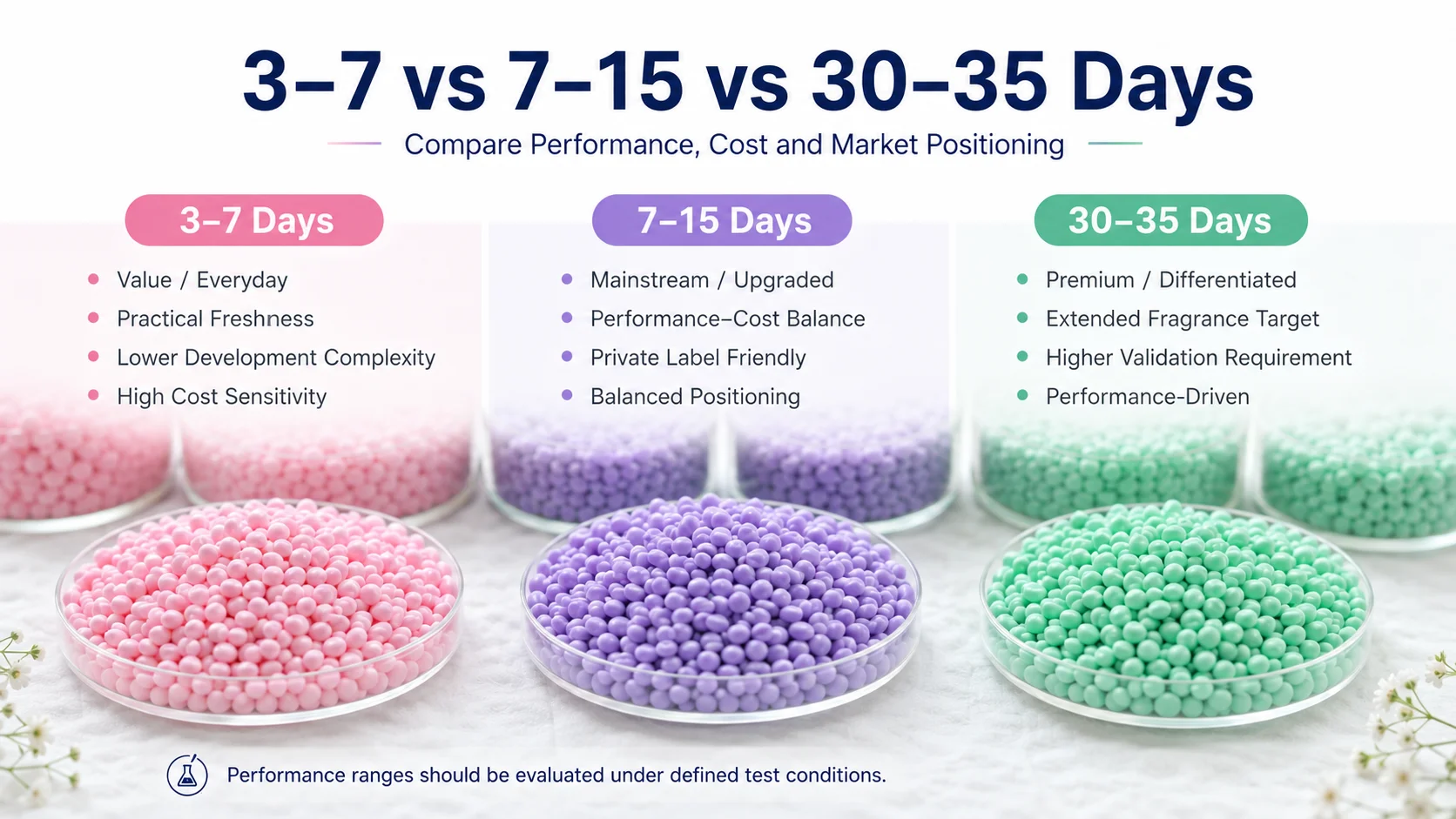
| Evaluation Area | 3–7 Days | 7–15 Days | 30–35 Days |
|---|---|---|---|
| Market positioning | Value / Everyday | Mainstream / Upgraded | Premium / Differentiated |
| Main objective | Practical freshness | Performance-cost balance | Extended fragrance positioning |
| Initial scent priority | Important | Important | Depends on target profile |
| Retained fragrance | Moderate target | Higher target | Extended target |
| Development complexity | Lower | Medium | Higher |
| Cost sensitivity | High | Balanced | Performance-driven |
| Validation requirement | Standard evaluation | Controlled comparison | Structured validation |
| Packaging importance | Important | High | Very high |
| Typical project | Wholesale / Market entry | Mainstream brand / Private label | Premium / Signature range |
This table describes commercial positioning, not universal technical specifications.
Actual performance must be evaluated using approved samples under defined conditions.
5. Higher Duration Does Not Automatically Mean Better Commercial Performance
A common mistake is to treat 3–7, 7–15 and 30–35 days as a simple progression from “basic” to “best.”
That is not how B2B product selection should work.
A longer-retention route may provide additional fragrance performance, but it may also involve:
Higher product cost
More demanding packaging
More extensive validation
Higher project complexity
Different MOQ requirements
Longer development cycles
For a value-market distributor, these additional requirements may not produce enough commercial return.
For a premium brand, however, extended fragrance retention may be an important part of the product proposition.
The correct route should therefore be selected according to:
consumer expectation + retail positioning + total project cost + target margin + validation requirement.
6. Do Not Compare Performance Routes Only by Price per Kilogram
A common purchasing mistake is comparing only:
USD/kg
or:
USD/package.
For scent booster beads, a more useful first calculation is often cost per consumer wash.
Cost per Wash
Cost per wash = Product price per kilogram × Product dosage per wash in kilograms
However, cost per wash is still only one part of the purchasing decision.
The total commercial result may also include:
Recommended dosage
Packaging size
Number of washes per package
Fragrance-performance level
Packaging material
Printing cost
Export carton
Freight
MOQ
Sampling cost
Development cost
Inventory exposure
Retail price
Distributor margin
Compare Total Commercial Fit
A longer-retention product may create additional commercial value when consumers are willing to pay for the difference.
If the target market is strongly price-sensitive, higher formulation and packaging costs may instead reduce competitiveness.
The objective is therefore not maximum fragrance duration.
It is the best combination of:
performance + cost per wash + packaging + landed cost + selling price + target margin.
7. Build a Controlled Three-Tier Sample Comparison
The most reliable way to select a performance route is to compare physical samples under controlled conditions.
Changing washing or evaluation conditions between samples makes the results difficult to interpret.
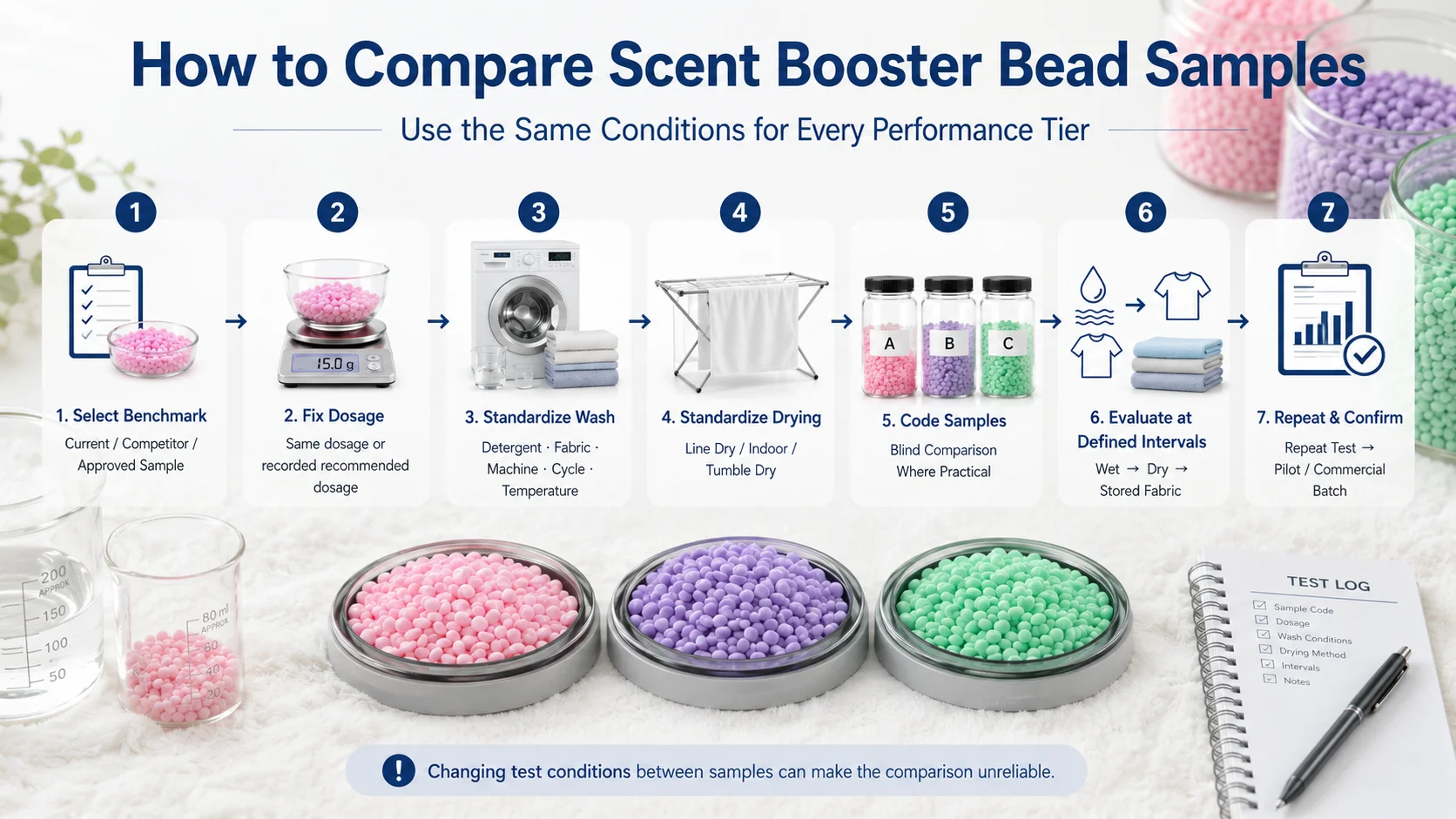
Step 1 — Define the Commercial Objective
Specify:
Target country
Target customer
Distribution channel
Retail positioning
Target selling price
Desired fragrance character
Expected product differentiation
Step 2 — Select a Benchmark
Use one consistent reference, such as:
Current product
Existing supplier product
Competitor product
Approved reference sample
The benchmark helps determine whether a new sample produces meaningful improvement.
Step 3 — Code the Samples
Where practical, compare samples using codes rather than revealing which product is the 3–7, 7–15 or 30–35 day route.
This can help reduce expectation bias during sensory evaluation.
Step 4 — Control Dosage
Use either:
The same dosage for all samples, or
The recommended dosage for each product when evaluating real commercial cost per wash
If different dosages are used, record them clearly.
Step 5 — Standardize Washing Conditions
Record:
Detergent
Detergent dosage
Fabric type
Fabric weight
Machine type
Wash program
Water temperature
Water volume where available
Scent booster placement
Step 6 — Standardize Drying
Use the same drying method:
Line drying
Indoor drying
Tumble drying
Drying temperature, airflow and drying time may significantly affect fragrance perception.
Step 7 — Evaluate at Defined Intervals
Possible evaluation stages include:
Product odor before use
Wet fabric
Immediately after drying
Several days after drying
Additional agreed intervals according to the target performance route
Do not change the evaluation schedule between samples.
Step 8 — Use a Consistent Sensory Method
Where practical:
Use several evaluators
Use the same scoring scale
Record individual scores
Record average or median results
Note large differences between evaluators
Individual sensory perception varies, so one evaluator should not automatically determine the commercial conclusion.
Step 9 — Repeat the Comparison
A single wash provides limited evidence.
Important commercial projects should repeat the comparison to determine whether the observed performance difference is reproducible.
Step 10 — Confirm With a Pilot or Commercial Batch
Before relying on development samples for a large commercial project, confirm that the approved fragrance profile and physical performance can be reproduced during commercial production.
8. From Sample Approval to Commercial Production
Selecting a fragrance-performance route is only the first step in a commercial scent booster bead project.
A successful product must not only perform well during sample evaluation but also maintain consistent quality during commercial production.
Step 1 — Approve a Reference Sample
The approved reference sample should establish the target for:
Fragrance profile
Initial fragrance intensity
Retained-fragrance expectation
Bead appearance
Color
Particle characteristics
Packaging format
The approved reference sample becomes an important comparison standard for future production.
Step 2 — Establish Written Specifications
Commercial expectations should be converted into written specifications.
Important areas may include:
Product appearance
Fragrance reference
Recommended dosage
Packaging requirements
Storage conditions
Performance evaluation method
Acceptance criteria
A written specification reduces misunderstanding between buyer and supplier.
Step 3 — Verify Pilot or Commercial Production
Before large-volume supply, buyers should confirm that the approved product can be reproduced during production.
Evaluation may include:
Batch consistency
Fragrance profile
Product appearance
Packaging performance
Storage stability
Step 4 — Maintain Batch Traceability
For long-term supply, appropriate records may include:
Batch identification
Raw-material identification
Production records
Quality documentation
Retained samples
A strong development sample creates commercial value only when the intended product experience can be reproduced consistently during supply.
For a more complete quality-management framework, see Scent Booster Beads Quality Control: From Product Specification to Shipment.
9. What Evidence Should Buyers Request for Fragrance-Duration Claims?
A duration claim becomes more meaningful when the supplier can explain how it was evaluated.
Buyers should ask:
What dosage was used?
Which detergent was used?
What fabric was tested?
What washing machine was used?
Which wash cycle was used?
What water temperature was used?
How was the fabric dried?
How was the fabric stored?
At what intervals was fragrance evaluated?
How many evaluators participated?
Was the test repeated?
Was performance reproduced across different batches?
A performance claim without test conditions provides much less purchasing value than a result connected to a documented and repeatable evaluation
method.
10. Common Performance Comparison Results and Possible Causes
Performance comparisons do not always produce a simple ranking.
A product designed for longer fragrance retention may not necessarily show the strongest fragrance at every evaluation stage.
| Observation | Possible Factors to Investigate |
|---|---|
| 30–35 day sample has weaker fragrance immediately after drying | Fragrance profile, release balance, dosage or drying conditions |
| 7–15 day sample performs strongly initially but declines faster | Fragrance volatility, delivery balance or fabric interaction |
| Different fabrics show different fragrance results | Textile composition, washing conditions or storage environment |
| Performance changes after changing detergent | Surfactants, builders, enzymes or other detergent interactions |
| Laboratory sample changes after storage | Packaging barrier, temperature, humidity or fragrance loss |
| Strong fragrance in the package but weak fragrance on fabric | Wash loss, deposition, transfer or retention |
| Commercial batch differs from approved sample | Raw-material variation, dosing control, production consistency or reference management |
These observations do not automatically identify one single root cause.
A controlled investigation should be completed before changing the formulation or rejecting a performance route.
11. Fragrance Duration and Fragrance-Delivery Technology Should Be Evaluated Separately
Longer perceived fragrance performance can involve several formulation and delivery variables.
Depending on the product design, these may include:
Free fragrance
Protected or encapsulated fragrance components
Combined fragrance-delivery systems
Carrier structure
Deposition or retention-supporting components
However, the presence of encapsulated fragrance alone does not prove superior finished-product performance.
Capsule design, fragrance composition, product compatibility, deposition, release, fabric interaction and washing conditions all affect the result.
For a deeper technical evaluation of free fragrance, encapsulated fragrance and combined delivery systems, read Laundry Fragrance Encapsulation: How to Evaluate Performance in Scent Booster Beads.
12. Packaging Can Change Performance Before the Consumer Uses the Product
A high-performing fragrance formula can lose commercial value if the package does not adequately protect the product during storage and transportation.
Important packaging factors include:
Moisture barrier
Fragrance barrier
Seal integrity
Closure performance
Repeated opening and closing
Storage temperature
Warehouse humidity
Transportation time
This becomes especially important in tropical and high-humidity markets.
Buyers comparing different performance routes should therefore evaluate the filled commercial package, not only an unpackaged laboratory sample.
The commercial product should be treated as:
formula + bead structure + packaging + storage + distribution + consumer use.
13. Compare Batch Repeatability, Not Only the First Sample
A strong development sample does not prove that commercial production will deliver the same result repeatedly.
Before approving a long-term supplier, buyers should understand how the supplier manages:
Approved reference samples
Fragrance raw-material identification
Batch coding
Dosing records
Finished-product specifications
Packaging specifications
Retained samples
Production records
Complaint traceability
For large or repeat-order projects, repeatability may be more commercially important than achieving the strongest result in one isolated test.
For a complete supplier-evaluation framework covering specifications, quality systems, packaging, customization, MOQ and commercial supply capability, see YARUN’s B2B Guide to Choosing a Reliable Scent Booster Beads Manufacturer.
14. Procurement Specification Checklist
Before selecting a 3–7, 7–15 or 30–35 day performance route, confirm the following information.
Product Information
Product name
Product code
Performance positioning
Recommended dosage
Appearance
Bead form
Fragrance reference
Available colors
Performance Information
Fragrance-performance target
Test conditions
Evaluation intervals
Recommended washing conditions
Dissolution or dispersion expectations
Storage requirements
Quality Information
Written product specification
Batch identification
Certificate of Analysis where applicable
Approved reference sample
Retained-sample policy
Shelf-life target
Packaging compatibility requirements
Batch acceptance criteria
Commercial Information
MOQ
Packaging size
Packaging material
Private-label options
Production lead time
Export carton specification
Pallet or container-loading information
Destination and freight terms
Sample availability
Two products using the same fragrance-duration description may still differ significantly in formulation, dosage, packaging, cost and batch repeatability.
15. Which Performance Route Fits Your Business?
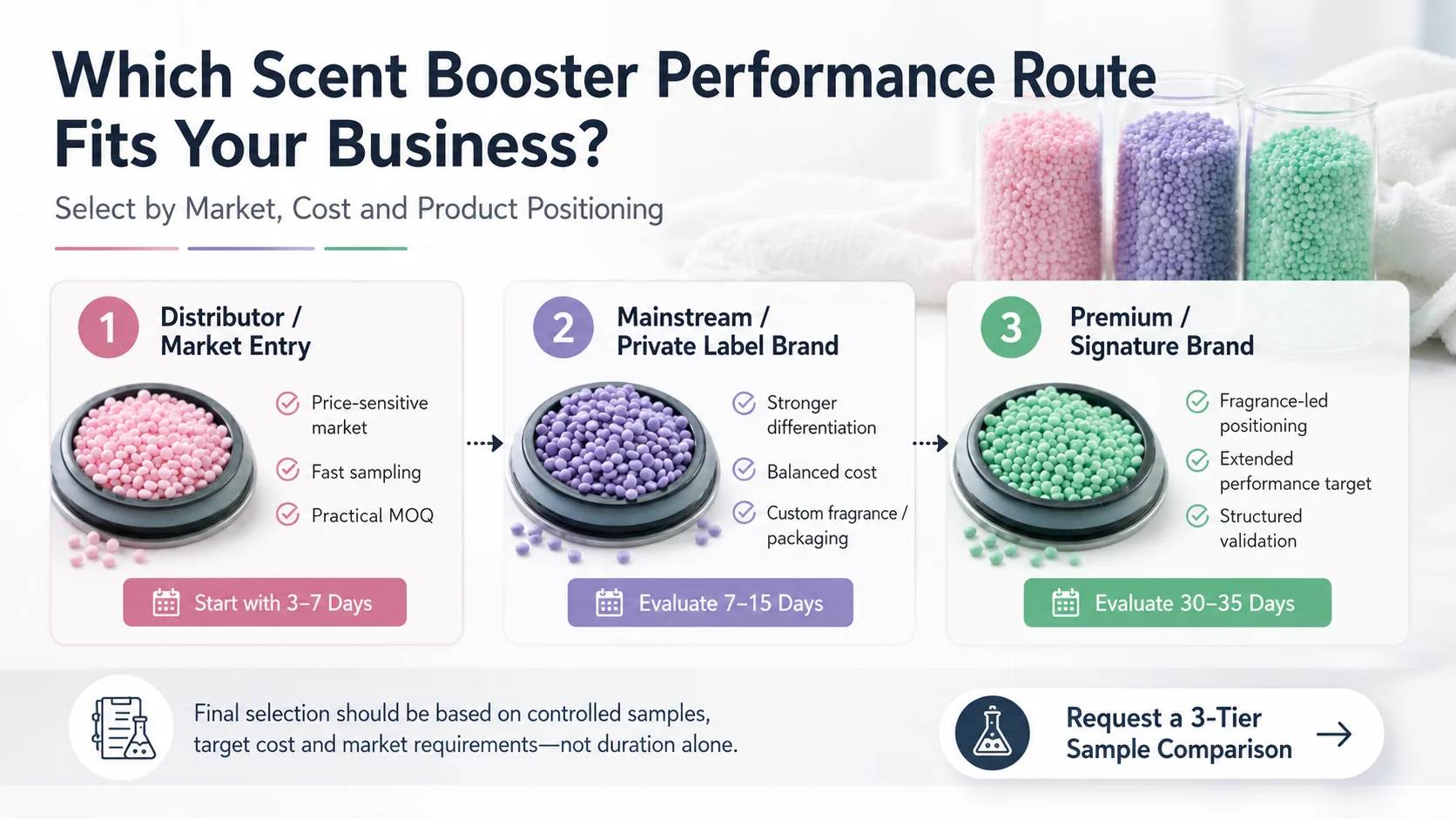
For Distributors and Market-Entry Projects
Prioritize:
Competitive landed cost
Marketable fragrance
Practical MOQ
Fast sample evaluation
Stable packaging
Repeatable supply
A 3–7 day route may provide a practical starting point where market entry, affordability and turnover are more important than maximum fragrance retention.
For Mainstream and Private-Label Brands
Prioritize:
Defined performance positioning
Stronger fragrance differentiation
Controlled sample comparison
Packaging customization
Written specifications
Batch repeatability
A 7–15 day route may provide an effective balance between fragrance performance and commercial cost.
For Premium and Signature-Fragrance Brands
Prioritize:
Fragrance identity
Sensory differentiation
Extended-performance validation
Packaging protection
Reference-sample management
Commercial-batch consistency
A 30–35 day route may be appropriate when extended fragrance performance supports the brand proposition and retail pricing.
Final selection should be based on controlled samples, target cost and market requirements—not duration alone.
16. Product Selection and Full Private-Label Development Are Different Projects
A buyer does not always need a completely new product.
Route 1 — Existing Product Selection
Suitable when the priority is:
Fast sampling
Faster market entry
Lower development complexity
Existing specification
Established performance route
Route 2 — Existing Performance Route + Fragrance Customization
Suitable when the buyer requires:
Differentiated fragrance
Custom color
Private-label packaging
Faster development than a fully customized project
Route 3 — Full Private-Label Development
Suitable when the project requires:
Defined fragrance-performance target
Custom fragrance direction
Packaging development
Market-specific evaluation
Approved reference samples
Commercial production validation
Customization depth can affect:
MOQ
Development time
Sample rounds
Testing requirements
Packaging cost
Final product cost
The most complex route is not automatically the most appropriate route.
For projects requiring customized fragrance, performance positioning, packaging and commercial production planning, read YARUN’s Private Label Scent Booster Beads: OEM/ODM Development Guide.
17. How YARUN Supports Performance-Tier Selection
YARUN supports B2B buyers comparing scent booster bead products for wholesale, distribution and private-label development.
Rather than automatically recommending the highest fragrance-duration route, product selection should reflect:
Target country
Customer type
Distribution channel
Retail price level
Fragrance preference
Performance objective
Packaging
Expected order volume
Launch schedule
YARUN can support:
Three-tier sample comparison
Fragrance selection
Performance-positioning review
Controlled sample evaluation
Packaging selection
Private-label development
Commercial production planning
Export supply coordination
The objective is to identify the most commercially appropriate route—not simply the highest numerical fragrance-duration claim.
Request a 3-Tier Scent Booster Bead Sample Comparison
If you are evaluating 3–7, 7–15 and 30–35 day scent booster bead routes, provide:
Target country
Customer type
Distribution channel
Preferred fragrance family
Target retail positioning
Preferred packaging
Expected order quantity
Target launch date
YARUN-brand or private-label requirement
YARUN can then recommend suitable samples for controlled comparison.
Request a 3-Tier Scent Booster Bead Sample Comparison
Frequently Asked Questions
Are 3–7, 7–15 and 30–35 day fragrance claims guaranteed?
No universal consumer result should be assumed.
Fragrance perception depends on fragrance composition, dosage, detergent, fabric, washing conditions, drying method, storage and sensory evaluation conditions.
Performance ranges should therefore be connected to defined product-development and testing conditions.
Is a 30–35 day scent booster bead always better than a 7–15 day product?
No.
A longer-retention route may be appropriate for premium positioning, while a mainstream or value product may achieve a better commercial result using a lower-cost performance route.
The correct choice depends on target consumers, retail positioning, total cost and validation requirements.
Does more fragrance automatically create longer-lasting scent?
No.
Fragrance composition, volatility, delivery method, dosage, fabric interaction, washing and drying conditions all affect performance.
Do longer-lasting products always require fragrance capsules?
Not necessarily.
Products may use free fragrance, protected fragrance components or combined fragrance-delivery systems.
The presence of encapsulated fragrance alone does not guarantee superior finished-product performance.
How should buyers compare three scent booster bead samples?
Use consistent detergent, dosage, fabric, washing machine, wash cycle, drying method, storage conditions and evaluation intervals.
Where practical, code samples and use several evaluators following the same scoring method.
How should private-label brands select a fragrance-performance level?
Private-label brands should evaluate fragrance performance together with target market, retail price, packaging, consumer expectations, cost structure and required product differentiation.
The highest numerical performance route is not automatically the best commercial solution.
How can buyers verify supplier fragrance-duration claims?
Buyers should request the evaluation conditions behind the claim, including dosage, detergent, fabric, washing conditions, drying method, storage conditions and evaluation intervals.
A performance claim is more useful when it can be connected to a repeatable test method and approved reference sample.
Should products be compared only by price per kilogram?
No.
Buyers should also compare dosage, cost per wash, packaging, freight, MOQ, development cost, performance, retail positioning and target margin.
Why might a 30–35 day sample smell weaker immediately after drying?
Long-term fragrance retention and immediate fragrance intensity are different performance dimensions.
The result may be influenced by fragrance composition, release balance, dosage, fabric and drying conditions.
Which performance tier is best for private-label scent booster beads?
There is no universal best tier.
The appropriate route depends on target market, retail position, fragrance direction, packaging, performance target, project budget and launch strategy.
Can YARUN provide samples from different performance routes?
YARUN can evaluate suitable sample routes according to the customer’s target market, fragrance preference, positioning, packaging and expected order quantity.
Conclusion
The difference between 3–7, 7–15 and 30–35 day scent booster bead products should not be reduced to a single fragrance-duration number.
A B2B buyer should evaluate the complete commercial result:
Fragrance profile
Retained fragrance
Dosage
Cost per wash
Total landed cost
Washing conditions
Drying conditions
Packaging
Stability
Test evidence
Batch repeatability
Target market
Retail positioning
The correct product is not automatically the one with the longest fragrance-duration claim.
It is the product that delivers the intended fragrance experience under defined conditions, fits the required commercial cost and can be reproduced consistently during commercial supply.
Contact YARUN to Compare 3–7, 7–15 and 30–35 Day Scent Booster Bead Samples