Laundry detergent pods are compact products, but their stability depends on a complex interaction between the water-soluble film, concentrated detergent formula, forming and sealing process, secondary packaging and distribution environment.
This interaction becomes especially important in Thailand and other tropical markets, where products may experience:
High relative humidity
Warm warehouses
Temperature changes during transportation
Long sea and inland distribution
Repeated opening of the retail package
Storage without climate control
A laundry pod that appears stable immediately after production may develop tackiness, deformation, seal weakness or leakage during storage.
At the same time, making a pod excessively resistant to moisture can create another problem: the film may not dissolve as intended during consumer use.
The objective is therefore not to select the “strongest” film.
The objective is to develop a balanced pod system that remains intact throughout production and distribution while still dissolving reliably in the intended wash cycle.
PVA and PVOH: Understanding the Film Material
The water-soluble film used for detergent pods is commonly described as PVA film.
In polymer terminology, PVOH—polyvinyl alcohol—is often the more chemically precise abbreviation. In commercial laundry discussions, however, PVA is widely used to refer to the same water-soluble film family.
These films can be engineered with different properties, including:
Water-solubility profile
Tensile strength
Elongation
Puncture resistance
Sealing behavior
Forming performance
Chemical resistance
Moisture response
There is no single universal PVA film suitable for every detergent formula and market.
Film selection should consider:
Pod formula
Pod geometry
Compartment design
Production equipment
Storage environment
Secondary packaging
Intended washing conditions
The film supplier’s technical recommendations should be treated as the starting point, followed by validation with the complete commercial product.
Why Humidity Affects Laundry Pods
Water-soluble film is designed to interact with water. It may also exchange moisture with the surrounding environment.
This does not mean that the film automatically dissolves when exposed to humid air. It means that environmental moisture can influence its physical behavior.
Depending on the film, formula and exposure conditions, humidity may contribute to:
Surface tackiness
Pods sticking together
Dimensional change
Reduced mechanical strength
Seal-area stress
Deformation
Changes in flexibility
Packaging-blocking behavior
Leakage risk
Very dry conditions can create a different risk by affecting flexibility and increasing susceptibility to cracking or mechanical damage.
The correct storage condition is therefore a controlled range defined for the selected film and finished pod—not a universal number applied to all products.
The Pod Must Be Developed as a Complete System
A laundry pod should not be evaluated as film plus detergent in isolation.
The complete system includes:
Water-soluble film
Concentrated detergent formula
Pod geometry
Compartment arrangement
Forming conditions
Seal design
Secondary package
Transportation
Consumer storage
Washing and dissolution
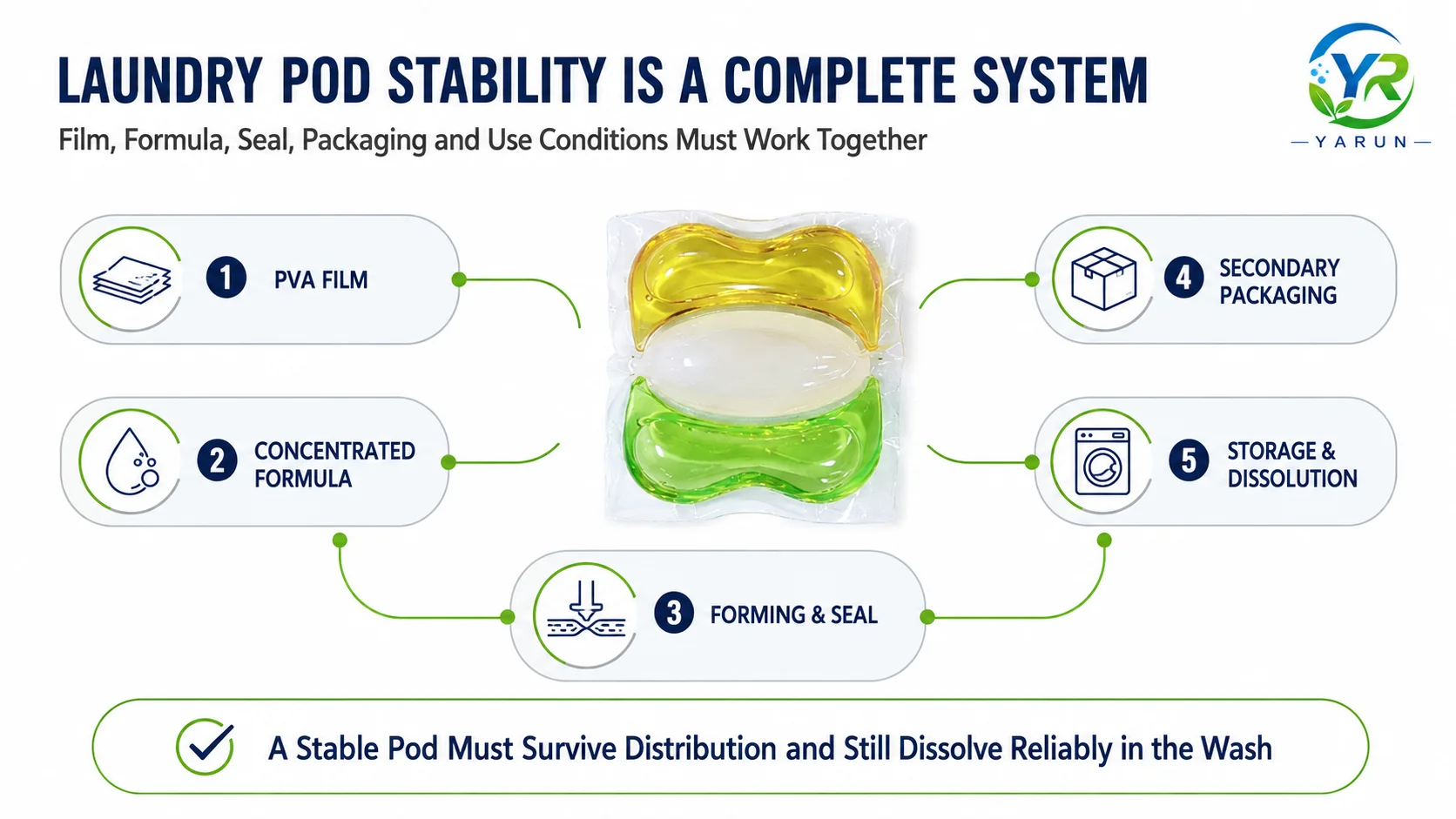
A failure in any one of these areas may appear to be a film problem even when the actual cause comes from formula compatibility, sealing, package protection or handling.
Formula Compatibility With PVA Film
The liquid or gel inside a laundry pod remains in direct contact with the film throughout its shelf life.
The complete formula can influence:
Film flexibility
Mechanical strength
Seal integrity
Migration
Premature softening
Embrittlement
Dissolution after storage
Compatibility should be evaluated using the complete formula at the intended commercial concentration.
Water and Water Activity
A pod formula normally requires careful control of available water.
However, total water percentage alone does not fully describe how water behaves inside a concentrated formulation. Other ingredients influence water activity and interaction with the film.
The correct limit must be established through film-supplier guidance and finished-product testing.
Solvents and Humectants
Solvents and humectants may be used to control:
Concentration
Viscosity
Ingredient solubility
Low-temperature behavior
Processing
They can also influence film flexibility and moisture balance.
Their suitability depends on the selected film and complete formula.
Surfactants
Surfactants such as SLES or neutralized LABSA systems should not automatically be described as destroying PVA film.
Compatibility depends on:
Surfactant type
Active concentration
Water content
pH
Counterions
Solvents
Other formulation ingredients
Storage time and temperature
Film grade
The complete formulation must be tested rather than judging compatibility from one ingredient name.
pH and Electrolytes
Extreme or poorly controlled formulation conditions may affect film and product stability.
Formulators should define and monitor:
pH target
pH variation during storage
Salt and electrolyte system
Ingredient purity
Batch consistency
Enzymes and Other Functional Ingredients
Enzymes, builders, polymers, fragrance, dyes and other additives must be assessed as part of the complete system.
A material that is acceptable in conventional bottled detergent may behave differently in a highly concentrated unit-dose formula.
Common Laundry Pod Failure Modes
Pods Become Sticky
Possible factors include:
Environmental humidity
Insufficient secondary-package protection
Formula migration
Inappropriate film grade
Storage temperature
Repeated package opening
Pods Stick Together
Possible causes include:
Surface tackiness
Pressure during transportation
Overfilled packaging
Warm storage
Insufficient package barrier
Long exposure after opening
Film Becomes Brittle or Cracks
Possible factors include:
Excessively dry storage
Formula-film imbalance
Mechanical stress
Folding or sharp geometry
Transportation damage
Aging
Seal Failure
Possible causes include:
Contaminated seal area
Incorrect sealing conditions
Uneven forming
Incompatible formula at the seal
Excessive fill volume
Mechanical stress
Environmental exposure
Pod Leakage
Leakage may result from:
Seal failure
Puncture
Film thinning
Formula compatibility
Pod-to-pod pressure
Packaging damage
Temperature and humidity exposure
Film Does Not Dissolve Completely
Possible factors include:
Film grade
Aging
Wash temperature
Short wash cycle
Low water volume
Product placement
Machine overloading
Formula-film interaction
Pod sticking to dry fabric
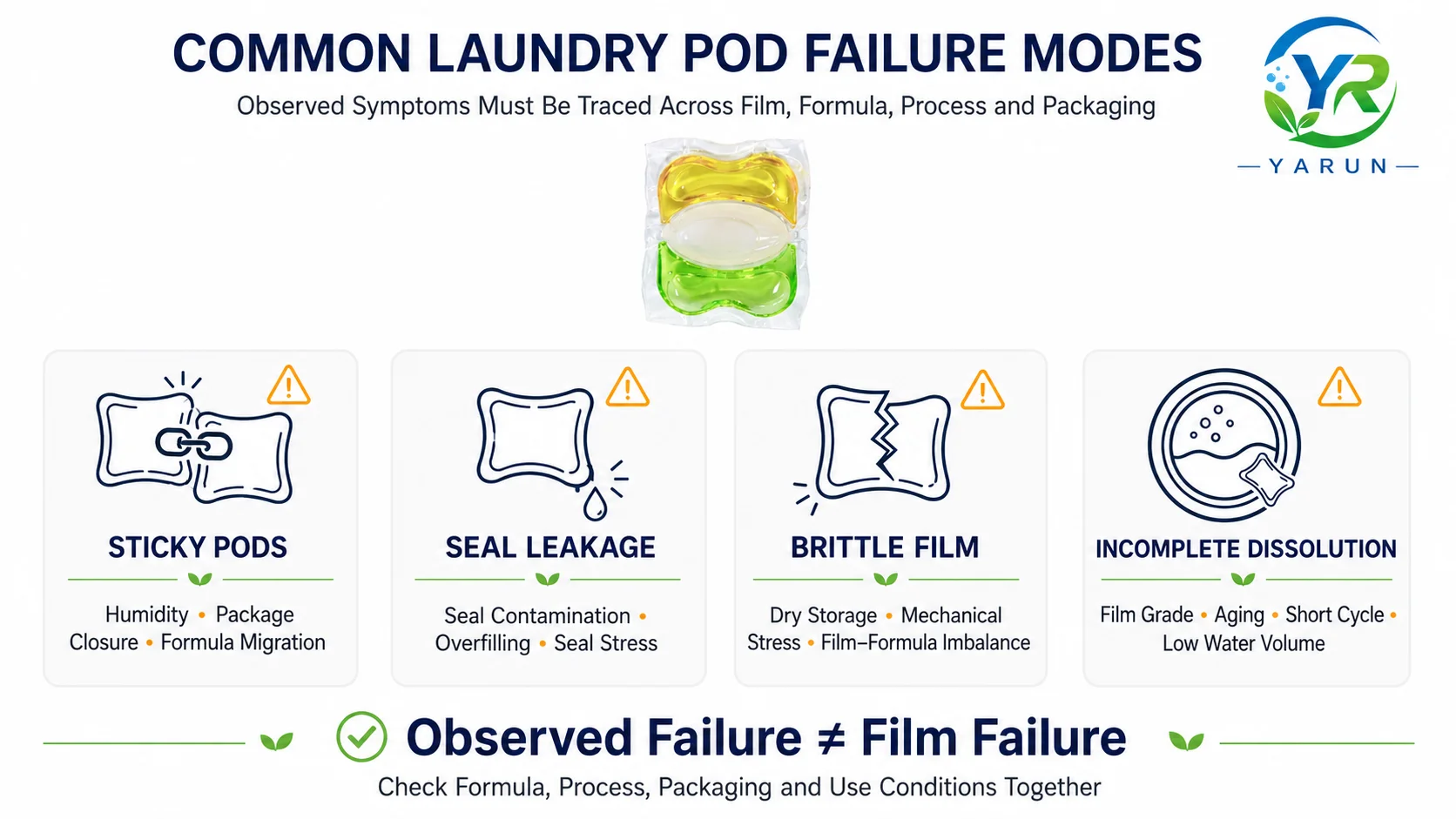
A pod can pass storage testing but fail consumer-use testing. Both sides of performance must be verified.
Film Selection Criteria
When comparing water-soluble films, buyers and product developers should evaluate:
Recommended applications
Solubility profile
Mechanical properties
Forming behavior
Seal compatibility
Chemical-resistance guidance
Storage recommendations
Film thickness
Supplier technical support
Batch consistency
Regulatory documentation for the target market
The final decision should be based on finished-pod testing.
A film specification alone cannot demonstrate compatibility with a specific detergent formula.
Forming and Sealing Process Control
Production conditions strongly influence pod stability.
Important variables may include:
Film conditioning
Film tension
Forming depth
Forming temperature where relevant
Fill volume
Formula temperature
Seal cleanliness
Sealing conditions
Cutting
Pod transfer
Finished-pod conditioning
The appropriate values depend on the film, machine and pod design.
Universal production settings should not be copied from another project without validation.
Seal-Area Cleanliness
Detergent contamination in the seal area can weaken the final package.
Controls should prevent:
Splashing
Overfilling
Stringing or dripping
Formula on the sealing surface
Misalignment
Fill-Volume Control
Excess fill volume may place additional stress on the seal and reduce flexibility during transport.
Low fill volume may create inconsistent appearance or dosing.
The fill target should be linked to pod geometry and film-forming capability.
Pod Geometry
Sharp corners, excessive forming depth and uneven compartment geometry can create localized film stress.
Multi-chamber pods require particular attention to:
Compartment balance
Internal seal areas
Formula separation
Fill accuracy
Mechanical handling
Production-Environment Control
The forming environment should follow the requirements of the selected film and process.
Important controls can include:
Temperature
Relative humidity
Film-storage condition
Time outside protective packaging
Formula temperature
Equipment cleanliness
Condensation prevention
There is no universal production-room temperature and humidity suitable for every PVA film.
The operating range should be defined with the film supplier and verified through stable production results.
Secondary Packaging Is Part of Pod Stability
Laundry pods should not depend on the water-soluble film alone for protection during distribution.
The secondary package may need to control:
Moisture exposure
Repeated opening
Mechanical damage
Pod-to-pod pressure
Fragrance transfer
Consumer access
Transportation stress
Possible formats include:
Rigid container with suitable closure
High-barrier pouch
Reclosable package
Individually protected configurations for specific applications
The correct format depends on product positioning, market, order volume, supply chain and regulatory requirements.
Terms such as “moisture-resistant” should be supported by the actual package construction and finished-product testing.
No secondary package should be described as an absolute barrier unless its performance has been established under a defined method.
Packaging Design for Tropical Markets
For Thailand and Southeast Asia, evaluate:
Package barrier performance
Closure after repeated use
Consumer opening behavior
Headspace
Number of pods per package
Package deformation
Seal integrity
Label adhesion
Carton protection
Container and pallet loading
A large package may remain open longer in the consumer’s home. This creates a different exposure pattern from a smaller package used quickly.
Packaging size is therefore part of the stability decision.
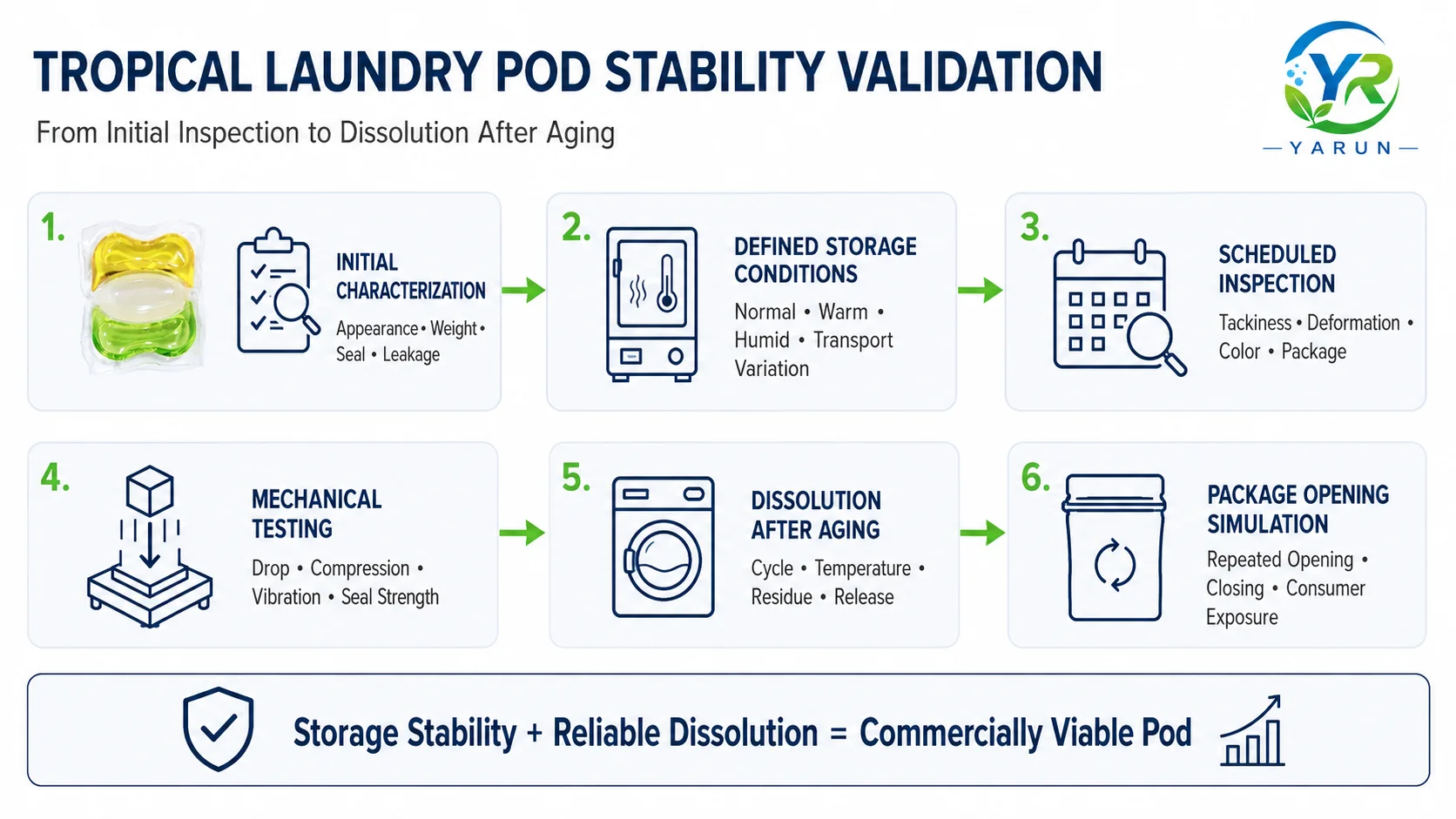
A Practical Stability-Testing Program
Testing should reflect the expected product lifecycle.
1. Initial Product Characterization
Record:
Pod appearance
Dimensions
Weight
Seal condition
Film condition
Formula appearance
Leakage
Mechanical handling
Dissolution
2. Defined Storage Conditions
Select conditions representing:
Normal intended storage
Warm storage
Humid exposure
Transportation variation
Consumer-use exposure after opening
The exact temperature, humidity and duration should be determined with the film supplier and project requirements.
3. Scheduled Evaluations
At defined intervals, inspect:
Tackiness
Pods sticking together
Deformation
Seal condition
Leakage
Color change
Odor
Package condition
Weight change where relevant
4. Mechanical Testing
Depending on the product and packaging, testing may include:
Drop or handling assessment
Compression
Vibration or transport simulation
Puncture resistance
Seal-strength evaluation
Pod-to-pod contact under load
5. Dissolution After Aging
Dissolution should be tested after storage—not only on newly produced pods.
Record:
Wash temperature
Machine type
Cycle
Load
Pod placement
Time to release
Visible residue
Film residue on fabric or drum
6. Package-Opening Simulation
For reclosable retail packs, simulate repeated opening and closing.
This can identify changes caused by consumer-use exposure.
Storage Testing and Shelf-Life Claims
Accelerated testing can help identify risks and compare alternatives. It should not automatically be converted into an exact shelf-life claim.
Shelf-life assessment should consider:
Accelerated testing
Real-time retained samples
Packaging
Distribution route
Market environment
Product specification
Failure criteria
Statements such as “stable for 36 months” require a defined validation basis.
What Procurement Managers Should Ask
Before purchasing laundry pods for a tropical market, request:
Pod specification
Film information
Recommended storage
Formula-performance description
Packaging specification
Stability-test summary
Dissolution-test conditions
Batch traceability
Certificate of Analysis
Leakage and seal controls
Production lead time
Export packing
Complaint-handling process
Procurement should not approve a pod based only on appearance and unit price.
The cost of leakage, damaged cartons, consumer complaints and product recall can exceed the initial price difference between suppliers.
Selecting a Laundry Pod Configuration
The correct pod design depends on the intended market and commercial position.
YARUN provides product-development routes including:
A more complex chamber design is not automatically better.
Selection should consider:
Formula separation requirements
Consumer benefit
Stability
Production complexity
Target price
Package size
Market differentiation
How YARUN Supports Tropical Laundry Pod Projects
YARUN is a formulation-led laundry care solution provider supporting brands, distributors and private-label buyers.
Our project support can include:
Product-brief development
Pod-configuration selection
Formula and film compatibility review
Sample development
Packaging selection
Stability-test planning
Quality requirements
Commercial-order coordination
Export supply
We evaluate the film, formula, pod structure and secondary package as one commercial system.
YARUN does not recommend a universal film or storage condition without considering the actual formulation and destination market.
Request a Tropical Laundry Pod Stability Review
To evaluate a laundry pod project, send YARUN:
Target country
Pod configuration
Intended formula or product type
Package format
Pods per package
Target shelf life
Expected transportation route
Storage concerns
Order quantity
Private-label or YARUN-brand requirement
YARUN can help identify the required product, packaging and validation route for the target market.
Request a Tropical Laundry Pod Stability Review
Frequently Asked Questions
Does high humidity automatically dissolve PVA film?
No. However, environmental moisture can affect film behavior, tackiness, flexibility, seals and pod-to-pod sticking. Results depend on the film and complete product system.
Do SLES or LABSA automatically damage PVA film?
No. Compatibility depends on the complete concentrated formula, film grade, water activity, pH, solvents, electrolytes and storage conditions.
Is thicker PVA film always more stable?
Not necessarily. Thickness can affect strength, forming and dissolution. The correct film must balance storage performance and in-use dissolution.
Can aluminum packaging completely solve humidity problems?
No packaging choice should be treated as a complete solution without finished-product testing. Barrier performance, seals, closure and consumer use all matter.
What production-room humidity should be used?
There is no universal value. The appropriate range should follow the selected film supplier’s guidance and be verified with the actual process.
Should pods be tested after accelerated storage?
Yes. Appearance, leakage, mechanical condition and dissolution should be evaluated after aging.
Why do pods stick together after opening?
Possible factors include humid air, warm storage, package closure, product pressure, film properties and length of exposure.
Can YARUN develop private-label laundry pods for Thailand?
Yes. YARUN can support pod selection, formulation, packaging, testing requirements and export supply based on the project brief.
Conclusion
Laundry pod stability in tropical markets cannot be controlled by film selection alone.
Reliable performance requires alignment between:
Water-soluble film
Concentrated formula
Pod geometry
Forming and sealing
Production environment
Secondary packaging
Storage
Transportation
Consumer use
Dissolution testing
The best pod is not the one with the most resistant film. It is the pod that remains intact throughout its commercial life and still dissolves reliably during the intended wash cycle.
YARUN helps laundry brands, distributors and private-label buyers develop pod systems for the practical conditions of Thailand and other emerging markets.
Contact YARUN to Review Your Tropical Laundry Pod Project