Introduction
Fragrance encapsulation is one of the important technologies used in advanced laundry scent booster bead systems.
For B2B buyers, however, encapsulation should not be evaluated simply as:
“More encapsulation means better fragrance performance.”
A fragrance delivery system creates commercial value only when it delivers the intended consumer experience under defined conditions.
The final performance depends on the interaction between:
- Fragrance composition
- Encapsulation system
- Release mechanism
- Carrier structure
- Product formulation
- Washing conditions
- Fabric interaction
- Packaging protection
- Evaluation method
A technically advanced fragrance system must achieve more than fragrance protection.
It must provide:
- Appropriate fragrance release timing
- Stable product performance
- Repeatable commercial production
- Suitable cost-performance balance
For a complete explanation of scent booster bead structure, fragrance delivery, dissolution, fabric interaction and packaging stability, see:
Laundry Scent Booster Beads: How They Work, Formulation and Performance Guide
This article focuses specifically on how brands, distributors, product developers and private-label buyers should evaluate fragrance encapsulation technology before selecting a product route or supplier.
1. Why Fragrance Encapsulation Matters in Scent Booster Beads
Fragrance ingredients naturally change during:
- Storage
- Transportation
- Washing
- Drying
- Fabric storage
Without an appropriate fragrance delivery system, some fragrance components may:
- Evaporate during storage
- Release too quickly during washing
- Lose intensity before reaching the consumer experience stage
- Provide strong initial fragrance but weak retained fragrance
Fragrance encapsulation is designed to protect selected fragrance components and influence how fragrance is released during product use.
Depending on system design, encapsulation may support:
- Fragrance protection
- Controlled release
- Reduced premature fragrance loss
- Improved retained fragrance perception
- More consistent sensory experience
However:
Encapsulation is not a standalone guarantee of superior performance.
The final consumer experience depends on the complete system:
Fragrance composition + Encapsulation technology + Product formulation + Washing conditions + Fabric interaction + Evaluation method
A supplier should therefore explain not only:
“Does the product contain encapsulated fragrance?”
but also:
“How does the fragrance delivery system create measurable performance under relevant conditions?”
2. Free Fragrance vs Encapsulated Fragrance vs Combined Fragrance System
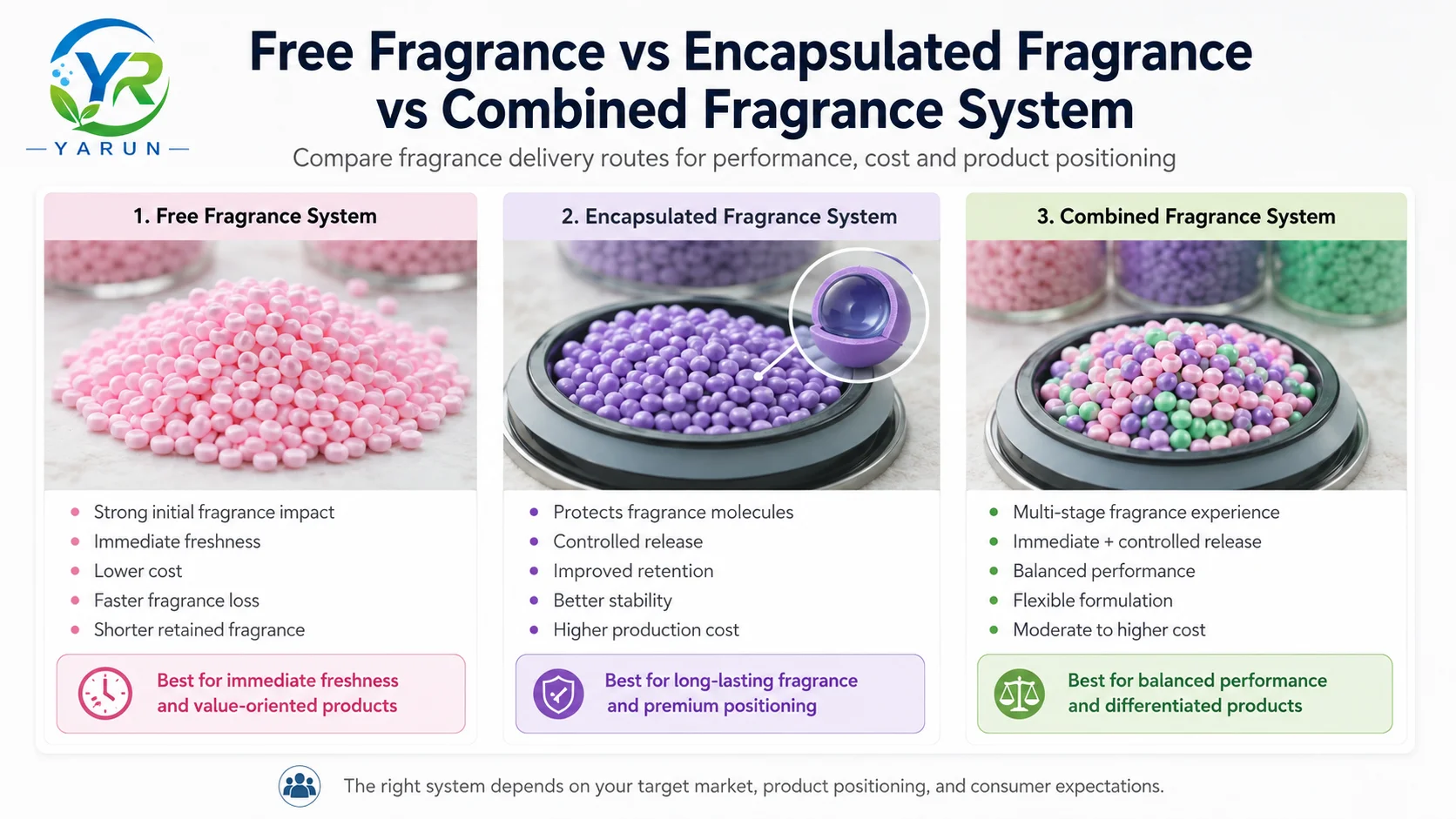
B2B buyers should understand that scent booster beads may use different fragrance delivery approaches.
The correct choice depends on:
- Target market
- Consumer expectation
- Product positioning
- Cost structure
- Required fragrance experience
2.1 Free Fragrance System
Free fragrance refers to fragrance components directly incorporated into the product without a protective encapsulation structure.
Potential Advantages
Free fragrance systems may provide:
- Strong initial fragrance impact
- Immediate sensory perception
- Flexible fragrance development
- Direct connection between product odor and consumer experience
This approach may be suitable when the main objective is:
- Immediate freshness
- Strong opening fragrance
- Cost-sensitive product positioning
Potential Limitations
Because fragrance components are directly exposed, some volatile components may be lost faster during:
- Storage
- Washing
- Drying
- Transportation
Therefore:
Strong initial fragrance does not always mean stronger fragrance retention.
2.2 Encapsulated Fragrance System
Encapsulated fragrance places selected fragrance components inside a protective structure.
The purpose is not simply to increase fragrance quantity.
The purpose is to influence:
- Protection
- Stability
- Release timing
- Fragrance retention
Potential benefits include:
- Protection of selected fragrance molecules
- Reduced premature fragrance loss
- Controlled fragrance release
- Improved retained fragrance under suitable conditions
However, performance depends on:
- Capsule structure
- Encapsulation efficiency
- Fragrance compatibility
- Release mechanism
- Product formulation
- Fabric interaction
- Washing conditions
A technically advanced encapsulation system still requires application-based validation.
2.3 Combined Fragrance Delivery System
Many advanced scent booster bead products use a combination of:
- Free fragrance
- Encapsulated fragrance
- Supporting fragrance components
The purpose is to create multiple fragrance stages:
- Product opening experience
- Initial washing fragrance
- Post-drying fragrance
- Stored-fabric fragrance
- Fragrance during handling
A combined system attempts to balance:
- Immediate fragrance impact
- Controlled release
- Cost
- Stability
- Consumer perception
However, more complex systems also require stronger formulation control.
3. How Controlled Release Works in Laundry Scent Booster Beads
A fragrance encapsulation system should be evaluated throughout the complete product lifecycle.
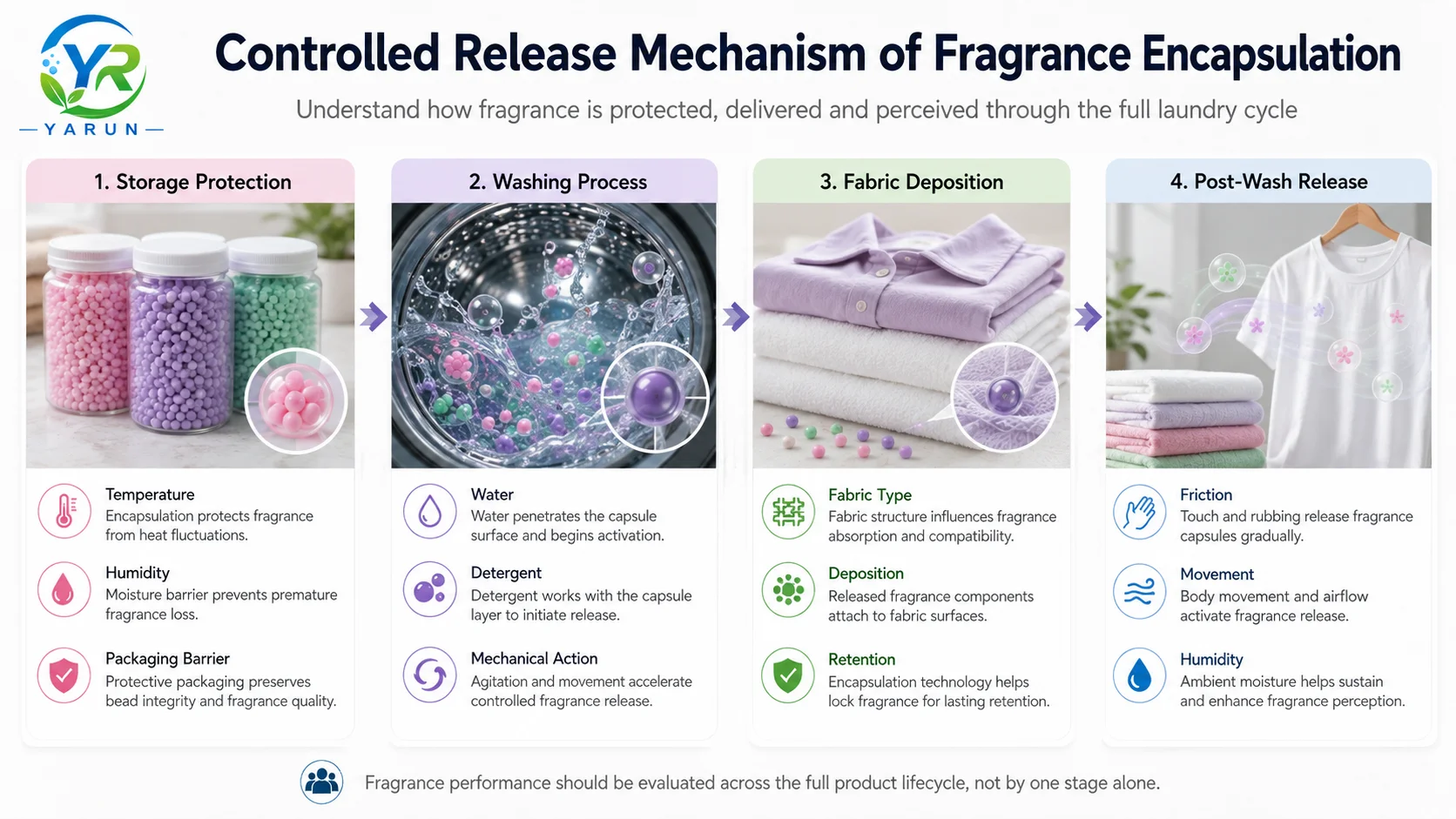
Stage 1 — Storage Protection
Before consumer use, the fragrance system must remain stable during:
- Manufacturing
- Packaging
- Transportation
- Warehouse storage
Important factors include:
- Temperature
- Humidity
- Packaging barrier
- Capsule stability
- Fragrance volatility
A fragrance system that performs well in laboratory conditions may still lose commercial value if packaging and storage conditions are not controlled.
Stage 2 — Washing Process
During washing, fragrance delivery systems interact with:
- Water
- Detergent ingredients
- Mechanical movement
- Temperature
- Washing duration
The system should release fragrance at an appropriate stage instead of releasing all fragrance immediately.
Evaluation should consider:
- Dispersion
- Dissolution
- Detergent compatibility
- Release profile
- Residue risk
A system developed under one washing condition should not automatically be assumed to perform identically in every market.
Stage 3 — Fabric Deposition and Interaction
After fragrance release, not all fragrance components remain on fabric.
Performance depends on:
- Fabric type
- Fibre structure
- Fragrance properties
- Deposition behavior
- Washing conditions
Different textiles may produce different fragrance results:
- Cotton
- Polyester
- Cotton-polyester blends
should be evaluated separately when performance claims are important.
Stage 4 — Post-Wash Fragrance Release
After drying, fragrance perception may continue to change.
Influencing factors include:
- Fabric movement
- Friction
- Humidity
- Temperature
- Storage conditions
This stage is important for consumers who expect fragrance during:
- Clothing storage
- Wearing
- Fabric handling
Controlled Release Mechanisms
Depending on capsule design, fragrance release may involve different mechanisms, including:
- Diffusion-based release
- Mechanical release
- Moisture-triggered release
- Friction-triggered release
- Temperature-influenced release
Not every encapsulation system uses all mechanisms.
The correct evaluation depends on the actual technology design and application conditions.
4. What Determines Fragrance Encapsulation Performance?
Encapsulation performance is not determined by one single technical parameter.
A reliable fragrance delivery system should be evaluated as a complete system, including:
- Encapsulation efficiency
- Capsule structure
- Release profile
- Fragrance loading
- Carrier compatibility
- Product formulation
- Washing conditions
- Fabric interaction
- Packaging protection
The objective is not to maximize one technical indicator.
The objective is to achieve the intended fragrance experience with reliable commercial repeatability.
4.1 Encapsulation Efficiency
Encapsulation efficiency influences how effectively fragrance components are protected inside the delivery system.
It may affect:
- Fragrance protection during storage
- Release consistency
- Fragrance stability
- Performance repeatability
However, higher encapsulation efficiency does not automatically create better consumer performance.
The important question is:
Does the encapsulation system release fragrance at the right time and under the right conditions?
For example:
A premium laundry fragrance product may require stronger retained fragrance after storage.
A value-oriented product may prioritize immediate freshness and cost efficiency.
The correct encapsulation design depends on the product objective.
4.2 Capsule Structure and Release Profile
Capsule structure influences:
- Mechanical stability
- Release timing
- Fragrance availability
- Environmental response
Different capsule systems may respond differently to:
- Washing action
- Moisture
- Temperature
- Friction
- Fabric handling
A system designed for rapid release may provide:
- Strong initial fragrance impact
A system designed for controlled release may provide:
- Later fragrance perception
- More balanced fragrance changes over time
Neither approach is universally better.
The correct choice depends on:
- Target market
- Product positioning
- Consumer expectation
- Cost structure
4.3 Fragrance Loading and Performance Balance
Higher fragrance loading does not automatically create better performance.
An effective system must balance:
- Initial fragrance intensity
- Retained fragrance
- Product stability
- Consumer perception
- Production cost
Excessive fragrance loading may increase:
- Raw material cost
- Stability challenges
- Packaging requirements
without creating proportional consumer value.
The goal is not maximum fragrance quantity.
The goal is:
The right fragrance performance at the right commercial cost.
4.4 Compatibility With the Scent Booster Bead System
Encapsulation technology must work together with the complete product structure.
Important compatibility factors include:
- Carrier material
- Bead structure
- Moisture sensitivity
- Processing conditions
- Storage environment
- Packaging system
A fragrance delivery system should therefore be evaluated as part of the complete finished product.
The technology itself is only one component of final performance.
5. How Should Buyers Evaluate Fragrance Encapsulation Performance?
For B2B buyers, the most important question is not:
“Does this product contain encapsulated fragrance?”
The more valuable question is:
“Can this fragrance delivery system create repeatable commercial performance under our target market conditions?”
A practical evaluation process should include the following steps.
Step 1 — Define the Performance Objective
Before selecting an encapsulation system, buyers should define the commercial objective.
Possible objectives include:
Immediate Fragrance Impact
Focus on:
- Strong opening fragrance
- Freshness after washing
- Immediate consumer perception
Retained Fragrance Performance
Focus on:
- Fabric fragrance after storage
- Longer fragrance perception
- Premium positioning
Balanced Commercial Performance
Focus on:
- Consumer experience
- Product cost
- Retail competitiveness
- Repeat purchase potential
The evaluation method should match the intended product position.
Step 2 — Establish a Reference Sample
A reliable comparison requires a benchmark.
Possible references include:
- Existing product
- Current supplier sample
- Competitor product
- Approved internal reference sample
The reference sample should define:
- Fragrance profile
- Initial fragrance intensity
- Retained fragrance expectation
- Bead appearance
- Color
- Packaging format
Without a reference standard, buyers cannot clearly determine whether a new encapsulation system creates meaningful improvement.
Step 3 — Standardize Testing Conditions
Encapsulation performance should be evaluated under controlled conditions.
Record:
- Product code
- Batch number
- Dosage
- Detergent used
- Fabric type
- Fabric weight
- Washing machine
- Wash cycle
- Water temperature
- Drying method
- Storage conditions
- Evaluation intervals
- Evaluator information
Changing test conditions between samples can make comparison unreliable.
Recommended Evaluation Stages
1. Package Evaluation
Before washing, evaluate:
- Package odor
- Product appearance
- Bead condition
- Fragrance stability
- Storage condition
2. Washing Evaluation
During washing, evaluate:
- Dispersion
- Dissolution
- Compatibility with detergent
- Fragrance release behavior
- Residue possibility
3. Fabric Evaluation
After washing, evaluate:
- Wet fabric fragrance
- Dry fabric fragrance
- Stored fabric fragrance
- Handling fragrance
4. Long-Term Evaluation
Evaluate changes over time:
- Day 1
- Day 3
- Day 7
- Extended storage periods where applicable
The evaluation schedule should match the product-performance objective.
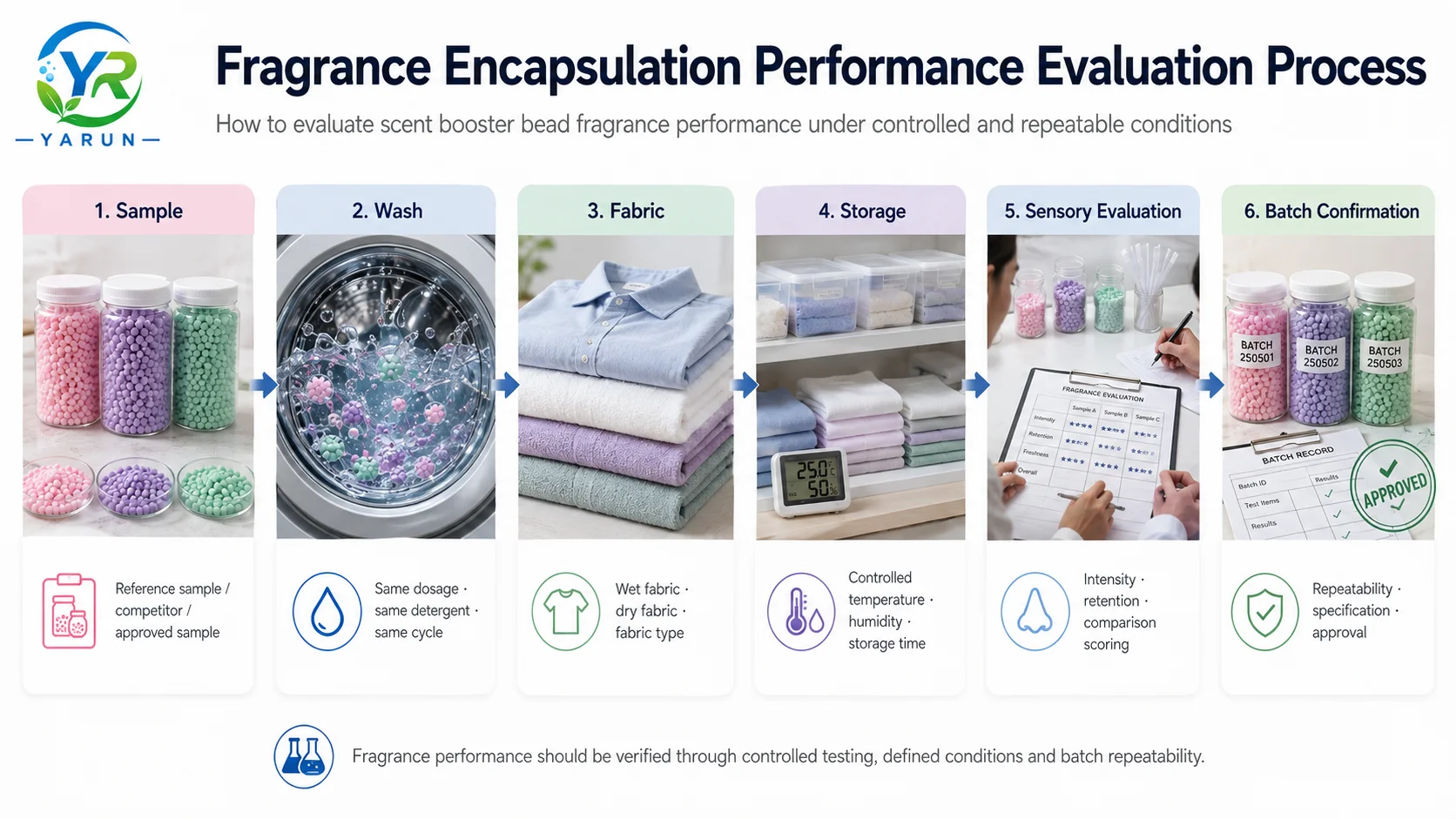
Step 4 — Compare Samples Under the Same Conditions
A reliable comparison should control major variables.
Keep consistent:
- Product dosage
- Detergent
- Fabric
- Washing conditions
- Drying method
- Evaluation timing
Where practical:
- Code samples
- Use multiple evaluators
- Record evaluation results
- Compare against reference samples
Individual fragrance perception varies.
Therefore, commercial decisions should not rely on one person's opinion.
Step 5 — Confirm Commercial Repeatability
A successful laboratory sample does not automatically guarantee successful commercial supply.
Before approving large-volume production, buyers should confirm:
- Approved reference sample
- Written product specification
- Production consistency
- Packaging performance
- Batch repeatability
For a complete quality-management framework covering specifications, batch records, packaging inspection and shipment control, see:
Scent Booster Beads Quality Control: From Product Specification to Shipment
6. Does Encapsulation Always Justify Higher Product Cost?
Fragrance encapsulation can create additional product value.
However, it may also increase:
- Raw material cost
- Processing complexity
- Testing requirements
- Quality-control requirements
- Packaging requirements
Therefore, buyers should not evaluate encapsulation only by technical complexity.
The commercial question is:
Does the additional technology create enough consumer value to justify the additional cost?
Evaluate Commercial Value Instead of Technology Cost Alone
A higher-cost encapsulated fragrance system may be suitable when:
- Fragrance is a key product differentiator
- The brand targets premium consumers
- Extended fragrance perception supports retail positioning
- Consumers recognize the added value
However, a simpler fragrance system may provide better commercial results in:
- Highly competitive markets
- Value-oriented channels
- Price-sensitive segments
The correct evaluation should consider:
- Cost per wash
- Retail price positioning
- Consumer willingness to pay
- Distributor margin
- Repeat purchase potential
- Product differentiation
For comparing different fragrance-performance routes, see:
3–7 vs 7–15 vs 30–35 Days Scent Booster Beads: A B2B Performance Selection Guide
7. Common Misunderstandings About Fragrance Encapsulation
Misunderstanding 1:
Encapsulation Automatically Means Longer Fragrance Duration
Not necessarily.
Performance depends on:
- Capsule design
- Fragrance composition
- Release profile
- Fabric interaction
- Washing conditions
- Evaluation method
Misunderstanding 2:
Higher Fragrance Loading Always Creates Better Performance
Not necessarily.
Higher loading may improve fragrance intensity but does not automatically improve:
- Retention
- Stability
- Consumer experience
- Cost efficiency
Misunderstanding 3:
The Most Advanced Technology Is Always the Best Choice
Not necessarily.
The most suitable technology depends on:
- Target market
- Product positioning
- Consumer expectation
- Cost structure
The correct technology is the one that creates the best commercial result.
8. Questions Buyers Should Ask About Fragrance Encapsulation Technology
Before approving an encapsulated fragrance system, buyers should ask suppliers:
Technology Questions
- What fragrance delivery system is used?
- Is it free fragrance, encapsulated fragrance or combined fragrance?
- What release behavior is expected?
- How is fragrance retention evaluated?
Testing Questions
- What conditions support the performance claim?
- Which fabrics were tested?
- Which detergent system was used?
- How were washing and drying controlled?
- Was the result repeated?
Commercial Questions
- How does encapsulation affect product cost?
- What packaging requirements are needed?
- Can commercial samples be provided?
- How is batch consistency controlled?
Supply Questions
- Is there an approved reference sample?
- Are specifications documented?
- Are retained samples maintained?
- Can commercial batches reproduce the approved performance?
9. How to Evaluate a Supplier’s Fragrance Encapsulation Capability
For B2B buyers, selecting an encapsulated fragrance system is also a supplier capability decision.
A supplier should not only provide a fragrance product.
The supplier should demonstrate the ability to connect:
- Fragrance technology
- Product formulation
- Testing methods
- Quality control
- Commercial production
A technically advanced sample has limited value if the supplier cannot reproduce the same performance during commercial supply.
9.1 Evaluate Technical Understanding
A capable supplier should understand:
- Fragrance composition
- Encapsulation technology
- Release behavior
- Product compatibility
- Target market requirements
The supplier should be able to explain:
- Why a specific fragrance delivery system is selected
- What performance objective it supports
- Under what conditions the performance should be evaluated
A professional supplier should discuss the complete system rather than only promoting a single technology feature.
9.2 Evaluate Testing Capability
Performance claims should be connected to clear evaluation methods.
Buyers should understand:
- How fragrance performance is measured
- What test conditions are used
- How samples are compared
- How repeatability is confirmed
A statement such as:
“Long-lasting fragrance”
has limited purchasing value without supporting information.
A stronger technical evaluation includes:
- Test conditions
- Reference samples
- Evaluation intervals
- Batch comparison
9.3 Evaluate Specification Management
Commercial supply requires more than an approved sample.
Buyers should confirm whether the supplier manages:
- Product specifications
- Approved reference samples
- Batch identification
- Quality records
- Retained samples
The objective is to reduce the risk of differences between:
- Development sample
- First commercial batch
- Repeat production
9.4 Evaluate Packaging and Storage Knowledge
Fragrance encapsulation performance can be affected before consumer use.
A supplier should understand:
- Moisture protection
- Fragrance barrier requirements
- Packaging compatibility
- Transportation conditions
- Warehouse environment
- Shelf-life expectations
The fragrance system and packaging system should be evaluated together.
For a complete supplier evaluation framework covering specifications, quality systems, packaging, customization and commercial supply capability, see:
B2B Guide to Choosing a Reliable Scent Booster Beads Manufacturer
10. Fragrance Encapsulation and Commercial Product Positioning
Fragrance encapsulation should always support a clear commercial objective.
Different markets may require different fragrance strategies.
Value-Oriented Products
Priority may include:
- Attractive fragrance
- Practical performance
- Competitive cost
- Stable supply
A highly complex encapsulation system may not always provide enough additional consumer value.
Mainstream Products
Priority may include:
- Balanced fragrance experience
- Product differentiation
- Repeat purchase potential
- Competitive retail positioning
A balanced fragrance delivery system may provide the best commercial fit.
Premium Products
Priority may include:
- Strong fragrance identity
- Extended fragrance perception
- Premium consumer experience
- Brand differentiation
Advanced fragrance delivery systems may become commercially valuable when consumers recognize the difference.
The objective is not selecting the most complex technology.
The objective is selecting the technology that best matches:
- Target market
- Consumer expectation
- Product positioning
- Cost structure
11. How Encapsulation Technology Connects With Private Label Development
For private-label brands, fragrance encapsulation should be evaluated as part of the complete product strategy.
Important decisions include:
- Target consumer
- Fragrance positioning
- Retail price
- Product performance objective
- Packaging design
- Production volume
A private-label project may require:
- Customized fragrance direction
- Defined performance target
- Sample comparison
- Packaging development
- Commercial production validation
For brands developing customized scent booster bead programs, see:
Private Label Scent Booster Beads: OEM/ODM Development Guide
12. How YARUN Supports Fragrance Encapsulation Projects
YARUN supports B2B customers developing scent booster bead products by connecting:
- Target market requirements
- Fragrance positioning
- Performance expectations
- Product specifications
- Sample evaluation
- Packaging selection
- Commercial supply planning
YARUN can support customers with:
- Fragrance system comparison
- Performance evaluation planning
- Sample coordination
- Product positioning
- Private-label development
- Export supply preparation
The objective is not simply to recommend the most advanced fragrance technology.
The objective is to identify the most appropriate solution according to:
- Market requirements
- Consumer expectations
- Product cost
- Performance objectives
- Commercial supply needs
Request a Fragrance Encapsulation Performance Evaluation
If you are developing or sourcing scent booster beads with fragrance encapsulation technology, provide:
- Target country
- Customer type
- Product positioning
- Desired fragrance profile
- Performance objective
- Expected order quantity
- Packaging requirements
- Private-label requirements
YARUN can help evaluate suitable fragrance delivery routes and prepare samples for comparison.
Request a Fragrance Encapsulation Performance Evaluation
Frequently Asked Questions
Does fragrance encapsulation automatically mean longer-lasting scent?
No.
Encapsulation can support fragrance protection and controlled release, but final performance depends on:
- Fragrance composition
- Encapsulation system
- Release mechanism
- Fabric interaction
- Washing conditions
- Evaluation method
Are encapsulated fragrance systems always better than free fragrance systems?
Not necessarily.
Free fragrance may provide stronger immediate fragrance impact, while encapsulated systems may support controlled release and retained fragrance.
The correct choice depends on the target application.
Does higher encapsulation efficiency always create better consumer performance?
No.
A higher technical parameter does not automatically guarantee better finished-product results.
The release profile must match the intended product objective.
Why can two encapsulated fragrance products perform differently?
Differences may come from:
- Capsule structure
- Fragrance composition
- Product formulation
- Dosage
- Packaging
- Washing conditions
- Fabric interaction
How should buyers compare encapsulated fragrance samples?
Buyers should compare samples under controlled conditions:
- Same dosage
- Same detergent
- Same fabric
- Same washing conditions
- Same drying method
- Same evaluation intervals
Does encapsulation replace good formulation design?
No.
Encapsulation is only one part of the complete fragrance delivery system.
Final performance also depends on:
- Product formulation
- Carrier system
- Bead structure
- Packaging
- Testing method
Is encapsulation suitable for every scent booster bead product?
Not necessarily.
The appropriate fragrance system depends on:
- Market position
- Consumer expectations
- Product cost
- Required performance level
How can buyers verify supplier encapsulation claims?
Buyers should request:
- Test conditions
- Evaluation methods
- Reference samples
- Product specifications
- Batch consistency information
A technology claim becomes more valuable when it is supported by repeatable evaluation.
Conclusion
Fragrance encapsulation is an important technology in advanced scent booster bead development.
However, it should not be evaluated as a standalone feature.
A successful fragrance delivery system requires balance between:
- Fragrance composition
- Encapsulation technology
- Controlled release behavior
- Product formulation
- Fabric interaction
- Washing conditions
- Packaging protection
- Testing method
- Commercial repeatability
For B2B buyers, the best solution is not always the most advanced technology.
The best solution is the fragrance delivery system that provides the right consumer experience, supports the target market position and can be reproduced consistently during commercial supply.
YARUN helps brands, distributors and private-label customers evaluate fragrance systems, compare samples and develop suitable scent booster bead solutions based on technical requirements and commercial objectives.