SLES 70% is often selected because it is concentrated, versatile and suitable for many liquid cleaning systems. Yet formulators do not work with SLES in isolation. They work with a dynamic system in which surfactant concentration, water, electrolytes, co-surfactants, fragrance, pH, temperature and processing history influence the final result.
This explains a common industrial problem: two formulations can use apparently similar quantities of SLES 70% and still produce different viscosity, foam, clarity and storage behavior.
For manufacturers and procurement teams, the correct question is therefore not simply:
“Is SLES 70% a good surfactant?”
The more useful questions are:
What function should SLES perform in the finished product?
What happens when the concentrated paste is diluted?
How does the system respond to salt and other ingredients?
Which raw-material parameters can affect batch consistency?
How should cost be compared on an active-matter basis?
What must be validated before commercial production?
This guide connects the molecular behavior of Sodium Laureth Sulfate with practical formulation, processing and procurement decisions.
1. What Is SLES 70%?
SLES stands for Sodium Laureth Sulfate, also called Sodium Lauryl Ether Sulfate or AES in some markets. It belongs to the anionic surfactant family.
A commercial SLES 70% grade is not a single pure molecule at exactly 70.00% concentration. It is a concentrated commercial mixture whose composition, ethoxylation distribution, active matter, water, inorganic salts and unsulfated components are controlled within an agreed specification.
YARUN’s current SLES 70% product specification identifies:
| Parameter | Current standard control range |
|---|---|
| Appearance at 25°C | White to light-yellow viscous paste |
| Active matter | 68–72% |
| pH value | 7.0–9.5 |
| Unsulfated matter | Maximum 2.0% |
| Sodium sulfate | Maximum 1.0% |
| Color | Maximum 10 Hazen |
These figures describe the current standard product control range. They should not replace the approved specification, applicable test methods or batch-specific Certificate of Analysis for a commercial shipment.
The word “70%” is therefore a grade designation. Buyers should confirm the actual contractual range rather than assuming that every product sold as SLES 70% has an identical composition or processing response.
2. Why the Molecular Structure Matters
SLES molecules contain two functionally different regions:
A hydrophobic hydrocarbon chain that has an affinity for oils and other non-polar materials
A hydrophilic ethoxylated sulfate head group that interacts with water and carries a negative charge in aqueous solution
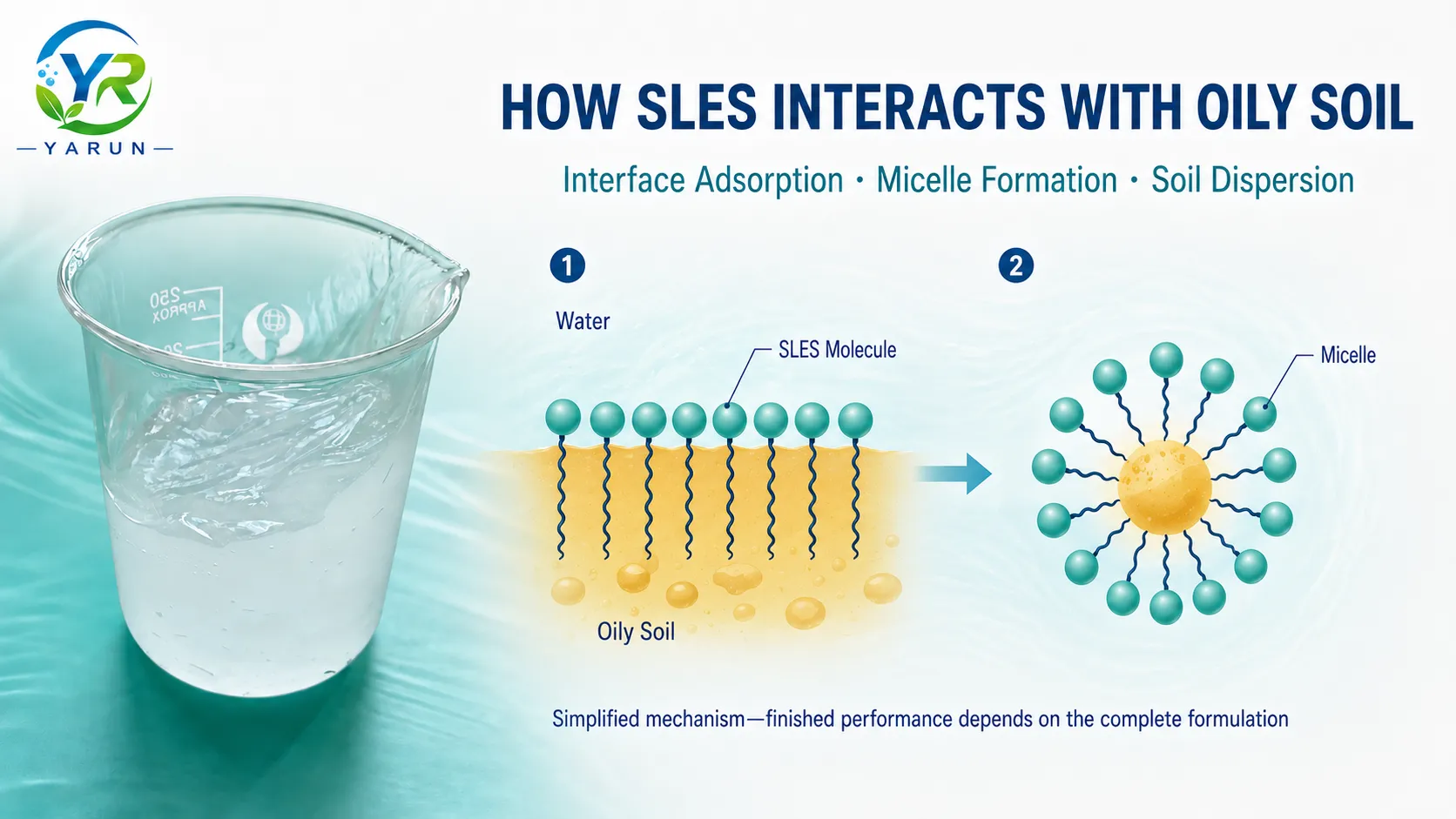
This amphiphilic structure allows SLES to accumulate at interfaces between water, air, oil and solid surfaces.
At a water–oil interface, the hydrophobic portion can associate with oily material while the hydrophilic portion remains oriented toward the aqueous phase. At a water–air interface, SLES can reduce surface tension and support the formation of foam films.
These interfacial effects help a cleaning solution:
Wet a surface
Spread across fabric or a hard surface
Contact oily soil
Disperse removed material into the wash liquor
Reduce rapid redeposition when the complete formula is properly designed
SLES does not “destroy dirt” through a single chemical reaction. Its contribution comes from changing interfacial behavior and supporting the removal, dispersion and suspension processes of the complete detergent system.
3. From Individual Molecules to Micelles
At low concentration, many surfactant molecules are present mainly as individual molecules in water and at available interfaces.
As the concentration increases, the system reaches a region in which surfactant molecules begin to organize into aggregates commonly called micelles. In a simplified model, their hydrophobic portions associate within the aggregate while their hydrophilic charged groups remain exposed to water.
Micelles can help accommodate hydrophobic material within an aqueous cleaning system. However, this does not mean that adding unlimited SLES will produce unlimited cleaning.
The practical result depends on:
Soil type and loading
Contact and mechanical action
Water quality
Temperature
Surfactant blend
Builders, solvents and other functional ingredients
Product dosage
Rinsing conditions
Published experimental work on SLES solutions confirms that surface tension and micellization behavior change with concentration and with the presence of other components. Other rheological research demonstrates that concentrated Sodium Lauryl Ether Sulfate–water systems can pass through different microstructural regions as concentration and temperature change.
For formulators, the important lesson is that SLES solutions are structured fluids. They should not be treated as simple mixtures in which viscosity and performance change linearly with the amount added.
4. What SLES Contributes to a Liquid Detergent
SLES can perform several connected functions, but the importance of each function depends on the finished product.
4.1 Wetting and Surface Contact
A cleaning liquid must reach the surface before it can remove soil.
By lowering interfacial tension, SLES helps the wash solution spread and make contact with fabric, tableware or hard surfaces. Wetting performance is affected by concentration, formulation composition and the surface being cleaned.
4.2 Oily-Soil Removal and Dispersion
SLES can assist the detachment and dispersion of oily and particulate soils. The complete removal process also depends on mechanical action, builders, solvents, nonionic surfactants and other formula components.
For this reason, SLES should not be evaluated only through a foam-height test.
4.3 Foam Generation
SLES is widely used where visible foam is part of the expected application experience, including dishwashing liquid, liquid soap and selected household cleaners.
Foam can help consumers judge product distribution and use, but foam height is not a direct measurement of detergency. A product can generate abundant foam while performing poorly against a defined soil, and an effective cleaning system can be designed with controlled foam.
The required foam profile should be defined for the actual application.
4.4 Formulation Structure and Viscosity
SLES-based systems can respond strongly to electrolytes and co-surfactants. This makes SLES useful in formulations where rheology must be adjusted, but it also means that viscosity cannot be predicted from the SLES percentage alone.
The same SLES grade may behave differently in:
Liquid laundry detergent
Hand dishwashing liquid
Liquid soap
Hand wash
Multipurpose cleaner
A formula containing high fragrance or solvent levels
SLES provides a structural platform. It does not guarantee that every final formula will become clear, stable or appropriately viscous.
5. Why SLES 70% Can Be Difficult to Dilute
A concentrated SLES 70% paste contains much less water than a dilute SLES grade. This improves the quantity of active material transported per unit of product weight, but it creates a more demanding handling and dilution process.
During dilution, the system does not necessarily move smoothly from a viscous paste to a thin liquid. Intermediate concentration regions can produce highly structured or gel-like phases.
BASF’s technical information for a commercial SLES 70% grade states that dilution produces gel structures typical of ether sulfates. It reports a rapid initial increase in viscosity before the system becomes considerably less viscous below a lower active-matter region.
Independent rheological research has also identified micellar, hexagonal, cubic and lamellar regions in concentrated Sodium Lauryl Ether Sulfate–water mixtures, with viscosity and flow behavior changing substantially with concentration and temperature.
This explains why poor dilution practice can cause:
Persistent gel lumps
Slow incorporation
Localized high concentration
Excessive air entrainment
Inconsistent batch time
Unnecessary heating or mixing
Apparent non-uniformity before equilibrium is reached
There is no universal dilution procedure suitable for every SLES grade, tank, agitator and batch size.
Before scaling up, manufacturers should define:
Water charging strategy
Addition sequence
Agitator type and speed
Batch temperature
Rate of SLES addition
Time allowed for hydration and equilibration
Method for controlling foam and air incorporation
Point at which other surfactants, salts and fragrance are added
Supplier processing guidance can provide a starting point, but the final method must be validated using the actual raw material, equipment and finished formulation.
6. Understanding the SLES Salt Curve
A salt curve describes how the viscosity of a surfactant formulation changes as electrolyte concentration changes while the other test variables are held as constant as practical.
In many suitable SLES-based systems, adding sodium chloride initially screens electrostatic repulsion between charged surfactant head groups. This can change micellar size, shape and interaction, increasing resistance to flow.
As more salt is added, viscosity may rise toward a maximum. Beyond the useful region, further electrolyte addition can reduce viscosity, impair clarity or destabilize the system.
The practical relationship is therefore not:
More salt = more viscosity.
It is closer to:
Insufficient salt → rising-viscosity region → formulation-specific peak → declining or unstable region.
The position and height of the curve can change when the formulator changes:
Total surfactant active matter
SLES grade or batch
Ethoxylation distribution
Sodium sulfate already present in the raw material
CAPB, CDEA or other co-surfactants
Nonionic surfactants
Fragrance
Solvents
Chelating agents
Preservatives
pH
Water hardness
Temperature
Order of addition
This is why a salt quantity copied from another formula may fail.
A Controlled Salt-Curve Study
A practical development study should keep the base formula constant and prepare a series of samples with controlled incremental electrolyte additions.
For each sample, record:
Exact batch and sample code
Raw-material lot numbers
Total active matter
Salt concentration
Addition sequence
Mixing time
Measurement temperature
Time between preparation and measurement
Viscosity method, spindle and speed
Appearance and clarity
pH
Stability observations
The selected salt level should not sit automatically at the absolute viscosity peak. A commercial formula may need operating margin on a stable part of the curve to reduce the risk that normal raw-material or production variation moves the batch into the declining region.
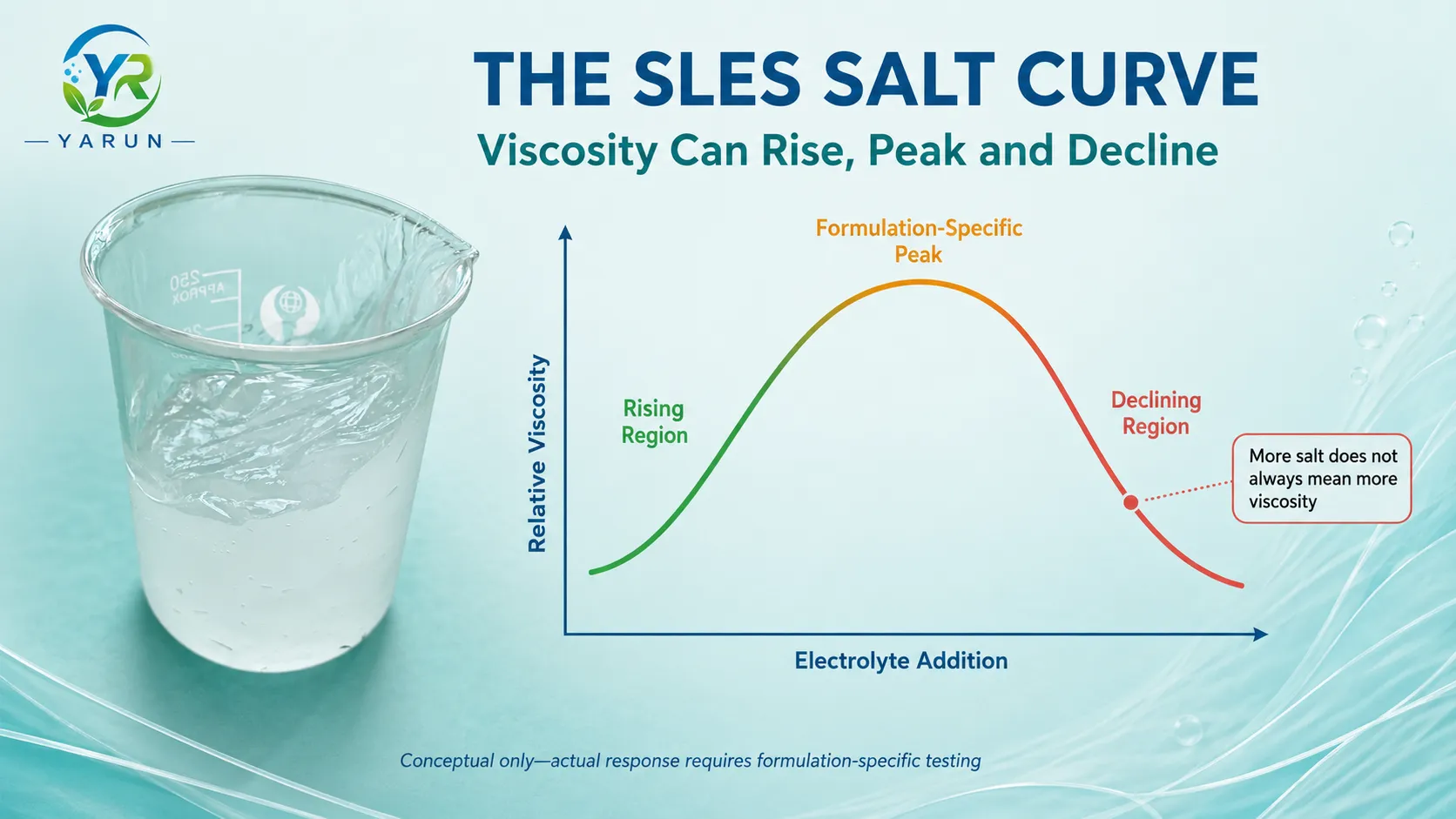
Image note: The chart must be labeled “Conceptual—actual curve requires formulation testing.” It must not display invented salt percentages or viscosity values.
7. Why a Formula May Remain Thin
When an SLES-based formulation does not reach the required viscosity, adding more salt immediately can make diagnosis more difficult.
The following variables should be reviewed first:
| Observation | Variables to investigate |
|---|---|
| Viscosity never develops | Total active matter, surfactant ratio, salt-response window, measurement temperature |
| Viscosity rises and then collapses | Electrolyte level may have passed the useful region |
| One batch is thinner than another | Raw-material lots, sodium sulfate, water quality, fragrance, pH, processing history |
| Product thickens only after standing | Hydration, micellar equilibration, temperature or delayed ingredient interaction |
| Product becomes hazy while thickening | Fragrance, electrolyte, temperature, solubility and phase behavior |
| Viscosity changes during storage | Microstructure, temperature cycle, evaporation, incompatibility or contamination |
A corrective investigation should compare controlled samples rather than changing several ingredients simultaneously.
8. Why a Formula May Become Hazy or Separate
Clarity is a system property. It cannot be guaranteed by selecting SLES alone.
Haze or phase separation may be associated with:
Fragrance incompatibility
High electrolyte loading
Insufficient solubilization
Temperature change
Water hardness
pH shift
Poorly dissolved ingredients
Incompatible polymers
Preservative interactions
Incorrect addition sequence
Contamination
The investigation should distinguish between temporary processing haze and a genuine stability problem.
Useful checks include:
Appearance at controlled temperature
Comparison before and after fragrance addition
Comparison before and after electrolyte addition
pH measurement
Centrifuge screening where appropriate
Defined-temperature storage
Temperature-cycle evaluation
Retained-sample comparison
A clear fresh sample does not automatically demonstrate long-term stability.
9. SLES and Co-Surfactant Selection
SLES is frequently used as part of a surfactant blend rather than as the only surface-active ingredient.
SLES and CAPB
CAPB is an amphoteric co-surfactant commonly evaluated with anionic systems when formulators need to adjust foam character, formulation mildness and rheology.
The effect depends on the ratio, active matter, salt content, pH and other ingredients. CAPB should not be treated as an automatic thickener at any dosage.
YARUN’s CAPB 35% product route can be evaluated when an amphoteric co-surfactant is required.
SLES and CDEA
CDEA 6501 may support foam stability and viscosity development in appropriate liquid detergent systems.
Its suitability depends on the application, destination-market requirements and complete formulation. The selected raw material and finished product must meet applicable regulatory and customer requirements.
See YARUN’s CDEA 6501 product page when comparing nonionic foam and viscosity-support options.
SLES and Neutralized LABSA
Neutralized LABSA systems may be combined with SLES when the manufacturer is balancing detergency, foam, processing and formulation cost.
LABSA is supplied in acid form and requires controlled neutralization. It should not be substituted directly for SLES kilogram for kilogram.
For the corresponding raw material, see LABSA 96%.
SLES and Nonionic Surfactants
Nonionic surfactants may be considered when oily-soil removal, low-temperature performance or foam control requires adjustment.
A nonionic surfactant can also change clarity, viscosity and salt response. Compatibility must be assessed in the complete formula.
SLES and Cationic Ingredients
SLES is an anionic surfactant. Direct combination with cationic materials can create incompatibility, complex formation, precipitation or loss of intended performance.
Any system containing both anionic and cationic components requires specific compatibility evaluation.
10. Select SLES by Finished-Product Objective
SLES should be selected according to the intended product—not because it appears in a competitor’s ingredient list.
Liquid Laundry Detergent
Important questions include:
What soil profile is targeted?
Is visible foam desirable for the washing method?
What other anionic and nonionic surfactants are present?
What builder, enzyme, polymer and solvent system is planned?
What water quality will the consumer use?
What viscosity is required for filling and dosing?
Will the formula remain stable during transportation and storage?
SLES may contribute cleansing, dispersion and foam, but it should be evaluated as part of the complete laundry system.
Hand Dishwashing Liquid
The commercial brief often gives greater weight to:
Oily-soil removal
Foam persistence under soil load
Hand-use experience
Rinsing
Viscosity
Clarity
Fragrance compatibility
Cost per usable dose
Foam should be evaluated both before and after representative soil is introduced.
Liquid Soap and Hand Wash
The selected SLES grade must be appropriate for the intended application and market. Formulators should evaluate:
Cleansing performance
Irritation and mildness strategy
Co-surfactant selection
pH
Preservative system
Fragrance
Finished-product safety and regulatory requirements
Raw-material identity alone does not establish finished-product safety.
Multipurpose and Technical Cleaners
Selection should reflect:
Target surface
Soil type
Foam requirement
Wiping or rinsing process
Alkalinity or acidity
Solvent system
Material compatibility
Occupational-use conditions
High foam may be useful in one application and undesirable in another.
11. Active Matter Changes the Real Cost Comparison
Bulk buyers frequently compare SLES offers by price per metric ton. This can be misleading when the offers have different active-matter concentrations.
A basic active-matter comparison is:
Raw-material cost per metric ton of active matter = Price per metric ton ÷ Active-matter fraction
For example, an offer at 70% active matter and an offer at 68% active matter should not be treated as identical solely because both are called “SLES 70%.”
The calculation is only the first step. A complete commercial comparison should also include:
Water transported with the raw material
Packaging cost
Loading quantity
Freight
Import duties and local charges
Pumping and transfer requirements
Dilution time
Energy and labor
Batch throughput
Formula yield
Rework risk
Batch consistency
Required document package
The lowest price per ton may not produce the lowest cost per ton of finished detergent.
Delivered Active-Matter Cost
For a more realistic comparison, procurement teams can calculate:
Delivered active-matter cost = Total landed raw-material cost ÷ Delivered active-matter quantity
This allows offers with different concentration, freight and packaging structures to be compared on a more consistent basis.
However, active-matter cost still does not measure final cleaning performance. Controlled formulation trials are required before concluding that one grade can replace another without affecting product quality.
12. Why Raw-Material Specifications Affect Formulation Behavior
Two SLES batches can both pass a broad active-matter requirement and still differ in ways that influence processing or the finished product.
Important purchasing parameters include:
Active Matter
Active matter affects formula calculation, water balance and delivered surfactant cost.
Sodium Sulfate
Sodium sulfate contributes to the total electrolyte environment. Variation may affect viscosity response in salt-sensitive formulations.
Unsulfated Matter
Unsulfated components are part of the product-quality profile and should be controlled according to the agreed specification.
pH
The reported pH must be interpreted with the applicable test method and sample preparation. It should not be compared across suppliers without confirming that the methods are equivalent.
Color and Odor
These can affect lightly colored or fragrance-sensitive finished products. Acceptance limits should reflect the intended application.
Physical Consistency
Temperature can change the physical condition and apparent viscosity of concentrated SLES. Buyers should distinguish temperature-related handling behavior from a confirmed chemical-quality failure.
13. A Better SLES Qualification Program
A professional qualification program should compare both the raw material and its performance in the target formula.
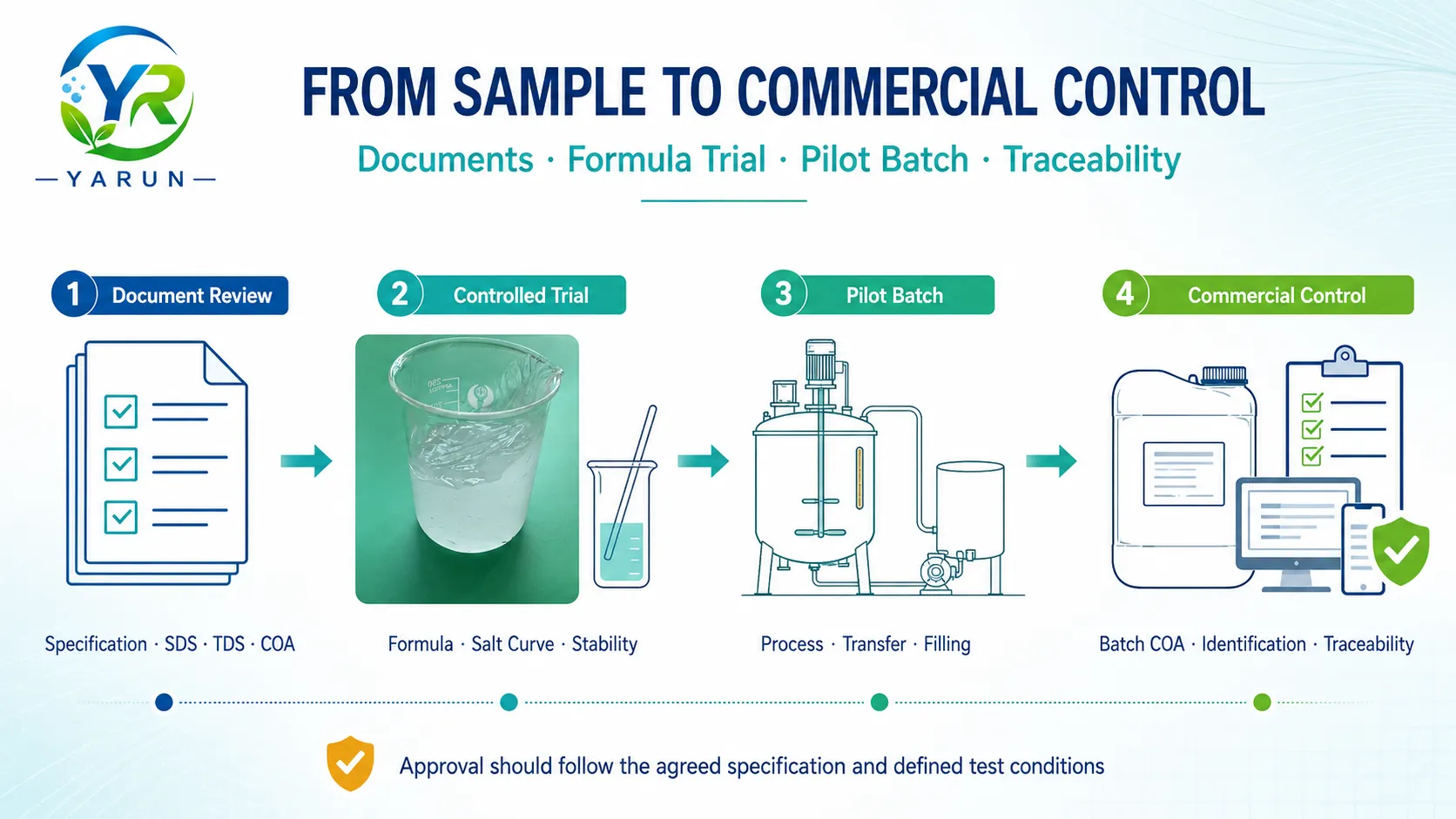
Stage 1: Document Review
Confirm:
Product identity
Approved specification
Current TDS
Current SDS
Representative COA
Packaging information
Storage and handling guidance
Country-specific documentation requirements
Stage 2: Incoming Sample Review
Record:
Supplier and sample code
Batch number
Appearance
Odor
Physical consistency
COA results
Packaging condition
Date received
Storage conditions
Stage 3: Controlled Formulation Comparison
Use the same:
Formula
Raw-material active-matter basis
Water
Equipment
Addition sequence
Mixing conditions
Batch size
Test temperature
Measurement methods
Compare:
Dilution behavior
Mixing time
Foam and air incorporation
pH
Viscosity development
Salt curve
Clarity
Fragrance compatibility
Cleaning performance
Stability
Stage 4: Pilot-Batch Verification
Confirm that the selected process can be repeated with production equipment.
Assess:
Transfer
Pumping
Batch time
Mixing uniformity
Foam control
Filling behavior
Finished-product consistency
Retained samples
Stage 5: Commercial-Batch Control
Link the supplied material to:
Purchase specification
Batch COA
Batch identification
Incoming inspection
Finished-product batch record
Complaint and traceability procedure
14. Information to Send Before Requesting a Recommendation
A request stating only “Please quote SLES 70%” is sufficient for an indicative price discussion, but it is not sufficient for a meaningful technical or commercial comparison.
For a more useful review, provide:
Target country
Finished-product type
Existing or planned formula structure
Required SLES specification
Expected raw-material quantity
Required packaging
Destination port
Production equipment
Current dilution or viscosity problem
Target finished-product viscosity
Foam requirement
Water quality where known
Other surfactants in the system
Fragrance or solvent level where relevant
Required documents
Target production or launch date
This information helps distinguish a simple bulk-price request from a formulation or supplier-change project.
15. How YARUN Supports SLES 70% Projects
YARUN supplies SLES 70% for liquid detergent, dishwashing liquid, liquid soap and household-cleaning applications, subject to the approved product specification and project requirements.
Support can include:
Product-specification confirmation
Sample availability confirmation
Batch COA
English SDS
TDS
Packaging confirmation
Bulk quotation
Export-document coordination
Comparison of active-matter and commercial requirements
Coordination of sample and formulation-review requirements
Final formulation suitability depends on the complete formula, processing equipment, water quality, target market and completed trials.
YARUN does not treat a laboratory-scale sample, a supplier specification or a single fresh-product result as proof of commercial repeatability.
16. Request an SLES Formula and Cost Review
If you are evaluating SLES 70% for a new detergent, changing suppliers or troubleshooting an existing formulation, send YARUN:
Target application
Required specification
Current surfactant system
Target active matter
Viscosity and foam objectives
Main formulation problem
Packaging requirement
Expected order quantity
Destination country and port
Required documents
YARUN can review the project information, identify the appropriate comparison route and coordinate specification, sample, documentation and quotation requirements.
Request an SLES Formula and Cost Review
Frequently Asked Questions
What does SLES 70% mean?
SLES 70% is a commercial concentrated Sodium Laureth Sulfate grade. The exact contractual active-matter range should be confirmed in the approved specification. YARUN’s current standard control range is 68–72%.
How does SLES remove oily soil?
SLES adsorbs at interfaces, lowers interfacial tension and forms aggregates such as micelles in water. These behaviors support wetting, soil detachment and dispersion as part of the complete detergent system.
Does more SLES always improve cleaning?
No. Cleaning depends on the complete formula, soil, dosage, water, temperature and mechanical action. Beyond the required level, adding more SLES may increase cost or change viscosity and rinsing without delivering a proportional performance improvement.
Why does SLES 70% form gel during dilution?
Concentrated SLES–water systems can pass through highly structured concentration regions during dilution. Their rheology changes with concentration, temperature and composition, which can produce temporary high-viscosity or gel-like phases.
Does adding more salt always increase viscosity?
No. Many SLES-based systems follow a formulation-specific salt curve. Viscosity may rise toward a peak and then decline when additional electrolyte is added.
Why is the same salt quantity unreliable in different formulas?
Co-surfactants, fragrance, solvents, active matter, pH, water quality, temperature and the raw material’s existing inorganic-salt content can shift the salt response.
Is foam a measure of cleaning performance?
Not by itself. Foam is an important product attribute in some applications, but cleaning must be evaluated against representative soil under controlled conditions.
Can SLES 70% be replaced kilogram for kilogram with SLES 28%?
No. Active matter, water contribution, handling and processing are different. The formula must be recalculated and tested.
What should buyers check on an SLES COA?
Check the parameters required by the approved specification, including active matter, pH, unsulfated matter, sodium sulfate, color and other agreed tests. Confirm that the COA is linked to the supplied batch.
Can YARUN provide SLES 70% documents and bulk quotations?
YARUN can provide or coordinate the applicable product specification, batch COA, English SDS, TDS, packaging confirmation and bulk quotation according to the confirmed project and order requirements.
Conclusion
SLES 70% is more than a high-foaming detergent ingredient.
Its commercial value comes from the interaction between:
Interfacial activity
Micelle formation
Active-matter concentration
Dilution behavior
Salt response
Co-surfactant selection
Water quality
Temperature
Processing
Raw-material consistency
Finished-product validation
The most important formulation lesson is that SLES behavior is not linear.
More SLES does not automatically mean proportionally more cleaning. More salt does not always mean more viscosity. A successful fresh sample does not automatically prove storage stability or commercial repeatability.
Manufacturers should define the product objective, qualify the raw material, build a controlled salt curve, compare samples on an active-matter basis and verify the final formula under actual production and use conditions.
YARUN connects SLES 70% product supply with specification review, batch documentation, sample coordination, packaging and export quotation support.