LABSA 96% can provide a high concentration of anionic surfactant precursor at a commercially competitive cost. However, it is not a ready-to-use neutral detergent ingredient.
It is an acidic industrial raw material that normally needs to be converted into a suitable Linear Alkylbenzene Sulfonate salt before or during detergent manufacture.
That conversion creates several practical questions:
- Which alkali should be used?
- How much alkali is theoretically required?
- How should raw-material purity be included in the calculation?
- How can reaction heat and local pH extremes be controlled?
- Why can two LABSA batches produce different color, viscosity or stability?
- Should LABSA offers be compared by price per metric ton or by usable active matter?
- What must be verified before commercial production?
These questions matter because neutralization is not merely a pH-adjustment step. It changes the chemical form of the material and influences the finished formulation’s active matter, counterion, electrolyte load, viscosity, appearance, stability, processing behavior and total cost.
This guide connects LABSA chemistry with practical formulation, troubleshooting and procurement decisions.
1. What Is LABSA 96%?
LABSA stands for Linear Alkylbenzene Sulfonic Acid. It is the acid form of a widely used anionic surfactant system.
A commercial LABSA 96% grade is normally supplied as a brown viscous liquid. The grade designation indicates high active matter, but it does not mean that every shipment contains exactly 96.00% of one pure molecular species.
Commercial LABSA is associated with a distribution of linear alkyl chain lengths and phenyl positions. Its quality profile can also include controlled quantities of:
- Water
- Free sulfuric acid
- Unsulfonated matter or free oil
- Color-forming components
- Other process-related constituents
YARUN’s current LABSA 96% product page identifies the following commercial parameters:
| Parameter | Current product information |
|---|---|
| Product | LABSA 96% |
| Chemical name | Linear Alkyl Benzene Sulphonic Acid |
| Chemical type | Acid-form anionic surfactant |
| Appearance | Brown viscous liquid |
| Active matter | ≥96% |
| Packaging | 220 kg HDPE drum; IBC or customized packaging subject to confirmation |
| China export HS reference | 3402310000 |
Free sulfuric acid, unsulfonated matter, water and color should be confirmed against the approved purchase specification and batch Certificate of Analysis.
The product page provides the commercial supply route. This article explains what happens during neutralization and why the result must be verified in the intended detergent system.
2. LABSA and LAS Are Not the Same Material
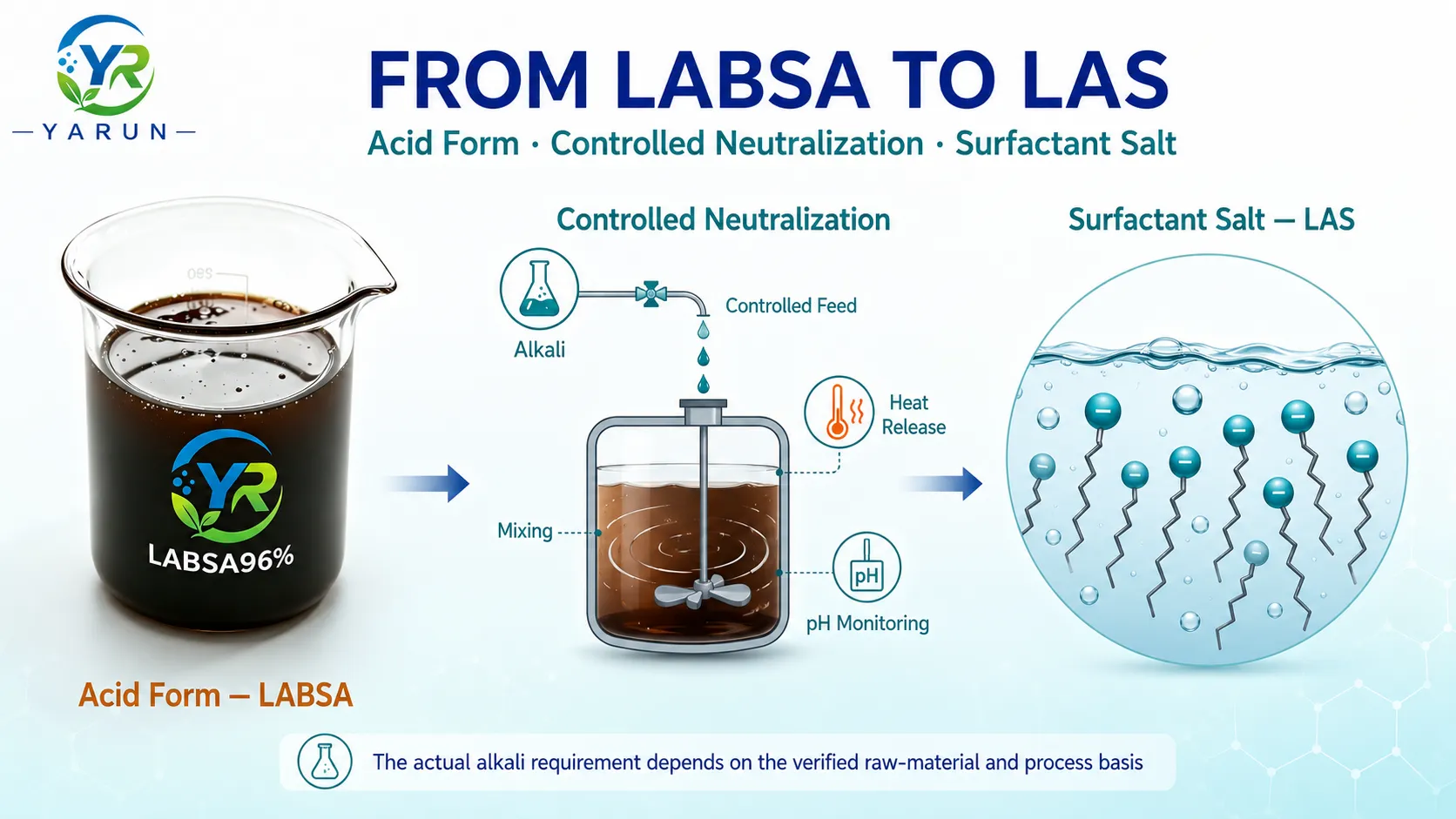
LABSA is the sulfonic-acid form. LAS is the Linear Alkylbenzene Sulfonate formed after neutralization with a suitable base.
A simplified reaction using sodium hydroxide is:
LABSA + NaOH → Sodium Linear Alkylbenzene Sulfonate + Water
This equation expresses the main acid–base reaction. Commercial processing is more complex because the LABSA grade is a mixture and may contain free sulfuric acid, water and unsulfonated matter.
After sodium neutralization, the surface-active product is commonly described as sodium LAS.
Different bases can produce different counterion forms. For example:
- Sodium hydroxide produces a sodium sulfonate;
- Potassium hydroxide produces a potassium sulfonate;
- Suitable amines can produce corresponding amine salts.
These salts should not automatically be treated as interchangeable. The counterion can influence:
- Solubility
- Viscosity
- Electrolyte balance
- Processing
- Finished-product form
- Cost
- Regulatory and application suitability
The neutralizing agent should therefore be selected according to the finished product and validated process—not solely according to the lowest alkali price.
3. Why Neutralization Requires Process Control
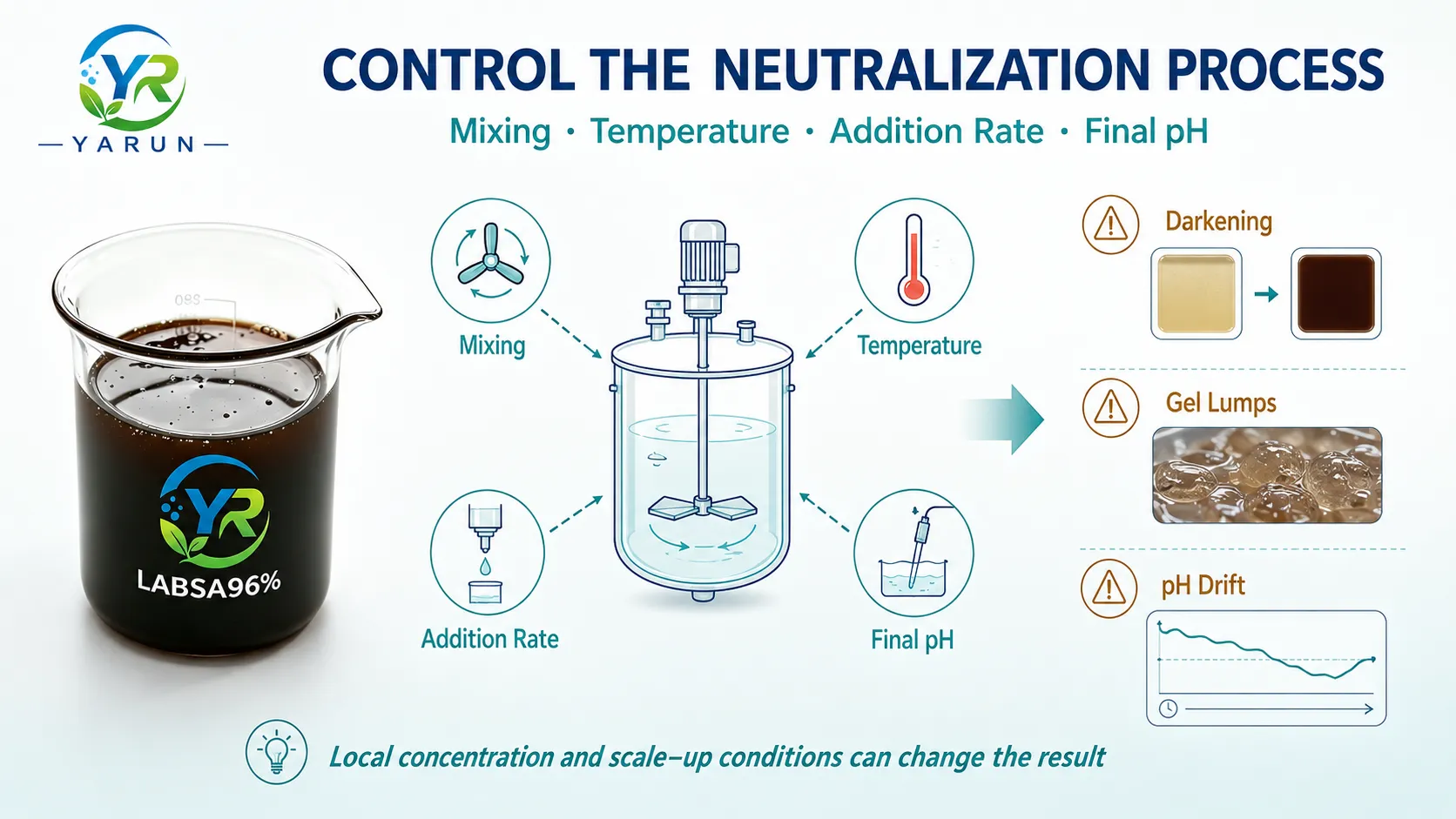
Sulfonic-acid neutralization releases heat. If the acid and alkali meet at excessive local concentration, the reaction zone may become much hotter or more alkaline than the average batch measurement suggests.
Possible consequences include:
- Localized overheating
- Darkening
- Scorched or degraded material
- Gel particles or non-uniform regions
- Alkali-rich zones
- Acid-rich zones
- Delayed pH drift
- Inconsistent viscosity
- Poor incorporation of other ingredients
- Increased rework risk
A single final pH measurement cannot reconstruct what occurred during the process.
A suitable manufacturing procedure should define:
- Initial liquid charge where applicable
- Neutralizing-agent concentration
- Addition sequence
- Addition rate
- Agitator type and mixing intensity
- Batch temperature
- Temperature limit and cooling capacity
- Sampling locations
- pH measurement method
- Equilibration time
- Final neutralization range
- Timing of other surfactant and additive additions
There is no universal addition sequence, alkali concentration or temperature limit that can safely be copied into every formulation. The correct method depends on the formula, batch size, vessel, agitation, heat removal and selected raw materials.
4. Calculating the Theoretical Alkali Requirement
Neutralization should begin with a chemical-equivalent calculation, not with a fixed “kilograms of caustic soda per drum” rule.
For a defined LABSA material, the simplified theoretical relationship is:
Pure alkali required = Acid-active quantity × Alkali equivalent weight ÷ LABSA equivalent weight
For an alkali solution:
Alkali solution required = Pure alkali required ÷ Alkali mass fraction
The acid-active quantity depends on:
LABSA charge × confirmed acid-active fraction
However, a reliable calculation requires more than the trade name “LABSA 96%.” The formulator must confirm:
- Applicable analytical basis;
- Average or specified equivalent weight;
- Active-matter definition;
- Free sulfuric acid;
- Alkali identity;
- Alkali assay;
- Required neutralization endpoint;
- Whether another acidic ingredient is present;
- Whether the process deliberately targets complete or partial neutralization.
Free sulfuric acid also consumes alkali. A calculation based only on nominal LABSA active matter can therefore differ from the actual batch demand.
Why This Article Does Not Give a Universal NaOH Ratio
A fixed ratio would require assumptions about molecular distribution, acid value, free sulfuric acid, LABSA purity and caustic-soda concentration.
Those assumptions may not match the supplied batch or manufacturing process.
The correct workflow is:
- Obtain the approved LABSA specification and batch COA;
- Confirm the agreed calculation basis;
- Confirm the alkali assay;
- Calculate a theoretical starting requirement;
- Apply the validated manufacturing procedure;
- Approach the target carefully;
- Allow adequate mixing and equilibration;
- Verify the result using the defined pH method;
- Confirm finished-product stability and performance.
The theoretical calculation is a starting control. It is not proof that the commercial batch has been processed correctly.
5. Active Matter Does Not Remain Numerically Unchanged
A common procurement error is assuming that 1 metric ton of LABSA 96% automatically becomes 1 metric ton of a 96% LAS product.
Neutralization adds:
- The neutralizing-agent mass;
- Water contained in the alkali solution;
- Reaction water;
- Any process water or other ingredients.
The mass of the neutralized system therefore increases, while the concentration of surfactant active in the total neutralized mixture depends on the complete mass balance.
To compare different routes, distinguish between:
- LABSA acid-active mass;
- Neutralized LAS active mass;
- Total neutralized paste or solution mass;
- Finished-detergent active matter;
- Total delivered formulation cost.
The exact conversion should use the agreed molecular or equivalent-weight basis and the actual raw-material assays.
A buyer should not compare LABSA, sodium LAS paste and finished detergent bases only by their total product weights.
6. What Final pH Can—and Cannot—Tell You
Final pH is important, but it is not a complete neutralization-control system.
The result can be affected by:
- Sample concentration;
- Water quality;
- Measurement temperature;
- Electrode suitability;
- Calibration;
- Time after mixing;
- Other acids and bases;
- Builders and buffers;
- Carbon dioxide absorption;
- Sampling location.
Two laboratories can report different pH values if they use different dilution or measurement methods.
The purchase specification and manufacturing record should therefore define:
- Whether pH is measured neat or at a stated dilution;
- Dilution water;
- Temperature;
- Equilibration time;
- Instrument calibration;
- Acceptance range.
A pH result within range does not automatically prove:
- Uniform neutralization;
- Suitable color;
- Correct active matter;
- Finished-product stability;
- Absence of localized excess alkali;
- Commercial repeatability.
7. Why the Batch May Darken During Neutralization
Commercial LABSA already has an inherent color profile. Additional darkening during processing may indicate that the process or raw-material combination requires investigation.
Potential variables include:
- LABSA starting color;
- Localized overheating;
- Excessively concentrated reaction zones;
- Slow heat removal;
- Alkali concentration;
- Addition rate;
- Mixing efficiency;
- Metal contamination;
- Water quality;
- Extended high-temperature residence;
- Other formulation ingredients.
Color should be compared using controlled samples and an agreed method. Visual inspection in different containers or lighting conditions can give misleading conclusions.
If a batch darkens, do not adjust several variables simultaneously. Compare controlled trials that isolate:
- Raw-material lot;
- Alkali lot and concentration;
- Addition sequence;
- maximum recorded temperature;
- mixing conditions;
- holding time;
- final pH and measurement method.
8. Why Gel Lumps or Non-Uniform Material Can Form
Gel particles or persistent non-uniform regions can result when LABSA and concentrated alkali meet without adequate dispersion.
Possible causes include:
- Addition too fast for the available mixing;
- Poor feed-point location;
- Inadequate agitation;
- Local excess alkali;
- Insufficient initial liquid phase;
- Low or inappropriate processing temperature;
- Interaction with electrolytes or other surfactants;
- Insufficient equilibration time;
- Incorrect order of addition.
The correct response is not automatically “mix faster.” Excessive agitation can entrain air or create other processing problems.
The process should be evaluated using:
- Vessel geometry;
- Batch volume;
- Impeller position;
- Feed location;
- circulation pattern;
- viscosity during the reaction;
- heat-transfer capacity;
- addition time;
- scale-up behavior.
Laboratory mixing and production mixing are not geometrically or energetically identical. A procedure that works in a beaker must be verified at pilot and commercial scale.
9. Why pH Can Drift After the Batch Appears Finished
A newly measured batch may appear to meet its target and then change after further mixing or storage.
Possible reasons include:
- Incomplete bulk mixing;
- Acid- or alkali-rich pockets;
- Slow dissolution;
- delayed interaction with builders or buffers;
- temperature-dependent measurement;
- sample dilution differences;
- later addition of acidic or alkaline ingredients;
- carbon dioxide absorption;
- electrode or calibration error.
A controlled process should specify when the pH is measured and how long the batch must equilibrate before release.
Where pH affects enzymes, preservatives, polymers, fragrance stability or packaging compatibility, the finished product should also be monitored during stability testing.
10. How LAS Contributes to Cleaning
After neutralization, LAS molecules contain:
- A hydrophobic alkylbenzene region with affinity for oily and non-polar material;
- A hydrophilic negatively charged sulfonate group that interacts with water.
This amphiphilic structure allows LAS to accumulate at water–oil, water–air and water–solid interfaces.
In a complete detergent system, LAS can contribute to:
- Wetting;
- oily-soil detachment;
- particulate-soil removal;
- dispersion;
- emulsification;
- foam;
- reduced rapid redeposition when the formula is properly designed.
Above an applicable concentration region, surfactant molecules can form aggregates such as micelles. These structures help accommodate hydrophobic material in an aqueous wash system.
Cleaning performance is not determined by LAS concentration alone. It also depends on:
- Soil type;
- surface or fabric;
- dosage;
- water hardness;
- temperature;
- mechanical action;
- builders;
- co-surfactants;
- solvents;
- enzymes;
- polymers;
- rinsing conditions.
Foam height should not be used as the only measurement of detergency.
11. Water Hardness and Builder Selection
LAS performance can be influenced by calcium and magnesium ions in hard water.
The complete formula may use builders, chelating agents or other strategies to manage water hardness and support surfactant efficiency.
The correct approach depends on:
- Intended market;
- expected water hardness;
- product format;
- environmental and regulatory requirements;
- cleaning objective;
- cost target;
- other ingredients.
A formula developed only with deionized water may not represent consumer-use conditions.
Testing should include water conditions relevant to the destination market, particularly where water quality varies substantially between regions.
12. Combining Neutralized LABSA With Other Surfactants
Neutralized LABSA is frequently used as part of a surfactant system.
LABSA and SLES
SLES may be evaluated when the formulation requires changes in:
- Foam profile;
- liquid-processing flexibility;
- viscosity response;
- application experience;
- surfactant balance.
The combination must be evaluated on an active-matter basis. One kilogram of LABSA acid and one kilogram of SLES 70% do not provide the same water contribution, chemical form or processing demand.
See the SLES 70% product route when comparing concentrated anionic surfactants.
LABSA and AOS
AOS may be evaluated when foam profile, application conditions or surfactant diversification is required.
The correct ratio depends on active matter, water quality, finished-product objective and cost. It should not be inferred from the trade names alone.
LABSA and Nonionic Surfactants
Nonionic surfactants may improve performance against selected oily soils and can change foam, clarity and low-temperature behavior.
They can also influence:
- Viscosity;
- solubilization;
- cloud behavior;
- fragrance compatibility;
- total active cost.
LABSA and Amphoteric Co-Surfactants
Amphoteric surfactants such as CAPB may be evaluated to modify foam character, rheology and application properties.
The effect depends on pH, electrolyte load, active-matter ratio and other ingredients. Compatibility must be tested after LABSA neutralization is under control.
The wider commercial matrix is available through YARUN’s detergent surfactant raw-material category.
13. Application-Specific Decisions
Laundry Detergent Powder
LABSA may be neutralized within an appropriate powder-detergent process or converted through another validated route.
Important considerations include:
- Neutralizing agent;
- moisture balance;
- builder system;
- powder structure;
- agglomeration;
- flowability;
- bulk density;
- storage stability;
- compatibility with other components.
A liquid-neutralization procedure should not automatically be transferred to a powder process.
Liquid Laundry Detergent
The formulator should evaluate:
- Neutralization control;
- total active matter;
- electrolyte load;
- clarity or opacity target;
- viscosity;
- builder compatibility;
- enzymes;
- polymers;
- fragrance;
- preservative;
- storage temperature;
- transport stability.
A freshly prepared uniform liquid does not prove long-term stability.
Hand-Dishwashing Liquid
Relevant decisions include:
- grease-removal target;
- foam under soil load;
- viscosity;
- clarity;
- rinsing;
- fragrance compatibility;
- hand-use safety strategy;
- cost per usable dose.
Finished-product safety cannot be established from LABSA identity alone.
Multipurpose and Degreasing Cleaners
Selection should consider:
- target surface;
- soil type;
- alkalinity;
- contact time;
- rinsing or wiping;
- solvent system;
- foam requirement;
- material compatibility;
- occupational exposure;
- applicable labeling.
A stronger alkaline system is not automatically better for every surface.
14. Diagnosing Common LABSA Formulation Problems
| Observation | Variables to investigate |
|---|---|
| Final pH remains too low | Alkali assay, calculation basis, free sulfuric acid, addition completeness, mixing and sampling |
| Final pH overshoots | Alkali quantity, feed control, local concentration, delayed equilibration and measurement method |
| pH changes after standing | Mixing uniformity, temperature, buffers, delayed ingredient interactions and sampling |
| Batch becomes darker | Starting color, peak temperature, local overheating, residence time, contamination and addition rate |
| Gel particles remain | Feed location, mixing, concentration gradients, order of addition and electrolyte interaction |
| Product remains thin | Total active matter, surfactant ratio, electrolyte balance, temperature and neutralization result |
| Product becomes hazy | pH, fragrance, nonionic surfactant, electrolyte, water hardness, temperature and solubility |
| Product separates during storage | Surfactant balance, neutralization, solvents, builders, polymers, temperature cycle and contamination |
| Foam differs between batches | Active matter, raw-material lots, water quality, co-surfactants, soil load and test conditions |
| Cost exceeds expectation | Alkali and water balance, active yield, processing time, rework, freight and packaging |
Corrective trials should change one controlled variable at a time wherever practical.
15. Quality Parameters Bulk Buyers Should Review
Active Matter
Active matter affects neutralization demand, formula calculation and delivered surfactant value.
The analytical definition and method must be confirmed. Results obtained under different methods should not automatically be treated as equivalent.
Free Sulfuric Acid
Free sulfuric acid consumes alkali and can influence neutralization demand, heat release and processing control.
It should be reviewed against the agreed specification and batch COA.
Unsulfonated Matter or Free Oil
Unsulfonated matter may affect:
- odor;
- appearance;
- detergency;
- foam;
- formulation stability;
- batch consistency.
It is not the same parameter as water or free sulfuric acid.
Water
Water affects the delivered acid-active quantity and the overall process mass balance.
Color
Starting color can influence lightly colored finished detergents. The agreed color method and acceptance limit should reflect the intended application.
Appearance and Uniformity
Incoming inspection should record physical appearance, contamination, phase uniformity and packaging condition.
Batch Identification
Every commercial delivery should be traceable to:
- supplier batch;
- batch COA;
- receipt record;
- incoming inspection;
- production batch;
- retained sample;
- complaint record where applicable.
16. Compare Cost on a Usable-Active Basis
Comparing only price per metric ton can hide differences in active matter, impurities, packaging and processing cost.
A basic acid-active comparison is:
Raw-material cost per metric ton of acid active = Raw-material price per metric ton ÷ confirmed acid-active fraction
For a 96% basis, the divisor is 0.96. The batch COA and contractual specification remain controlling.
A more complete comparison should include:
- LABSA price;
- actual active matter;
- neutralizing agent;
- alkali concentration and delivered water;
- processing water;
- drum or IBC cost;
- freight;
- import charges;
- handling requirements;
- cooling;
- mixing time;
- batch throughput;
- yield;
- rework risk;
- batch consistency;
- document package.
Cost of Neutralized Active
A project-specific calculation should establish:
Total neutralization-route cost ÷ usable neutralized surfactant active
The calculation must use an agreed equivalent-weight and assay basis.
The lowest-priced LABSA offer may not produce the lowest-cost finished detergent if it creates:
- higher alkali demand;
- longer processing;
- darker product;
- inconsistent viscosity;
- stability failures;
- extra rework;
- lower commercial yield.
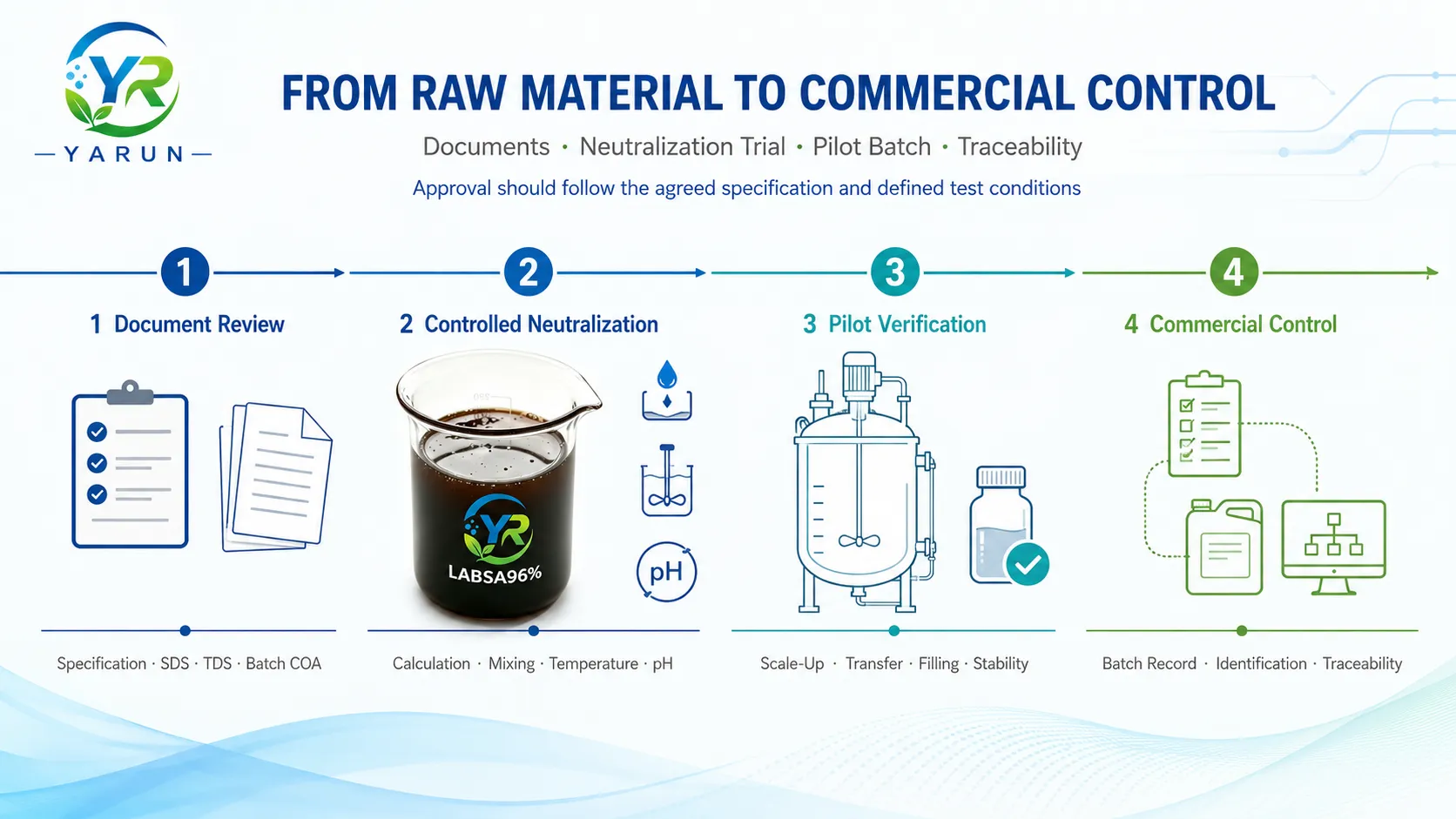
17. A Better LABSA Qualification Program
Stage 1: Document Review
Confirm:
- Product identity;
- approved specification;
- current TDS;
- current SDS;
- representative COA;
- analytical methods;
- packaging;
- storage and handling guidance;
- destination-market requirements.
Stage 2: Incoming Sample Review
Record:
- supplier;
- sample code;
- batch number;
- appearance;
- color;
- odor;
- physical consistency;
- packaging condition;
- COA results;
- date received;
- storage conditions.
Stage 3: Controlled Neutralization Study
Keep constant:
- batch size;
- water;
- alkali identity and assay;
- equipment;
- agitation;
- addition sequence;
- addition rate;
- temperature-control method;
- sampling;
- pH method.
Record:
- theoretical alkali requirement;
- actual addition;
- temperature profile;
- mixing time;
- pH after defined equilibration;
- color;
- appearance;
- uniformity;
- neutralized active calculation.
Stage 4: Controlled Formulation Comparison
Compare:
- active-matter basis;
- viscosity;
- clarity;
- foam under relevant conditions;
- cleaning against representative soils;
- water-hardness response;
- fragrance compatibility;
- storage stability;
- temperature-cycle behavior;
- packaging compatibility.
Stage 5: Pilot Verification
Confirm:
- feed control;
- mixing;
- cooling;
- transfer;
- batch time;
- sampling;
- filling;
- cleaning procedure;
- operator safety;
- finished-product consistency.
Stage 6: Commercial-Batch Control
Link:
- purchase specification;
- LABSA batch COA;
- alkali batch and assay;
- manufacturing record;
- temperature and pH records;
- finished-product tests;
- batch identification;
- retained samples;
- traceability.
18. Information to Send Before Requesting a Recommendation
For a useful technical and commercial review, provide:
- Target country;
- finished-product type;
- current or planned formula structure;
- required LABSA specification;
- expected quantity;
- packaging requirement;
- destination port;
- preferred Incoterm;
- neutralizing agent;
- alkali concentration where known;
- batch size;
- production equipment;
- current neutralization procedure;
- target finished-product pH;
- viscosity and appearance objectives;
- water quality;
- other surfactants;
- current processing or stability problem;
- required technical documents;
- target production date.
This information distinguishes a bulk-price inquiry from a neutralization, supplier-change or formulation-development project.
19. How YARUN Supports LABSA 96% Projects
YARUN supplies LABSA 96% for detergent-manufacturing applications, subject to the approved specification and confirmed project requirements.
Available project support can include:
- Product-specification confirmation;
- sample availability confirmation;
- batch COA;
- English SDS;
- TDS;
- packaging confirmation;
- bulk quotation;
- active-matter and commercial comparison;
- export-document coordination;
- coordination of sample and formulation-review requirements.
Final suitability depends on:
- raw-material specification;
- alkali and neutralization method;
- complete formulation;
- processing equipment;
- water quality;
- destination market;
- completed trials.
A supplier specification, calculated alkali quantity or successful fresh sample should not be treated as proof of commercial repeatability.
20. Request a LABSA Neutralization and Cost Review
If you are evaluating LABSA 96% for a new detergent, changing suppliers or troubleshooting an existing neutralization process, send YARUN:
- Target application;
- required specification;
- current formulation;
- neutralizing agent;
- target pH;
- main processing or stability problem;
- required packaging;
- expected order quantity;
- destination country and port;
- required documents.
YARUN can review the information and coordinate the appropriate specification, sample, document and quotation route.
Request a LABSA Neutralization and Cost Review
Frequently Asked Questions
What is the difference between LABSA and LAS?
LABSA is the sulfonic-acid raw material. LAS is the Linear Alkylbenzene Sulfonate formed after LABSA is neutralized with a suitable base.
Can LABSA 96% be added directly to a finished neutral detergent?
LABSA normally requires controlled neutralization. The method should be designed by qualified personnel for the actual formula, equipment and safety requirements.
How much sodium hydroxide is required to neutralize LABSA 96%?
The amount depends on LABSA active matter, equivalent-weight basis, free sulfuric acid, sodium-hydroxide assay and target neutralization. A universal fixed ratio should not replace a verified calculation and controlled trial.
Why does LABSA neutralization release heat?
Neutralization is an acid–base reaction and is exothermic. Addition rate, concentration, mixing and cooling must be controlled.
Why can LABSA become darker during processing?
Possible causes include starting raw-material color, localized overheating, concentrated reaction zones, residence time, contamination and other formulation ingredients.
Is final pH enough to confirm successful neutralization?
No. pH is important, but uniformity, temperature history, active matter, color, appearance and finished-product performance should also be evaluated.
Does 1 MT of LABSA 96% produce 1 MT of LAS?
No. Neutralization adds alkali and may add water. The total neutralized mass and active concentration depend on the complete mass balance and chemical-equivalent basis.
Can LABSA be combined with SLES?
Yes, after appropriate neutralization and compatibility evaluation. The materials should be compared on an active-matter basis and tested in the complete formulation.
Is higher foam proof of better cleaning?
No. Foam is an application attribute, while cleaning performance depends on soil, dosage, water, temperature, mechanical action and the complete formulation.
What should buyers check on a LABSA COA?
Review the parameters required by the approved specification, including active matter, free sulfuric acid, unsulfonated matter or free oil, water, color and other agreed tests.
How should two LABSA offers be compared?
Compare acid-active cost, impurity profile, neutralizing-agent demand, packaging, freight, processing, batch consistency, rework risk and usable finished-product yield.
Can YARUN provide LABSA documents and bulk pricing?
YARUN can provide or coordinate the applicable specification, batch COA, English SDS, TDS, packaging confirmation and bulk quotation according to the confirmed project requirements.
Conclusion
LABSA 96% is not simply a low-cost detergent ingredient.
Its commercial value depends on the complete route from acidic raw material to a controlled neutralized surfactant system.
The critical variables include:
- Acid active;
- free sulfuric acid;
- unsulfonated matter;
- neutralizing agent;
- chemical-equivalent calculation;
- addition sequence;
- mixing;
- heat removal;
- final pH;
- water quality;
- co-surfactants;
- batch consistency;
- commercial validation.
More alkali does not mean better neutralization. A final pH result does not prove uniform processing. A successful beaker sample does not prove production-scale repeatability. The lowest LABSA price per metric ton does not necessarily produce the lowest finished-detergent cost.
Manufacturers should qualify the raw material, calculate on a verified basis, control the neutralization process and validate the complete formula under actual production, storage and use conditions.