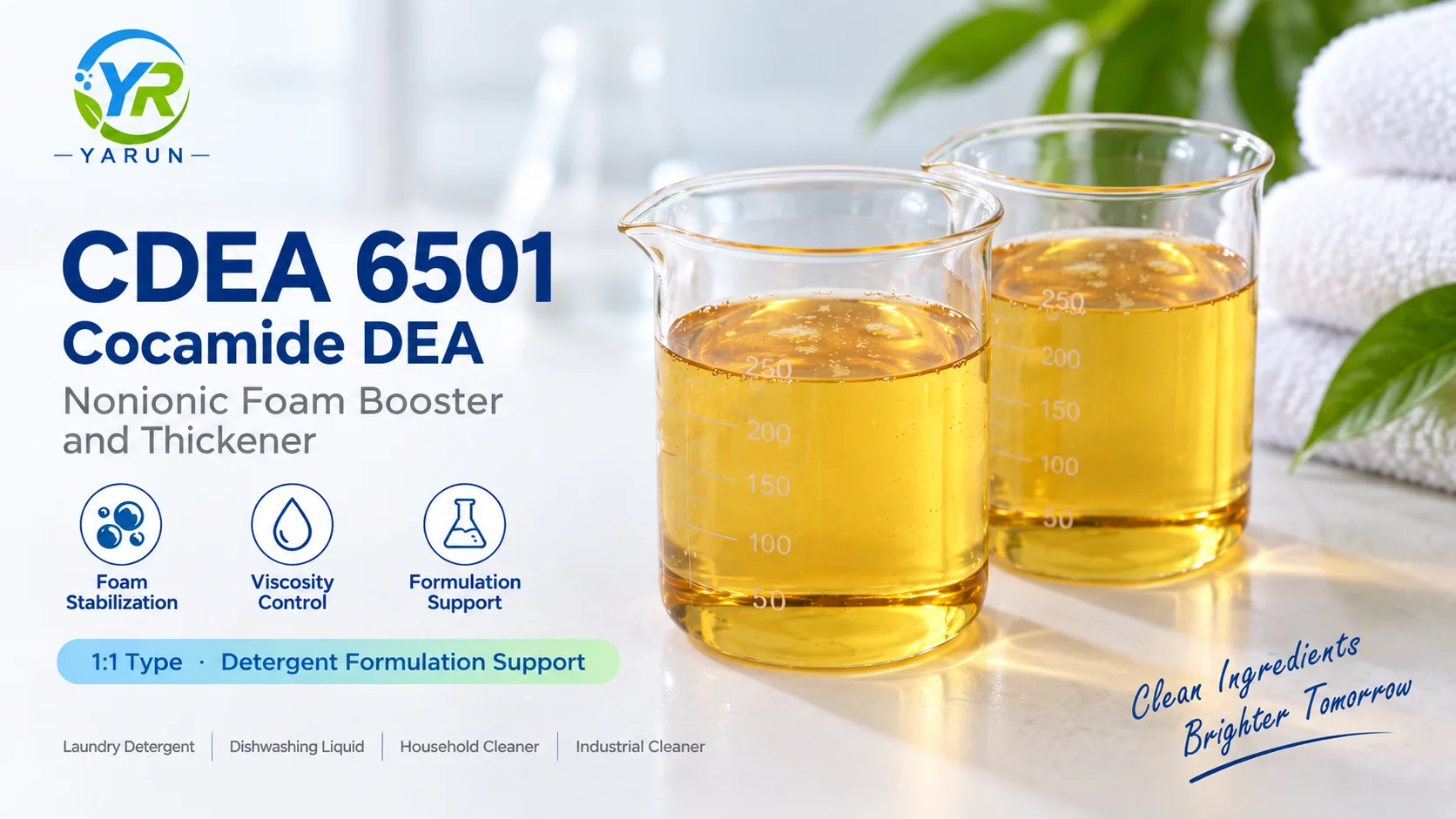
CDEA 6501 is often introduced to detergent manufacturers as a foam booster or thickener.
Both descriptions are useful, but neither fully explains how the ingredient should be evaluated in a commercial formulation.
For a manufacturer or procurement team, the more important questions are:
- What role does CDEA perform inside the complete surfactant system?
- Why can the same CDEA grade produce different viscosity results in different formulas?
- How does its role change when the base system contains SLES, neutralized LABSA/LAS, AOS, SLS or CAPB?
- Why can viscosity remain low even after adding more CDEA?
- How should laboratory performance be verified before commercial production?
- Which purchasing parameters matter beyond price per metric tonne?
CDEA should therefore be treated as a formulation-support ingredient whose performance depends on the complete system, rather than as a universal shortcut for increasing foam or viscosity.
Manufacturers comparing the wider roles of SLES, LABSA, AOS, SLS, CAPB and CDEA should first review the detergent surfactant selection guide.
1. What Is CDEA 6501 Doing in a Liquid Detergent?
CDEA, commonly referred to as Cocamide DEA or Coconut Diethanolamide, is generally used as a nonionic co-surfactant and formulation-support ingredient rather than as the principal source of detergency.
Depending on the formulation, CDEA may support:
- foam stability;
- viscosity development;
- product body;
- wetting;
- compatibility within the surfactant system;
- processing flexibility.
This distinction is commercially important.
A buyer should not compare one kilogram of CDEA directly with one kilogram of SLES, AOS or SLS as though they perform the same function.
The better question is:
What functional contribution does CDEA make to the finished product?
Its commercial value depends on the performance it enables within the complete formulation.
2. Foam Generation and Foam Stability Are Different Functions
Foam generation and foam stability should not be treated as the same thing.
Primary anionic surfactants such as SLES, AOS or SLS can provide strong foam generation when air is introduced through mixing, washing or mechanical action.
CDEA is usually evaluated for a supporting role.
When incorporated into a compatible surfactant system, it can alter the overall foam response of the formulation. Depending on the composition and use conditions, manufacturers may observe:
- denser foam texture;
- slower foam collapse;
- improved foam persistence;
- a more consistent foam profile during use.
However, this does not mean:
more CDEA = more foam
or:
more foam = better cleaning.
A hand-dishwashing liquid, laundry detergent and industrial cleaner may require very different foam profiles.
The target should therefore be:
foam appropriate for the intended application, rather than maximum foam.
3. Why CDEA Can Support Viscosity Development
CDEA is also frequently described as a detergent thickener.
This description can create an overly simple expectation.
Liquid-detergent viscosity is normally the result of the complete surfactant-water-electrolyte system.
CDEA can modify the overall rheological response of a compatible formulation, but its effect depends on variables including:
- primary surfactant type;
- total surfactant active matter;
- CDEA level;
- electrolyte concentration;
- pH;
- water content;
- other co-surfactants;
- fragrance;
- hydrotropes or solvents;
- temperature;
- order of addition;
- mixing conditions.
For this reason:
CDEA dosage and final viscosity do not follow one universal linear relationship.
Two formulas containing the same nominal CDEA 6501 dosage can produce different viscosity results because the surrounding surfactant system is different.
When viscosity does not meet the target, the formulation should be investigated as a system rather than assuming that the CDEA itself is the only variable.
4. How CDEA Behaves in Different Surfactant Systems
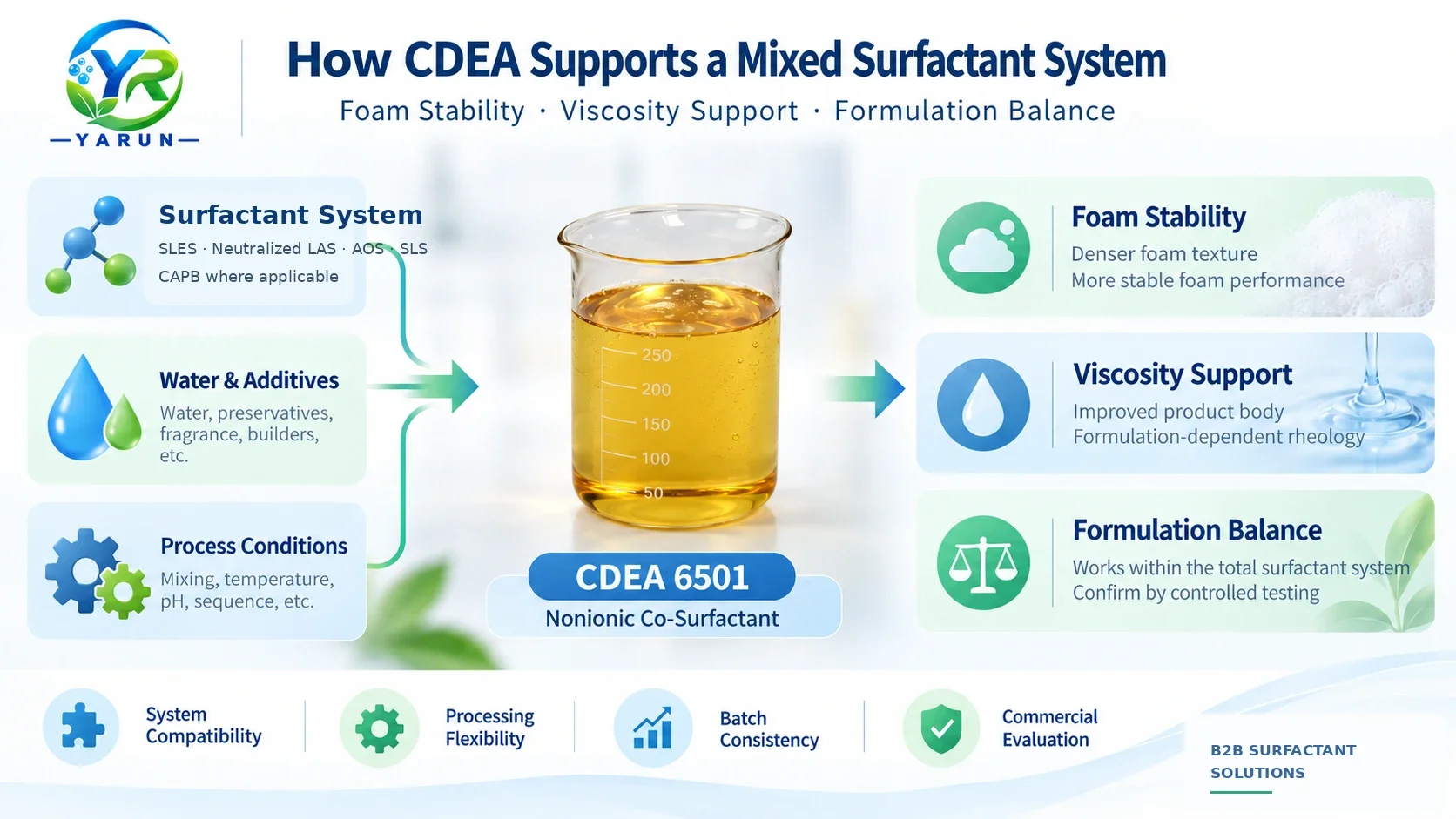
CDEA does not perform identically in every detergent formulation.
Its supporting role should be evaluated according to the base surfactant system.
| Base Surfactant System | Typical CDEA Supporting Role | Key Variables to Control |
|---|---|---|
| SLES | Foam stability and viscosity support | Active matter, CDEA ratio, electrolyte, pH |
| Neutralized LABSA/LAS | Foam and rheology support | Neutralization, final pH, electrolyte, temperature |
| AOS | Foam and viscosity support where compatible | Dissolution, active matter, electrolyte response |
| SLS | Supporting role in selected formulations | Physical form, dissolution and processing |
| CAPB-containing system | Complementary co-surfactant function | Ratio, pH, foam target and finished-product requirement |
SLES-Based Systems
SLES commonly supplies the primary anionic cleansing and foam-generation function.
CDEA may then be evaluated for additional foam stability and viscosity support.
There is no universal SLES:CDEA ratio.
The useful combination depends on:
- finished-product type;
- surfactant active matter;
- salt response;
- target viscosity;
- fragrance;
- cost;
- production process.
For deeper SLES formulation behavior, see YARUN's SLES 70% product information.
Neutralized LABSA/LAS Systems
LABSA is supplied in acidic form and requires appropriate neutralization before the behavior of the resulting LAS-containing detergent system can be evaluated.
Important variables include:
- neutralization procedure;
- alkali selection;
- final pH;
- neutralization temperature;
- water balance;
- electrolyte level;
- CDEA addition point.
The correct question is therefore not simply:
Can CDEA thicken LABSA?
It is:
How does CDEA perform in the final neutralized LAS-containing formulation under the intended processing conditions?
AOS- and SLS-Containing Systems
AOS and SLS may also be used in formulations where CDEA is considered as a supporting ingredient.
However, their physical forms can introduce additional processing variables.
For example, high-active AOS used in a liquid formulation may first require controlled dissolution and compatibility evaluation.
SLS powder or needle grades can introduce their own dissolution, handling and processing considerations.
The final formulation response must therefore be verified experimentally rather than predicted from raw-material names alone.
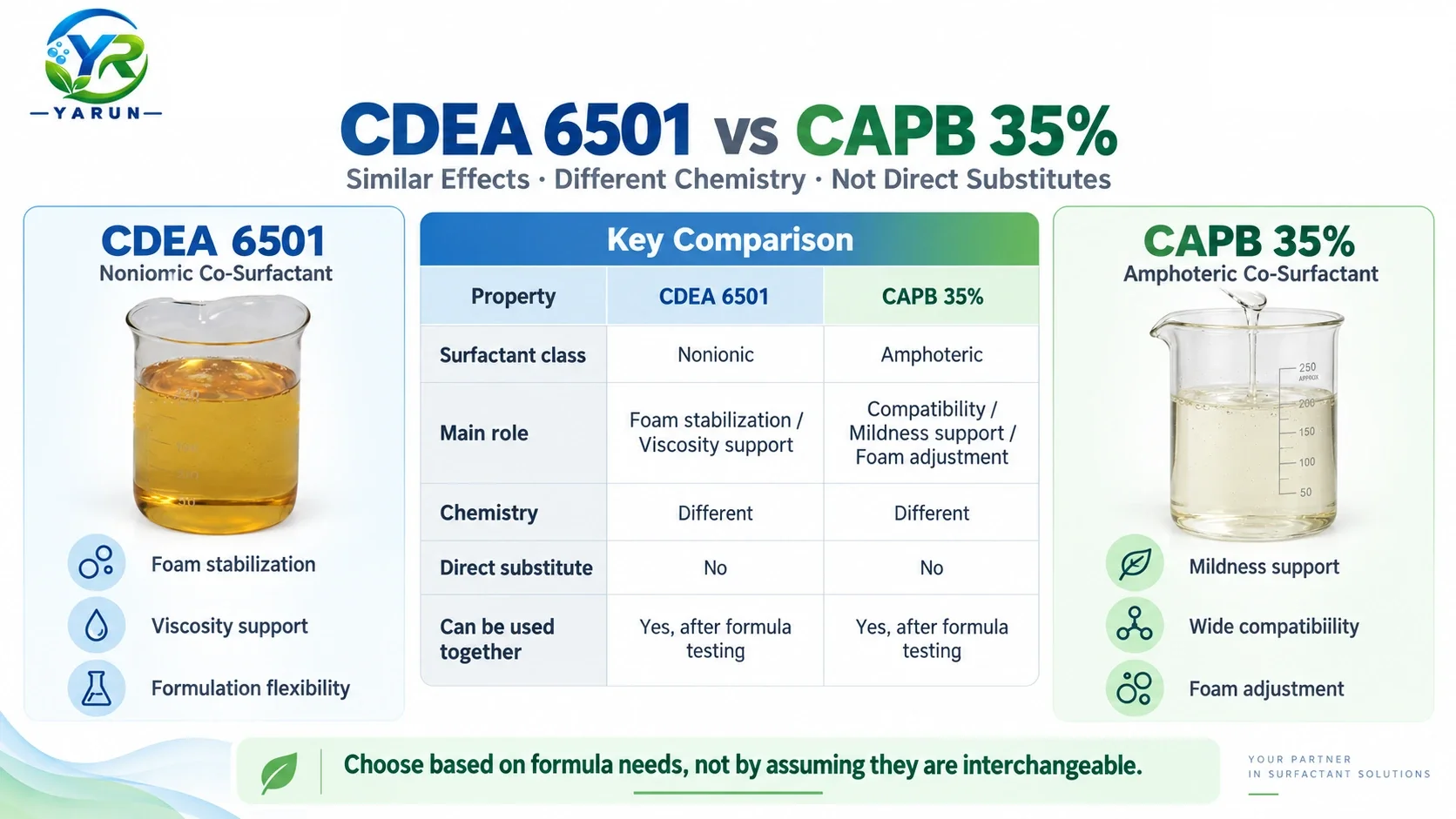
5. CDEA 6501 vs CAPB 35%: Similar Effects, Different Chemistry
CDEA and CAPB sometimes appear in the same purchasing discussion because both can affect foam and viscosity.
They are not equivalent ingredients.
| Decision Factor | CDEA 6501 | CAPB 35% |
|---|---|---|
| Surfactant class | Nonionic co-surfactant | Amphoteric surfactant |
| Typical role | Foam stabilization and viscosity support | Foam modification, compatibility and mildness support |
| Viscosity effect | Formulation-dependent | Formulation-dependent |
| Direct substitute for the other | No | No |
| Can both be used in one system? | Possible after formulation testing | Possible after formulation testing |
CAPB is particularly useful when formulators need to balance anionic surfactants with compatibility, foam quality and mildness requirements.
CDEA is generally evaluated more directly for foam stability and rheology support.
Some formulas may use one.
Some may use both.
Some may require neither.
They should therefore be selected according to the finished-product requirement rather than treated as interchangeable raw materials.
For the amphoteric surfactant mechanism, review How CAPB 35% Works and the CAPB 35% product page.
6. Why Does CDEA Sometimes Fail to Increase Viscosity?
When CDEA is added and the detergent remains too thin, repeatedly increasing CDEA is not a reliable troubleshooting method.
The complete system should be reviewed.
Check the Primary Surfactant System
Confirm:
- actual raw-material grades;
- active matter;
- surfactant ratios;
- batch-to-batch consistency.
A change in the primary surfactant can alter viscosity before the CDEA level is considered.
Check the Electrolyte Level
Salt and other electrolytes can materially change detergent rheology.
Too little electrolyte may leave the system below the useful viscosity range.
Too much electrolyte can also reduce viscosity in some surfactant systems.
Therefore:
adding more salt is not a universal corrective action.
Check pH
Final pH should be measured consistently and compared with the approved formulation target.
This is especially important in systems involving neutralized LABSA or other pH-sensitive components.
Check Fragrance and Solubilization
If viscosity changes after fragrance addition, evaluate:
- fragrance type;
- fragrance dosage;
- solubilization system;
- addition temperature;
- addition sequence;
- electrolyte level;
- final pH.
Do not automatically conclude that fragrance is the only cause.
Check Temperature
Viscosity measured at different temperatures can produce misleading comparisons.
Control:
- raw-material temperature;
- batch temperature;
- cooling conditions;
- measurement temperature.
Check Addition Sequence
Record:
- when CDEA is added;
- when electrolyte is added;
- when fragrance is added;
- neutralization sequence where applicable;
- mixing time between additions.
Check Water Quality
Changes in hardness, dissolved salts or water source can alter the behavior of a surfactant formulation.
Water should therefore be treated as a controlled formulation variable.
7. Controlled Trials Are Better Than Random Formula Changes
A troubleshooting program should change one main variable at a time.
Start with an approved or known baseline.
Then prepare controlled trials.
For example:
Control
Approved formula and approved process.
Trial A
Change the CDEA level only.
Trial B
Keep CDEA constant and change electrolyte only.
Trial C
Keep both constant and change the addition sequence only.
For each batch, record:
- raw-material batch numbers;
- actual weights;
- water source;
- mixing speed;
- mixing time;
- temperature;
- order of addition;
- pH;
- viscosity;
- appearance;
- foam;
- storage conditions.
The objective is not simply to identify the thickest sample.
The objective is to identify a repeatable and commercially workable formulation window.
8. Evaluate Foam and Viscosity Together with Stability
A formula can look acceptable immediately after production and still fail during storage or distribution.
CDEA evaluation should therefore include more than initial foam and viscosity.
Depending on the finished product, manufacturers may also evaluate:
- viscosity drift;
- phase separation;
- cloudiness;
- sediment;
- color change;
- odor change;
- temperature-related changes;
- packaging compatibility;
- performance after storage.
A formulation that reaches the required viscosity at the end of mixing but later separates is not commercially successful.
9. Laboratory Success Must Be Confirmed at Larger Scale
A laboratory beaker and a commercial mixing tank do not provide identical processing conditions.
Scale-up can change:
- mixing energy;
- shear;
- addition speed;
- heat transfer;
- neutralization control;
- aeration;
- holding time;
- cooling rate.
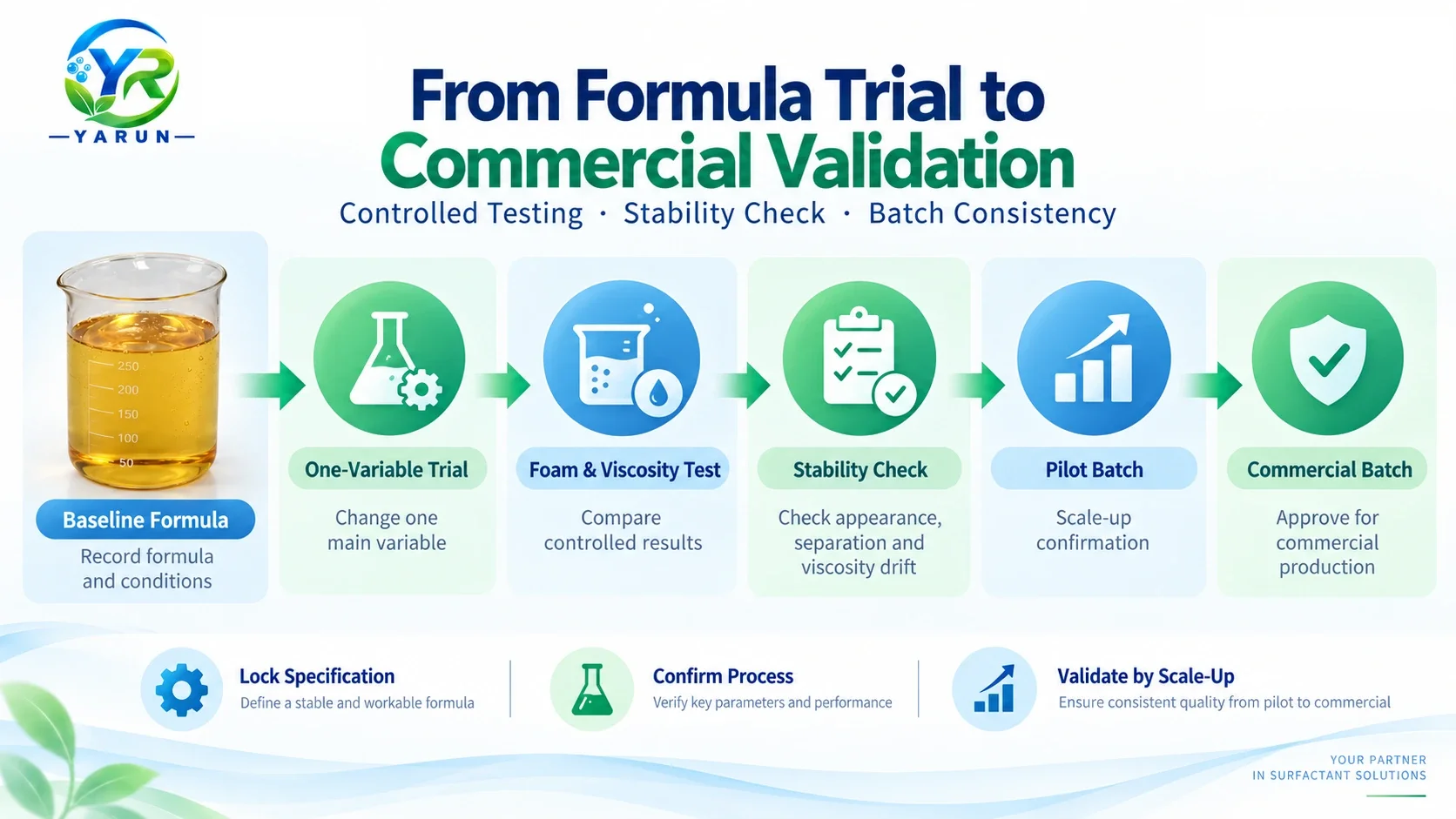
After selecting a laboratory formulation, compare:
Baseline Formula → Controlled Trial → Performance Test → Stability Check → Pilot Batch → Commercial Batch
Record the same key parameters at each stage.
This makes it easier to determine whether a difference is caused by:
- raw-material variation;
- formula design;
- processing;
- scale-up;
- equipment;
- storage.
10. Which CDEA Specifications Matter to Procurement Teams?
A purchase decision should not be based only on the commercial name:
CDEA 6501
Two suppliers may use similar product names while controlling different specifications or impurity parameters.
Before supplier qualification, procurement teams should confirm the applicable specification for:
- commercial grade or type;
- appearance;
- amide-related specification;
- amine-related control;
- water;
- pH;
- color;
- free fatty acid where applicable;
- other grade-specific impurities;
- packaging;
- storage conditions;
- batch identification.
The document package may also include:
- approved product specification;
- Technical Data Sheet;
- Safety Data Sheet;
- representative or batch-specific Certificate of Analysis;
- packaging information;
- sample information.
Grade-specific numerical specifications should always be confirmed against the current approved supplier specification and applicable batch COA rather than taken from a general technical article.
11. Technical Suitability and Regulatory Suitability Are Different Questions
A CDEA grade can perform technically in a formulation while still requiring separate regulatory review for a particular market or product category.
This is particularly important for applications involving:
- repeated skin contact;
- personal-care products;
- regulated consumer categories;
- customer-specific restricted-substance programs.
Before commercialization, confirm:
- supplied product identity;
- relevant impurity controls;
- intended application;
- destination market;
- applicable local requirements;
- customer-specific requirements;
- finished-product safety obligations.
A successful detergent formulation trial should therefore not be interpreted as automatic approval for every other application or destination market.
12. Do Not Compare CDEA Only by Price per Metric Tonne
Primary surfactants are often compared partly through active-matter economics.
For a co-surfactant such as CDEA, unit price alone gives an incomplete picture.
A more useful question is:
What is the functional cost of achieving the required finished-product result?
Compare:
- required CDEA dosage;
- target viscosity;
- foam profile;
- requirement for other rheology-support ingredients;
- processing time;
- adjustment or rework;
- batch consistency;
- stability;
- delivered raw-material cost.
A cheaper grade can become more expensive if it requires:
- higher dosage;
- additional formulation adjustment;
- longer production time;
- additional rheology aids;
- rework;
- rejected product.
Procurement should therefore connect raw-material price with finished-formula economics.
13. A Practical CDEA 6501 Evaluation Workflow
Step 1 — Define the Finished Product
Confirm the intended product:
- liquid laundry detergent;
- hand-dishwashing liquid;
- household cleaner;
- liquid soap;
- industrial cleaner;
- other relevant formulation.
Step 2 — Establish the Baseline
Record:
- current formula;
- primary surfactants;
- active matter;
- pH;
- viscosity;
- foam;
- fragrance;
- electrolyte;
- current cost.
Step 3 — Define CDEA's Required Function
Determine whether the project mainly requires:
- foam stability;
- viscosity support;
- processing improvement;
- a combination of functions.
Step 4 — Run Controlled Trials
Change one principal variable at a time.
Step 5 — Evaluate Finished Performance
Review:
- appearance;
- pH;
- viscosity;
- foam;
- stability;
- fragrance compatibility;
- relevant cleaning performance.
Step 6 — Compare Functional Cost
Evaluate the cost of the complete formulation rather than raw-material price alone.
Step 7 — Conduct Scale-Up Verification
Confirm that the laboratory result can be reproduced using the intended production process.
Step 8 — Lock the Approved Specification and Process
Commercial purchasing should reference:
- approved raw-material specification;
- approved formulation;
- approved process parameters;
- batch documentation;
- agreed quality requirements.
14. How YARUN Supports CDEA and Surfactant-System Projects
YARUN supports detergent manufacturers, distributors and procurement teams evaluating detergent raw materials and formulation-support ingredients.
For a CDEA-related project, support may include:
- product-grade review;
- specification comparison;
- surfactant-system requirement review;
- existing-formula review;
- sample coordination;
- technical-document support;
- commercial quotation;
- packaging confirmation;
- export supply planning.
Final suitability should be validated under the customer's actual formulation, production, storage and application conditions.
For product-level information, review the CDEA 6501 product page.
For the wider product portfolio, review YARUN's detergent surfactant raw materials.
15.FAQ
Is CDEA 6501 a primary detergent surfactant?
CDEA is generally used as a nonionic co-surfactant and formulation-support ingredient rather than as the primary source of detergency. Its commercial role is commonly associated with foam stability, viscosity support and surfactant-system performance.
Does CDEA automatically increase detergent viscosity?
No. Final viscosity depends on the complete formulation, including the primary surfactants, active matter, electrolyte level, pH, fragrance, water, temperature and processing conditions.
Can CDEA 6501 be used with SLES?
CDEA can be evaluated in compatible SLES-based systems. SLES normally provides the main anionic cleansing and foam-generation function, while CDEA may support foam stability and viscosity. The useful ratio must be established through formulation testing.
Are CDEA and CAPB interchangeable?
No. CDEA is a nonionic co-surfactant, while CAPB is amphoteric. Both can influence foam and viscosity, but they perform different functions and should not be treated as direct substitutes.
Why can viscosity remain low after adding CDEA?
Possible causes include the primary surfactant ratio, active matter, electrolyte level, pH, fragrance, temperature, water quality and addition sequence. Controlled troubleshooting is more reliable than repeatedly increasing CDEA.
Is one CDEA dosage suitable for every liquid detergent formula?
No. A universal dosage should not be copied from another formulation. The appropriate level must be established through controlled trials and verified under the intended production and storage conditions.
Request a CDEA 6501 Formulation and Sample Review
If you are evaluating CDEA 6501 for a detergent or cleaning formulation, send YARUN:
- finished-product type;
- destination market;
- current primary surfactants;
- current formula where available;
- target viscosity;
- current viscosity;
- foam requirement;
- target pH;
- electrolyte system;
- current CDEA or alternative;
- main formulation problem;
- expected monthly requirement;
- destination port.
YARUN can review the project requirements and help determine whether the next step should be:
- a CDEA sample comparison;
- surfactant-system review;
- specification comparison;
- or commercial quotation.
Request a CDEA 6501 Formulation and Sample Review