AOS 92% offers detergent manufacturers a high concentration of anionic surfactant in dry form. That combination can support concentrated powders, reduce the amount of water transported with the raw material and provide formulation flexibility.
However, a high-active powder creates a different set of decisions from a pumpable liquid surfactant.
Manufacturers must consider:
- What commercial AOS actually contains;
- how the powder wets and dissolves;
- how particle condition affects processing;
- what water, electrolytes and co-surfactants do to the system;
- how foam should be evaluated;
- why a liquid formulation may become hazy or form sediment;
- how to compare offers on a delivered-active basis;
- what must be verified before commercial approval.
The correct question is not simply, “Does AOS produce good foam?”
The more useful question is:
Can the selected AOS grade be processed consistently and deliver the required performance in the actual formulation, water conditions, equipment and target market?
For buyers comparing several surfactant families, begin with YARUN’s complete detergent surfactant selection guide. This article focuses specifically on the composition, dissolution, foam behavior and commercial qualification of AOS 92% powder.
1. What Is AOS 92%?
AOS stands for Alpha Olefin Sulfonate. It is an anionic surfactant system produced from alpha-olefin feedstock through sulfonation, neutralization and hydrolysis.
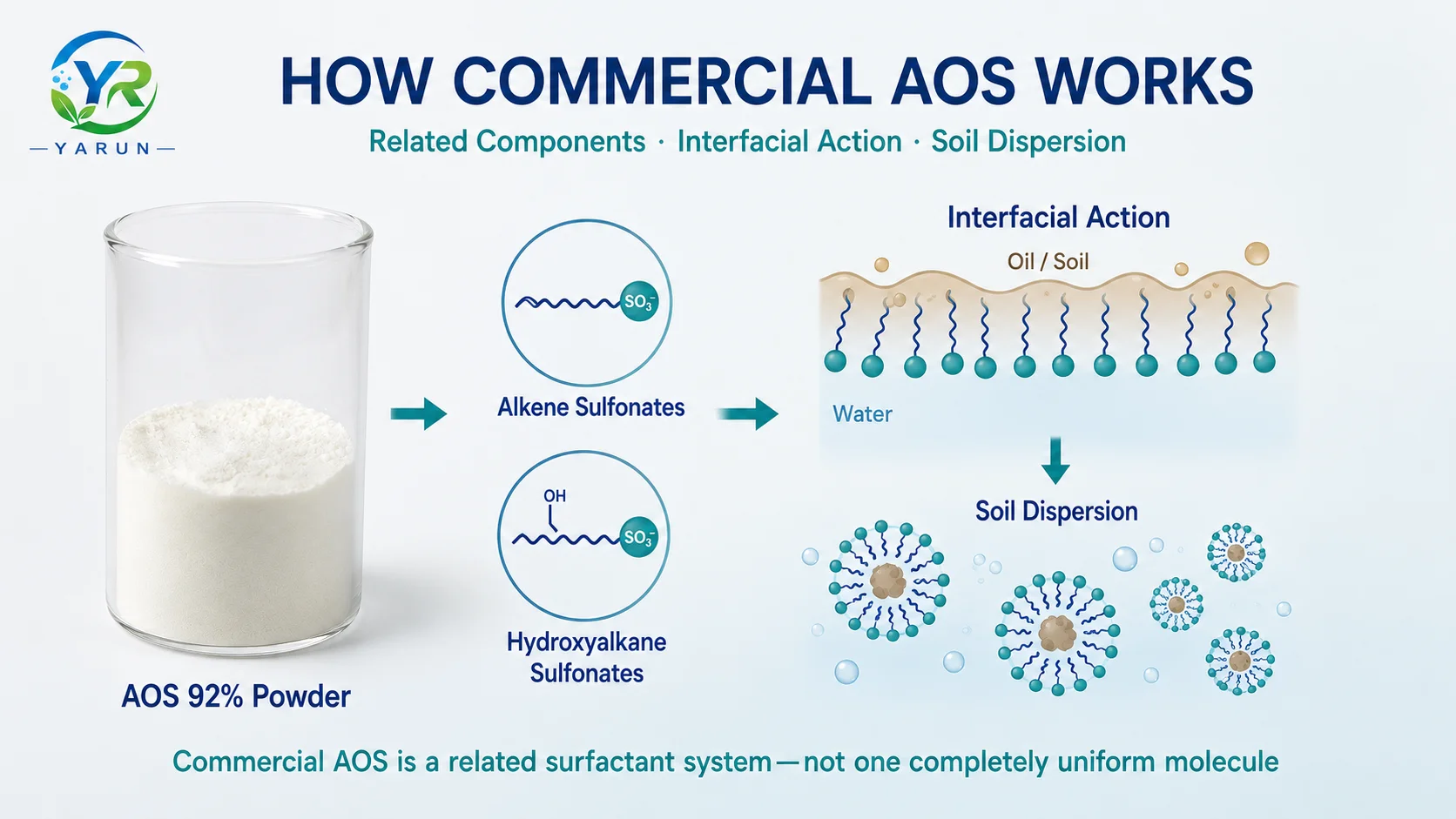
Commercial AOS should not be understood as one completely uniform molecular species. It normally contains related sulfonated components, principally:
- Alkene sulfonates;
- hydroxyalkane sulfonates;
- other components associated with the manufacturing and hydrolysis process.
The distribution can be influenced by:
- Alpha-olefin feedstock;
- carbon-chain distribution;
- sulfonation conditions;
- neutralization;
- hydrolysis;
- separation and drying;
- final product specification.
This matters because two products sold under the same general abbreviation can differ in active matter, inorganic salts, moisture, organic extractables, physical form and processing behavior.
The YARUN article and product route discussed here relates specifically to the high-active powder grade—not every AOS grade available in the market.
2. Current YARUN AOS 92% Product Facts
YARUN’s Alpha Olefin Sulfonate 92% powder product page identifies the following current control specification:
| Parameter | AOS 92% control specification |
|---|---|
| Product | Alpha Olefin Sulfonate |
| CAS number | 68439-57-6 |
| Surfactant class | Anionic surfactant |
| Physical form | Powder |
| Appearance | Light-yellow powder |
| Active matter | ≥92.0% |
| Petroleum ether solubles | ≤3.0% |
| Sodium sulfate | ≤5.5% |
| Sodium chloride | ≤0.15% |
| Free alkali | ≤1.0% |
| Moisture | ≤3.0% |
| pH, 1% aqueous solution | 9.0–12.0 |
| Whiteness | ≥80 |
| Color, Hazen, 5% active solution | ≤120 |
| Testing reference | GB/T 20200 |
| Packaging | 25 kg/bag |
| Minimum order quantity | 1 MT |
| China export HS reference | 3402390000 |
This table represents the current product control specification. It is not a substitute for the approved purchase specification, applicable analytical methods or commercial batch COA.
The pH range shown applies to the stated raw-material test solution. It is not a recommended pH range for every finished detergent.
Final customs classification must be confirmed according to product composition, shipment documents and the importing country’s requirements.
3. Why AOS Composition Matters
A simplified illustration of one sulfonated molecule cannot fully represent commercial AOS.
Both alkene sulfonate and hydroxyalkane sulfonate components contain:
- A hydrophobic hydrocarbon region that associates with non-polar soil and interfaces;
- a hydrophilic sulfonate group that interacts with water and carries a negative charge.
However, the commercial mixture’s chain distribution and component proportions can influence solution and interfacial behavior.
For procurement teams, this means that product identity should be controlled through:
- Agreed name and grade;
- product specification;
- applicable analytical methods;
- representative and batch-specific COA;
- physical-form confirmation;
- controlled formulation testing.
A CAS number or trade abbreviation alone does not demonstrate that two AOS products will process identically.
4. How AOS Acts at Interfaces
When AOS is introduced into water, surfactant molecules can migrate toward interfaces between:
- Water and air;
- water and oil;
- water and solid surfaces;
- wash liquor and fabric.
At an oil–water interface, the hydrophobic region can associate with oily material while the sulfonate group remains oriented toward the aqueous phase.
This interfacial adsorption can support:
- Surface wetting;
- spreading;
- contact with soil;
- oily-soil detachment;
- dispersion of removed material;
- foam-film formation.
AOS does not remove every soil through a single mechanism. Finished detergency also depends on:
- Soil type and loading;
- surface or fabric;
- product dosage;
- builders and chelating agents;
- other surfactants;
- alkalinity;
- solvents;
- polymers and enzymes;
- temperature;
- mechanical action;
- rinsing conditions.
A surfactant should therefore be evaluated inside the complete detergent system.
5. Micelle Formation and Soil Dispersion
As surfactant concentration increases, AOS components can form aggregates such as micelles under suitable solution conditions.
In a simplified micelle:
- Hydrophobic regions associate toward the interior;
- hydrophilic sulfonate groups face the surrounding water.
These aggregates can help accommodate hydrophobic material in an aqueous wash system.
Micelle formation does not mean that adding unlimited AOS produces unlimited cleaning. Above the concentration needed for the formulation’s intended function, additional surfactant may:
- Increase raw-material cost;
- change rinsing;
- alter viscosity;
- affect clarity;
- increase foam beyond the application requirement;
- create additional dissolution or stability demands.
Cleaning trials should use representative soil, water, dosage and mechanical conditions. A clear surfactant solution or high foam result is not, by itself, proof of cleaning performance.
6. How AOS Supports Foam
AOS can adsorb at the air–water interface and participate in the liquid films surrounding air bubbles.
The observed foam profile depends on:
- AOS concentration;
- active matter;
- carbon-chain and component distribution;
- water hardness;
- temperature;
- electrolyte concentration;
- co-surfactants;
- soil loading;
- oils and solvents;
- mixing or agitation;
- test method;
- time after foam generation.
Foam should be assessed in terms of the finished product’s intended use.
Useful distinctions include:
- Initial foam volume;
- foam retention;
- foam under oily-soil load;
- foam during mechanical agitation;
- rinsing behavior;
- foam after storage;
- consumer-visible foam versus measured detergency.
High foam can be desirable in manually used dishwashing or cleaning products. It may be undesirable in automated, low-rinse or machine-cleaning systems.
The correct target is not the highest possible foam. It is the foam profile appropriate to the application.
7. Why AOS 92% Powder Requires a Dissolution Strategy
AOS 92% powder is not a ready-to-pump liquid surfactant.
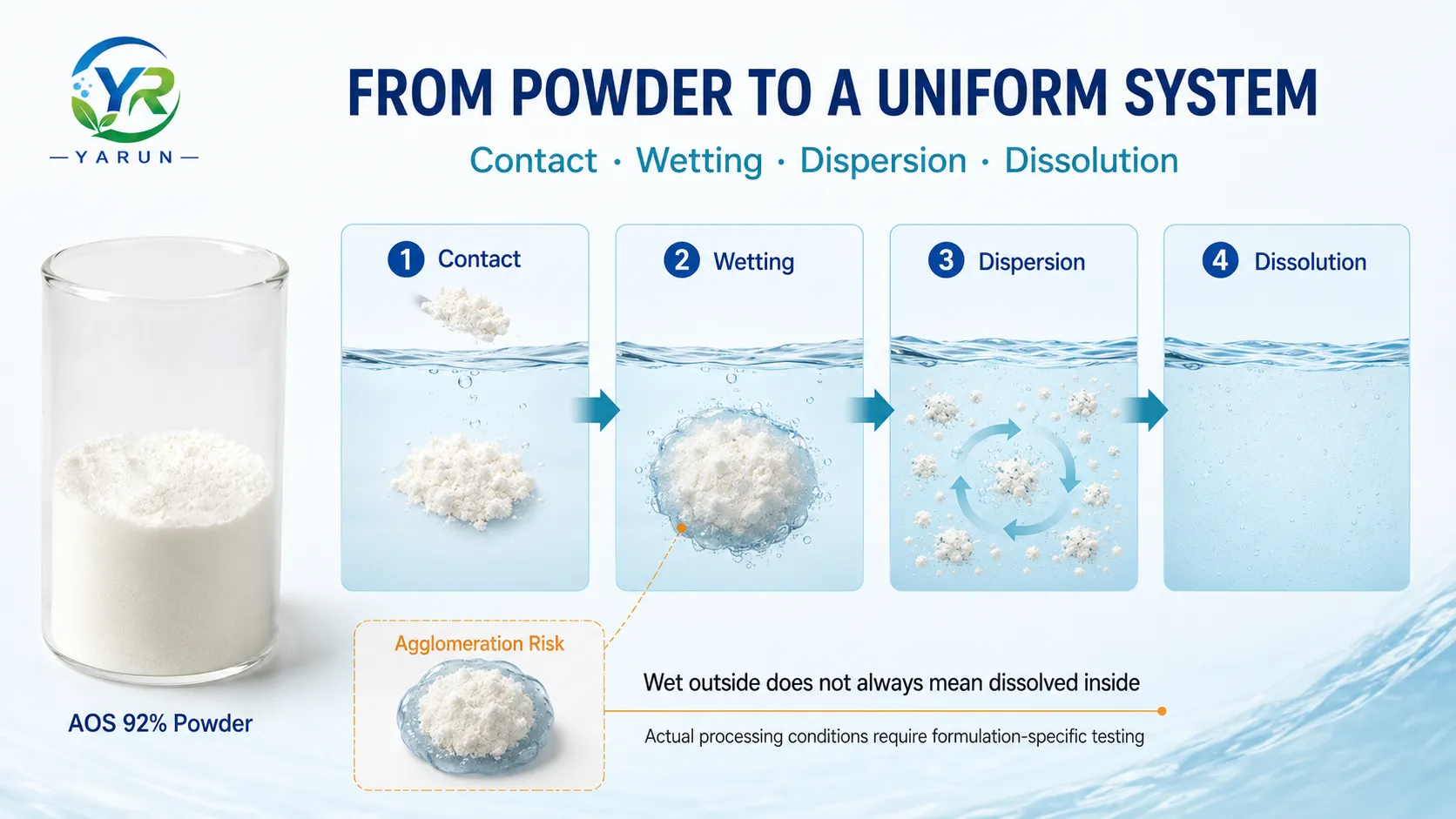
Before it can function uniformly in a liquid formulation, the particles must:
- Contact the aqueous phase;
- become wetted;
- disperse without persistent agglomeration;
- dissolve or become incorporated into the intended system;
- reach adequate uniformity before sensitive ingredients are added.
These stages are affected by:
- Particle size and distribution;
- powder condition;
- moisture;
- caking;
- water temperature;
- batch concentration;
- addition rate;
- feed location;
- agitation;
- vessel geometry;
- electrolyte content;
- other ingredients already present;
- processing time.
A visually uniform surface does not prove that all material has dissolved. Undissolved material may remain:
- At the bottom;
- on vessel walls;
- around the agitator;
- inside floating agglomerates;
- in poorly circulated zones;
- in transfer lines or filters.
There is no universal dissolution temperature, addition speed or mixing time suitable for every AOS powder and production system.
8. Wetting and Dissolution Are Different
A powder can appear wet on the outside while remaining dry or highly concentrated inside an agglomerate.
This can occur when the outer layer rapidly interacts with water and forms a barrier that slows penetration into the particle cluster.
The result may include:
- Floating powder islands;
- fish-eye-like agglomerates;
- persistent lumps;
- long mixing time;
- non-uniform active matter;
- blocked screens or filters;
- sediment after filling.
A useful investigation should separate four questions:
- Did the powder enter the liquid uniformly?
- Did each agglomerate become wetted?
- Did the internal material dissolve?
- Did the complete formula remain stable after dissolution?
Adding more agitation is not always the answer. Excessive shear or vortex formation may entrain air and make it harder to inspect the batch.
9. Developing a Controlled Dissolution Study
A controlled laboratory study should use the actual AOS lot and intended base formula.
Keep constant:
- Batch size;
- water source;
- equipment;
- impeller;
- mixing speed;
- feed location;
- AOS active-matter target;
- ingredient sequence;
- sampling method;
- observation time.
Compare one variable at a time, such as:
- Water temperature;
- AOS addition rate;
- initial water quantity;
- mixing intensity;
- time before electrolyte addition;
- time before fragrance or polymer addition.
Record:
- AOS lot number;
- powder appearance and condition;
- addition start and finish time;
- batch temperature;
- visible agglomeration;
- foam and entrained air;
- dissolution time under the defined method;
- residue on a defined screen where appropriate;
- pH;
- clarity or opacity;
- viscosity after equilibration;
- sediment after storage.
The selected procedure should then be confirmed in the intended production equipment.
A beaker test demonstrates laboratory feasibility. It does not prove transfer, heat distribution, circulation or repeatability at commercial scale.
10. Why Water Quality Matters
Water quality can influence AOS formulation behavior through:
- Calcium and magnesium hardness;
- alkalinity;
- dissolved salts;
- iron or other trace metals;
- microbial quality;
- pH;
- seasonal variation.
Builders, sequestrants or other formulation strategies may be required according to the product and target market.
AOS is sometimes promoted using broad statements about performance in hard water. Such statements should not replace finished-product testing.
The practical result depends on:
- Actual hardness level;
- calcium-to-magnesium balance;
- surfactant blend;
- builder system;
- alkalinity;
- soil;
- dosage;
- temperature;
- washing conditions.
A formula developed only with purified water may not represent manufacturing water or consumer-use conditions.
For Thailand-focused projects, YARUN’s detergent formulation optimization guide for Thai manufacturers provides a broader framework for comparing surfactants, water conditions, process requirements and finished-product economics.
11. Electrolytes Can Change the Result
The commercial AOS powder already contains controlled inorganic salts. Additional electrolytes may enter through:
- Water;
- builders;
- sodium chloride;
- sodium sulfate;
- neutralized acidic ingredients;
- preservatives;
- dyes;
- other surfactants.
Electrolytes can influence:
- Dissolution;
- ionic strength;
- micellar structure;
- viscosity;
- clarity;
- precipitation;
- low-temperature behavior;
- interaction with other ingredients.
A salt level used in an SLES formulation should not automatically be transferred to an AOS formulation.
If viscosity adjustment is required, develop an empirical response curve using the complete formula and controlled measurement conditions. Do not assume:
More salt = more viscosity.
The useful range can shift when the formulator changes active matter, co-surfactants, fragrance, temperature or raw-material lot.
12. Combining AOS With Other Surfactants
AOS and SLES
SLES may be evaluated with AOS when the formulator is balancing:
- Liquid processing;
- foam profile;
- viscosity response;
- detergency;
- product positioning;
- active-matter cost.
The materials have different physical forms and concentrations. They should be compared on an active basis, including the water introduced by SLES 70%.
For deeper SLES processing and viscosity analysis, see how SLES 70% works in liquid detergents.
AOS and Neutralized LABSA
Neutralized LABSA may be combined with AOS when detergency, foam and formulation economics require a blended anionic system.
LABSA is supplied in acidic form and normally requires controlled neutralization. It cannot be substituted directly for AOS powder kilogram for kilogram.
Before combining these systems, confirm:
- LABSA neutralization;
- final pH;
- total electrolyte load;
- active-matter balance;
- dissolution sequence;
- viscosity;
- clarity;
- storage stability.
See how LABSA 96% neutralization affects LAS formation and formulation cost.
AOS and Amphoteric Surfactants
An amphoteric co-surfactant such as CAPB may be evaluated when the formulation requires adjustment of:
- Foam character;
- rheology;
- application properties;
- surfactant balance.
The effect depends on ratio, active matter, pH, electrolytes and the complete formulation.
AOS and Nonionic Surfactants
Nonionic surfactants may be considered when oily-soil removal, temperature performance or foam control requires adjustment.
They can also change:
- Clarity;
- viscosity;
- cloud behavior;
- fragrance solubilization;
- dissolution sequence;
- finished-product cost.
Compatibility must be determined in the final formula.
13. Powder Versus Liquid AOS
Powder and liquid AOS grades should not be compared on equal product weight.
| Decision factor | AOS 92% powder | Liquid AOS grade |
|---|---|---|
| Active concentration | High | Lower and grade-dependent |
| Water transported | Lower | Higher |
| Dosing | Dry-material handling | Pumpable liquid handling |
| Processing | Requires controlled wetting and dissolution | Requires liquid transfer and storage |
| Packaging | Bags | Drums, totes or bulk formats |
| Main handling risks | Dust, moisture uptake, caking and agglomeration | Pumping, leakage, freezing or viscosity depending on grade |
| Formula water balance | Adds little water with the raw material | Adds significant formulation water |
| Commercial comparison | Cost per delivered active plus dissolution | Cost per delivered active plus freight and handling |
This table describes general decision factors, not specifications for every commercial liquid AOS.
Select the form according to:
- Existing equipment;
- worker-exposure controls;
- batch size;
- production frequency;
- warehouse conditions;
- formula concentration;
- freight structure;
- required throughput.
The highest-active option is not automatically the lowest-cost manufacturing route.
14. Powder Storage and Caking Control
AOS 92% powder must be protected from moisture.
Moisture exposure can contribute to:
- Caking;
- reduced flowability;
- bag compaction;
- difficult dosing;
- inconsistent feeding;
- agglomeration during dissolution;
- damaged packaging;
- contamination risk.
Incoming and stored material should be assessed for:
- Bag integrity;
- closure and liner condition;
- water damage;
- compression;
- powder flow;
- hard lumps;
- contamination;
- label and batch identification.
Storage and handling should follow the applicable SDS, supplier guidance and workplace requirements.
If caked material is found, do not assume that mechanical breaking alone restores the original processing behavior. Investigate the exposure history and compare dissolution performance before approval.
15. Diagnosing Common AOS Formulation Problems
| Observation | Variables to investigate |
|---|---|
| Powder floats on the surface | Wetting, feed rate, addition point, surface agitation and powder condition |
| Persistent lumps remain | Agglomeration, water temperature, mixing, addition rate and electrolyte sequence |
| Residue appears after mixing | Dissolution time, circulation zones, screens, powder condition and formula concentration |
| Liquid becomes hazy | Electrolytes, temperature, fragrance, nonionic surfactant, pH and water hardness |
| Sediment develops during storage | Incomplete dissolution, contamination, low-temperature behavior or incompatibility |
| Viscosity remains too low | Total active matter, surfactant ratio, electrolyte response, temperature and measurement method |
| Viscosity rises unexpectedly | Local concentration, electrolyte load, co-surfactants and equilibration time |
| Foam is lower than expected | Soil load, water hardness, test method, co-surfactants, active matter and contamination |
| Foam is excessive | Application mismatch, surfactant balance, dosage and mechanical conditions |
| Powder cakes in storage | Moisture ingress, damaged liner, humidity, compression and storage duration |
| Batches differ | AOS lot, water, inorganic salts, process history, sampling and measurement conditions |
Corrective trials should change one controlled variable at a time wherever practical.
16. Understanding the Main Purchasing Parameters
Active Matter
Active matter determines the amount of surfactant-active material delivered under the applicable analytical method.
It affects:
- Formula calculation;
- raw-material dosage;
- freight efficiency;
- cost per unit of active;
- batch-to-batch control.
Higher active matter does not automatically prove better finished-product performance.
Petroleum Ether Solubles
This parameter controls organic material extracted under the applicable method.
It should be interpreted according to the stated procedure. It is not a complete standalone measurement of purity or performance.
Sodium Sulfate and Sodium Chloride
These contribute to the inorganic-salt content of the product and may affect:
- Delivered active matter;
- dissolution;
- ionic strength;
- viscosity;
- clarity;
- compatibility;
- stability.
Free Alkali
Free alkali and pH are related but different measurements.
Free alkali may be relevant to finished-product pH, ingredient compatibility and safety. The agreed method and limit must be used.
Moisture
Moisture affects:
- Dry-material content;
- flowability;
- caking;
- storage condition;
- delivered active matter.
Whiteness and Solution Color
Powder whiteness and prepared-solution color are different measurements.
Neither parameter should be treated as proof of active matter, detergency or foam performance.
17. Compare Offers on Delivered Active and Processing Cost
A basic active-matter comparison is:
Raw-material cost per metric ton of active matter = Price per metric ton ÷ active-matter fraction
For a confirmed 92% result, the divisor is 0.92.
The approved specification and batch COA remain controlling.
A complete commercial comparison should also include:
- Packaging;
- container loading;
- freight;
- import charges;
- warehouse requirements;
- dust and handling controls;
- bag-opening and dosing labor;
- dissolution time;
- energy;
- batch throughput;
- screen or filter losses;
- rework;
- stability failures;
- document package;
- supplier consistency.
Delivered Active-Matter Cost
A more realistic procurement calculation is:
Delivered active-matter cost = Total landed raw-material cost ÷ delivered active-matter quantity
Converted Formula Cost
For liquid products, also calculate:
Converted formula cost = Delivered raw-material cost + dissolution and processing cost + quality-loss risk
This prevents a high-active powder from appearing artificially inexpensive when the plant lacks appropriate dry-material handling or dissolution capability.
It also prevents a lower-active liquid from appearing artificially expensive when it reduces processing time and increases throughput.
18. A Better AOS 92% Qualification Program
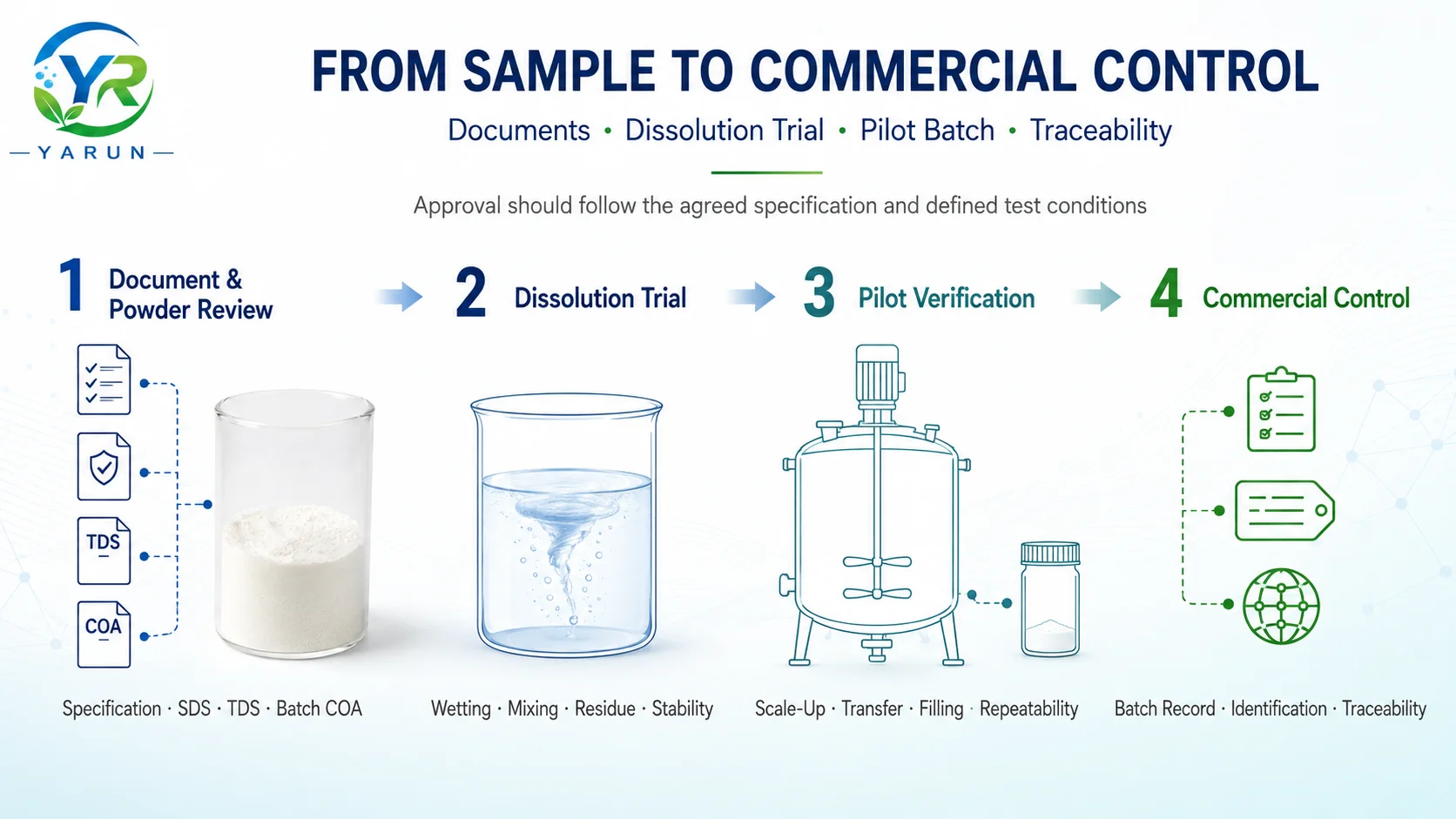
Stage 1: Document Review
Confirm:
- Product name and grade;
- approved specification;
- current TDS;
- current SDS;
- representative COA;
- analytical methods;
- packaging;
- storage guidance;
- destination-market requirements.
Stage 2: Incoming Sample Inspection
Record:
- Supplier and sample code;
- batch number;
- appearance;
- color;
- powder condition;
- flowability;
- visible lumps;
- packaging condition;
- COA results;
- date received;
- storage conditions.
Stage 3: Controlled Dissolution Study
Keep constant:
- AOS lot;
- batch size;
- water;
- equipment;
- feed point;
- mixing;
- active-matter target;
- sampling;
- observation method.
Record:
- Water temperature;
- addition time;
- mixing time;
- visible agglomeration;
- foam and entrained air;
- residue;
- pH;
- clarity;
- viscosity;
- sediment after defined storage.
Stage 4: Controlled Formulation Comparison
Compare:
- Active-matter basis;
- dissolution;
- viscosity;
- foam before and after representative soil;
- cleaning performance;
- water-hardness response;
- electrolyte response;
- fragrance compatibility;
- storage stability;
- low-temperature behavior.
Stage 5: Pilot Verification
Confirm:
- Bag handling;
- dosing;
- feed rate;
- dust control;
- circulation;
- dissolution time;
- transfer;
- filtration where applicable;
- filling;
- cleaning procedure;
- batch consistency.
Stage 6: Commercial-Batch Control
Link:
- Purchase specification;
- AOS batch COA;
- incoming inspection;
- manufacturing record;
- finished-product tests;
- batch identification;
- retained samples;
- traceability;
- complaint investigation.
19. Information to Send Before Requesting a Recommendation
For a useful AOS 92% review, provide:
- Target country;
- finished-product type;
- powder or liquid manufacturing route;
- required specification;
- expected quantity;
- packaging requirement;
- destination port;
- preferred Incoterm;
- current surfactant system;
- target active matter;
- water quality;
- production equipment;
- available dry-material handling;
- current dissolution method;
- viscosity and foam objectives;
- current processing or stability problem;
- required documents;
- target production date.
This information distinguishes a simple price request from a supplier-change, dissolution or formulation project.
20. How YARUN Supports AOS 92% Projects
YARUN supplies AOS 92% powder for detergent and cleaning-product applications, subject to the approved specification and project requirements.
Support can include:
- Product-specification confirmation;
- sample availability confirmation;
- batch COA;
- English SDS;
- TDS;
- packaging confirmation;
- bulk quotation;
- active-matter and commercial comparison;
- export-document coordination;
- coordination of sample and formulation-review requirements.
Final suitability depends on:
- Product specification;
- physical condition;
- dissolution method;
- complete formulation;
- water quality;
- equipment;
- target market;
- completed trials.
YARUN does not treat a specification sheet, a fresh solution or a single laboratory sample as proof of commercial repeatability.
21. Request an AOS Dissolution and Cost Review
If you are evaluating AOS 92% for a new detergent, changing suppliers or troubleshooting dissolution, haze, sediment, foam or batch variation, send YARUN:
- Target application;
- required specification;
- current surfactant system;
- target active matter;
- dissolution method;
- main formulation problem;
- packaging requirement;
- expected order quantity;
- destination country and port;
- required documents.
YARUN can review the project information and coordinate the appropriate specification, sample, document and quotation route.
Request an AOS Dissolution and Cost Review
Frequently Asked Questions
What is AOS 92%?
AOS 92% is a high-active Alpha Olefin Sulfonate grade supplied by YARUN as a light-yellow powder. The current control specification states active matter of at least 92.0%.
Is commercial AOS one pure molecule?
No. Commercial AOS is a related surfactant system that can include alkene sulfonates and hydroxyalkane sulfonates. Acceptance should be based on the complete specification and batch COA.
Can AOS 92% be added directly to a liquid detergent?
It requires a validated wetting, dissolution and addition procedure. The correct method depends on the formula, water, equipment, concentration and production conditions.
Why does AOS powder form lumps?
Possible causes include moisture exposure, caking, rapid addition, poor feed-point selection, inadequate wetting, local high concentration and electrolyte interaction.
Is warmer water always better for dissolving AOS?
No universal temperature applies to every grade and formulation. Temperature can affect dissolution and the stability of other ingredients. Establish the operating range through controlled trials.
Does AOS always perform well in hard water?
Water response depends on the actual hardness, surfactant blend, builder system, dosage, soil and test conditions. Broad hard-water claims should be verified in the finished formula.
Does more AOS always produce more foam?
No. Foam depends on concentration, water, soil, electrolytes, co-surfactants and mechanical conditions. Above the required level, more AOS may increase cost without improving the intended result.
Is high foam proof of stronger detergency?
No. Foam and cleaning performance are different properties and should be evaluated separately.
Can AOS 92% replace SLES 70% kilogram for kilogram?
No. Their active matter, physical form, water contribution, dissolution, processing and rheological behavior differ. Reformulation and testing are required.
Can AOS be combined with neutralized LABSA?
Yes, in suitable formulations. LABSA must first be controlled appropriately, and the complete system must be assessed for pH, electrolyte load, dissolution, viscosity and stability.
What should buyers check on an AOS COA?
Check the parameters required by the approved specification, including active matter, petroleum ether solubles, sodium sulfate, sodium chloride, free alkali, moisture, pH, whiteness and solution color.
How should powder and liquid AOS be compared?
Compare delivered active matter, water transported, packaging, freight, equipment, labor, dissolution, throughput and finished-formula performance.
Can YARUN provide AOS documents and bulk pricing?
YARUN can provide or coordinate the applicable specification, batch COA, English SDS, TDS, packaging confirmation and bulk quotation according to the confirmed project requirements.
Conclusion
AOS 92% is not simply a high-foaming powder.
Its commercial value depends on the complete relationship between:
- Commercial composition;
- active matter;
- inorganic salts;
- moisture;
- powder condition;
- wetting;
- dissolution;
- water quality;
- electrolytes;
- co-surfactants;
- equipment;
- storage;
- batch validation.
A high-active grade can improve freight and formula concentration, but it also requires suitable dry-material handling and dissolution capability.
More AOS does not automatically mean more cleaning. More foam does not prove better detergency. A visually uniform fresh batch does not prove complete dissolution or storage stability. The lowest price per metric ton does not necessarily produce the lowest converted formula cost.
Manufacturers should qualify the raw material, control powder storage, develop a verified dissolution method, compare samples on an active-matter basis and validate the final formulation at pilot and commercial scale.
Request an AOS Dissolution and Cost Review