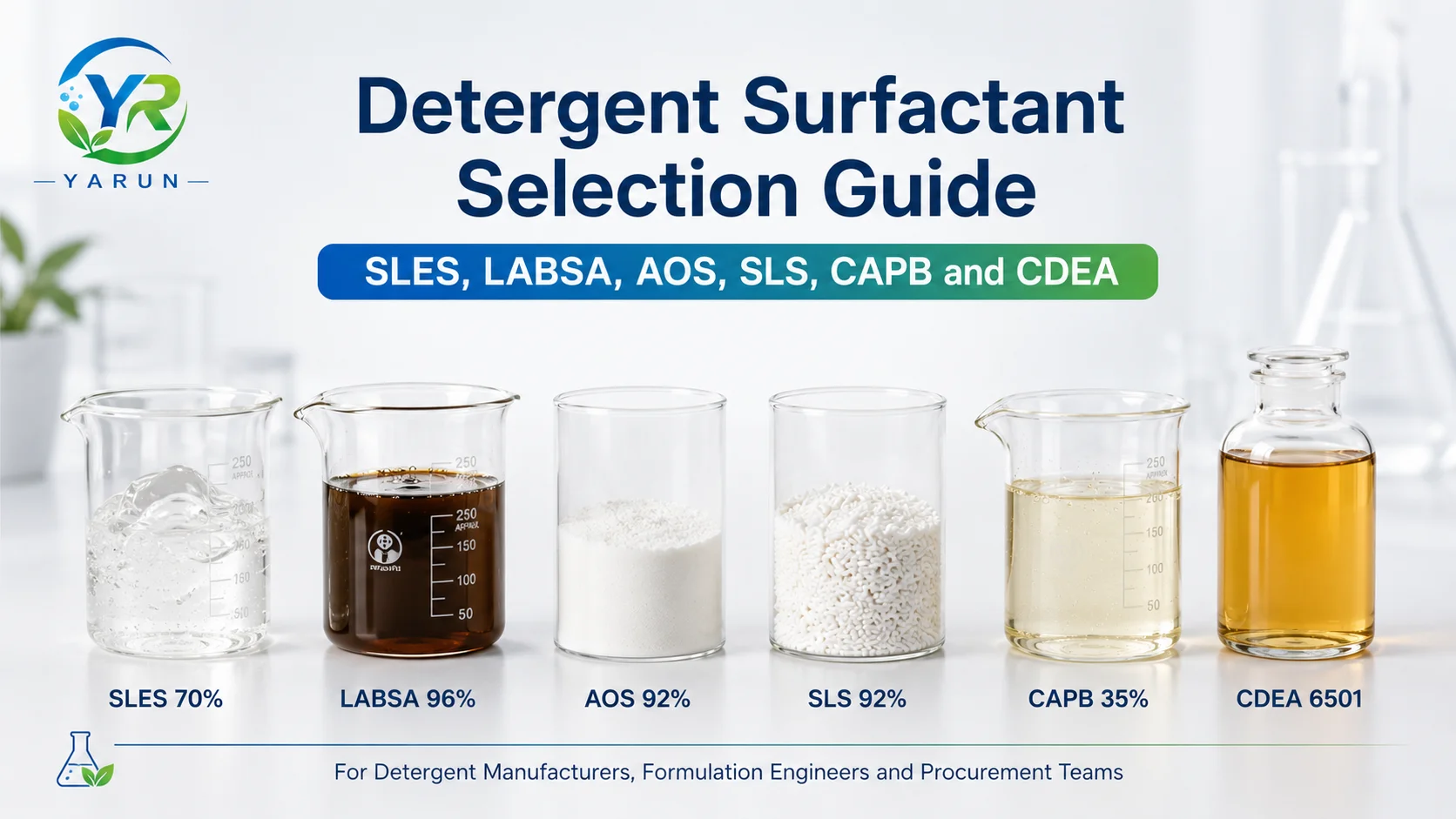
Selecting detergent raw materials is not simply a matter of comparing chemical names and prices.
SLES, LABSA, AOS, SLS, CAPB and CDEA have different chemical classifications, active-matter levels, formulation functions and processing requirements.
They cannot always replace one another at the same dosage, and they should not all be described as high-active anionic surfactants.
For detergent manufacturers and procurement teams, the correct decision depends on:
Product category
Target market
Required cleaning performance
Foam profile
Active matter
Water conditions
Production equipment
Formula stability
Target cost
Raw material consistency
This guide explains how to compare six widely used detergent ingredients before formulation trials and commercial purchasing.
Surfactant Classification Comes First
A surfactant’s chemical class influences its charge, compatibility and functional role.
The six materials covered in this guide belong to different categories:
| Raw material | Chemical category | Typical commercial role |
|---|---|---|
| SLES | Anionic surfactant | Primary detergency and foam in liquid systems |
| LABSA | Acid precursor of an anionic surfactant | Cost-efficient detergency after neutralization |
| AOS | Anionic surfactant | Detergency and persistent foam |
| SLS | Anionic surfactant | Rapid foam and detergency in selected applications |
| CAPB | Amphoteric surfactant | Co-surfactant, foam modification and compatibility support |
| CDEA | Nonionic alkanolamide | Foam and viscosity support in compatible formulations |
CDEA is not an anionic surfactant.
CAPB is also not an anionic surfactant.
This distinction matters because their cost and performance should not be evaluated in exactly the same way as primary anionic surfactants.
SLES 70%
SLES 70%, or Sodium Laureth Sulfate, is a concentrated anionic surfactant commonly supplied as a paste.
It is widely used in liquid detergent and cleaning formulations because it can provide:
Detergency
Strong foam
Water solubility
Compatibility with several co-surfactants
Flexible viscosity adjustment
Convenient use in concentrated liquid systems
Formulation Considerations
SLES viscosity behavior depends on the complete formula.
Important variables include:
Active-matter concentration
Electrolytes
Co-surfactants
Fragrance
Temperature
Water quality
Order of addition
Salt can increase viscosity in some SLES-based systems, but the response follows a formulation-specific curve. Adding more salt does not always continue increasing viscosity and may eventually reduce it.
Processing Considerations
Concentrated SLES can form high-viscosity intermediate structures during dilution.
Manufacturers should control:
Addition sequence
Mixing
Water temperature where appropriate
Localized concentration
Air incorporation
The processing method should be validated with the actual equipment.
When to Consider SLES
SLES may be appropriate when the product requires:
Liquid processing
Noticeable foam
Good detergent performance
Flexible viscosity design
Concentrated raw material supply
LABSA 96%
LABSA 96%, or Linear Alkylbenzene Sulfonic Acid, is an acidic raw material used to produce the corresponding neutralized surfactant in detergent formulations.
It is commercially important because it can provide:
Strong detergency
Useful cost-performance
Application in liquid and powder detergent systems
Flexible neutralization routes
LABSA Must Be Neutralized
LABSA should not be evaluated as if it were a ready-to-use neutral surfactant.
The manufacturer must define:
Neutralizing agent
Required amount
Addition sequence
Temperature control
Mixing
Final pH
Resulting salt form
Incorrect neutralization may cause:
pH variation
Excessive heat
Color change
Odor
Viscosity instability
Batch inconsistency
Cost Considerations
LABSA may have an attractive purchase price, but the complete cost includes:
Neutralizing agent
Process control
Mixing time
Heating or cooling where required
Final yield
Quality-control risk
Price per kilogram of LABSA alone does not represent the finished surfactant cost.
When to Consider LABSA
LABSA may be suitable when:
Detergency economics are important
Neutralization capability is available
The production team can control pH and temperature
The formulation has been validated
Consistent raw material supply is available
AOS 92%
AOS 92%, or Alpha Olefin Sulfonate, is a high-active anionic surfactant.
Depending on the supplied form and formulation, it can contribute:
Detergency
Strong foam
Persistent foam profile
Performance across varying washing conditions
Differentiation from conventional surfactant systems
Formulation Considerations
AOS should be evaluated for:
Solubility
Dispersion
Foam behavior
Compatibility
Viscosity response
Water conditions
Processing temperature
High-active powder, needle or granular materials may require different handling from liquid surfactants.
When to Consider AOS
AOS may be considered when:
Foam persistence matters to consumers
A high-active raw material is preferred
The manufacturer wants to adjust the SLES or LABSA system
Powder or concentrated applications are being developed
Performance under varying water conditions requires evaluation
AOS should not automatically replace SLES kilogram for kilogram. Active matter and performance must be recalculated.
SLS 92%
SLS 92%, or Sodium Lauryl Sulfate, is a high-active anionic surfactant available in several physical forms.
It can provide:
Rapid foam generation
Detergency
Wetting
Application in powder, paste and selected concentrated systems
SLS Is Not the Same as SLES
SLS and SLES differ in structure and performance.
Potential differences include:
Water solubility
Irritation profile
Hard-water response
Processing
Foam character
Viscosity behavior
The two materials should not be treated as identical simply because both are sulfate surfactants.
Processing and Handling
For powder grades, manufacturers should consider:
Dust management
Worker exposure controls
Dispersion
Mixing sequence
Storage
Moisture protection
The Safety Data Sheet and supplier handling recommendations should be followed.
When to Consider SLS
SLS may be appropriate for:
Powder detergent systems
Selected cleaning products
Products requiring rapid foam
Concentrated formats where its physical form is compatible
Finished-product suitability must be verified for the intended consumer and market.
CAPB 35%
CAPB 35%, or Cocamidopropyl Betaine, is an amphoteric surfactant commonly supplied as an aqueous liquid.
CAPB is often used as a co-surfactant rather than the main detergency source.
It may support:
Foam modification
Foam stability
Compatibility in blended systems
Mildness improvement in applications where skin contact matters
Viscosity adjustment in some formulations
CAPB in Detergent Formulations
CAPB may be considered in:
Hand dishwashing liquid
Liquid soap
Selected household cleaning products
Formulations requiring a modified foam profile
Systems where compatibility with anionic surfactants is useful
Its commercial value should be evaluated according to the function it provides—not only by cost per kilogram of active matter.
Quality Considerations
Buyers should confirm:
Active matter or solids specification
pH
Color
Salt content where relevant
Free amine or other relevant impurity controls
Odor
Microbiological or preservation status where applicable
Requirements depend on the intended application and destination market.
CDEA 6501
CDEA 6501, or Coconut Diethanolamide, is a nonionic alkanolamide-type ingredient.
It is not an anionic surfactant.
Depending on the formulation, CDEA can support:
Foam stability
Viscosity
Product body
Surfactant-system performance
Processing flexibility
CDEA as a Functional Co-Surfactant
CDEA is generally evaluated according to the function it adds to the formulation.
It should not be compared directly with SLES, LABSA, AOS or SLS as if all six materials were equivalent sources of primary detergency.
Regulatory and Quality Review
Requirements for diethanolamide-containing ingredients may vary by market and application.
Buyers should confirm:
Product specification
Free diethanolamine limits where relevant
Nitrosamine-related controls where applicable
Intended application
Destination-market requirements
Supplier documentation
No universal compliance claim should be made without reviewing the supplied grade and target market.
Functional Comparison
| Raw material | Primary role | Important processing issue | Key purchasing question |
|---|---|---|---|
| SLES 70% | Detergency and foam | Dilution and viscosity behavior | What is the active-matter specification? |
| LABSA 96% | Detergency after neutralization | pH and neutralization heat | What is the acid value and active content? |
| AOS 92% | Detergency and persistent foam | Dispersion and physical form | Which grade and form suit the process? |
| SLS 92% | Rapid foam and detergency | Dust, dissolution and handling | What is the particle form and active matter? |
| CAPB 35% | Amphoteric co-surfactant | Salt, preservation and compatibility | Which quality parameters are controlled? |
| CDEA 6501 | Foam and viscosity support | Formula compatibility | What impurity and regulatory data are available? |
Compare Cost by Active Matter
For primary surfactants, one useful starting calculation is:
Cost per kilogram of active matter = Delivered price per kilogram ÷ Active-matter fraction
Example:
| Material | Delivered price | Active matter | Calculated cost per kg active |
|---|---|---|---|
| Material A | USD 1.00/kg | 30% | USD 3.33 |
| Material B | USD 1.80/kg | 70% | USD 2.57 |
Material B costs more per delivered kilogram but less per kilogram of active matter.
However, active-matter cost is not the final decision.
The manufacturer must also consider:
Neutralization
Water introduced with the raw material
Solvents
Viscosity modifiers
Builders
Processing time
Heating or cooling
Packaging
Freight
Production loss
Product performance
CAPB and CDEA may provide supporting functions, so their value should also be measured by the additional performance or formulation benefit they provide.
Active Matter Does Not Equal Finished-Product Performance
A formula with more total surfactant active matter is not automatically better.
Finished detergent performance depends on:
Surfactant blend
Soil type
Washing method
Water quality
Builders
Chelating agents
Enzymes
Nonionic surfactants
Dosage
Rinsing
Consumer expectations
The goal is not to maximize active matter. It is to achieve the required performance at the intended consumer dosage and total cost.
Selecting a Surfactant System by Product Type
Liquid Laundry Detergent
Possible evaluation areas include:
SLES or neutralized LABSA as primary anionic components
AOS for performance or foam adjustment
Nonionic surfactants for oily-soil performance
Builders and polymers
Enzymes
Viscosity system
Fragrance compatibility
Front-load products may require different foam control from hand-washing or top-load products.
Powder Laundry Detergent
Possible raw material routes include:
Neutralized LABSA systems
AOS
SLS
Builders
Alkalinity sources
Bleaching system where applicable
Enzymes and functional additives
Physical form, moisture and mixing process are important.
Hand Dishwashing Liquid
Possible evaluation areas include:
SLES
Neutralized LABSA
AOS
CAPB
CDEA or alternative rheology and foam-support systems
Salt response
Mildness
Grease removal
Fragrance and preservation
General-Purpose Liquid Cleaners
Selection depends on:
Target soil
Surface compatibility
Foam requirement
pH
Consumer use
Rinsing
Fragrance
A raw material should be selected for the application rather than because it is the least expensive available surfactant.
A Practical Selection Process
Step 1: Define the Finished Product
Specify:
Product category
Target market
Washing method
Consumer dosage
Required foam
Target price
Packaging
Product claims
Step 2: Establish the Current Baseline
Record:
Existing formula
Raw material grades
Active matter
Dosage
Delivered cost
Processing
Current problems
Step 3: Compare Functional Roles
Decide which ingredient provides:
Primary detergency
Foam
Oil removal
Mildness
Viscosity
Stability
Supporting performance
Step 4: Calculate Active Contribution
For each surfactant:
Active contribution = Raw material dosage × Active-matter fraction
Step 5: Prepare Controlled Trials
Change one main variable at a time.
Record:
Batch code
Addition sequence
Temperature
Mixing time
Water source
pH
Viscosity
Appearance
Step 6: Test Finished Performance
Evaluate:
Cleaning
Foam
Rinsing
pH
Viscosity
Storage stability
Packaging compatibility
Consumer dosage
Cost
Step 7: Conduct a Pilot Batch
Confirm that laboratory performance can be reproduced using commercial equipment.
Procurement Specification Checklist
Before ordering, request:
Chemical and trade name
CAS information where applicable
Product specification
Active matter or solids
pH or acidity
Color
Relevant impurity limits
Physical form
Packaging
Net weight
Certificate of Analysis
Safety Data Sheet
Shelf life
Storage requirements
Country of origin
MOQ
Production lead time
Destination and freight terms
Two suppliers offering the same chemical name may provide different grades, concentrations and processing behavior.
How YARUN Supports Detergent Manufacturers
YARUN is a formulation-led laundry care solution provider.
Our detergent raw material portfolio includes:
YARUN can support:
Raw material selection
Active-matter cost comparison
Existing-formula review
Supplier specification comparison
Sample coordination
Production troubleshooting
Export supply planning
We do not recommend a raw material only because it has the lowest unit price.
The recommendation should reflect the finished product, process, market and total formulation cost.
Request a Surfactant Selection and Cost Review
Send YARUN:
Product category
Target market
Current formula
Current surfactant grades
Main formulation problem
Target cost
Production equipment
Monthly requirement
Destination port
YARUN can help determine whether the improvement should come from active-matter grade, surfactant blend, process, supporting additives or purchasing structure.
Request a Surfactant Selection and Cost Review
Frequently Asked Questions
Is CDEA an anionic surfactant?
No. CDEA is a nonionic alkanolamide-type ingredient commonly used for foam and viscosity support in compatible formulations.
Is CAPB an anionic surfactant?
No. CAPB is an amphoteric surfactant.
Can SLES be replaced directly with AOS?
A direct kilogram-for-kilogram replacement is not recommended. Active matter, foam, solubility, viscosity and complete-formula compatibility must be evaluated.
Is LABSA ready to use without neutralization?
No. LABSA is acidic and must be neutralized appropriately for the intended detergent system.
Are SLS and SLES the same?
No. They differ in structure, solubility, processing and application performance.
Is the highest-active surfactant always the cheapest?
No. Compare delivered cost per active matter, processing, supporting ingredients, finished performance and production risk.
Can YARUN recommend a complete surfactant system?
Yes. A recommendation requires the product category, market, target cost, performance requirement, equipment and expected volume.
Conclusion
SLES, LABSA, AOS, SLS, CAPB and CDEA should not be compared as if they were interchangeable materials.
The correct selection begins with chemical classification and formulation function:
SLES, AOS and SLS are anionic surfactants
LABSA is an acid precursor requiring neutralization
CAPB is amphoteric
CDEA is nonionic
Manufacturers should compare active matter, processing, compatibility, finished performance and total cost.
YARUN helps detergent manufacturers and procurement teams connect raw material selection with formulation performance and commercial supply.
Contact YARUN to Review Your Detergent Surfactant System