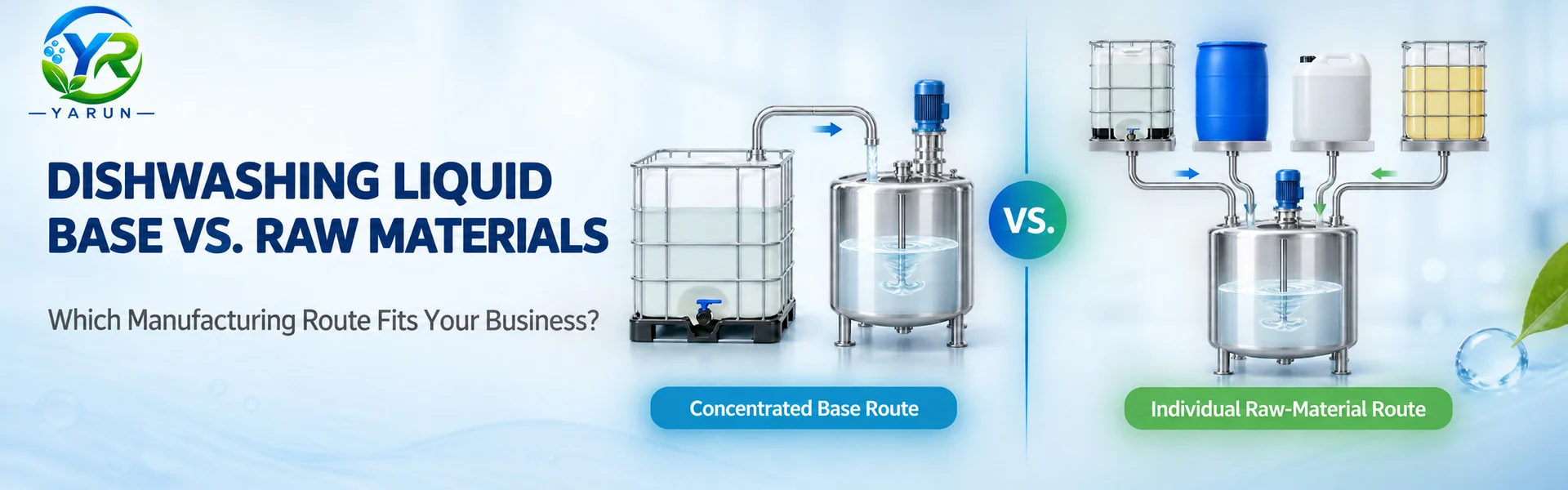
A company planning to manufacture hand dishwashing liquid locally may consider two main routes:
Purchase a concentrated dishwashing liquid base and complete the finished product locally; or
Purchase individual raw materials and formulate the complete product in its own factory.
The comparison is often reduced to one question: Which route is cheaper?
Price alone does not provide a reliable answer. The two routes allocate formulation work, inventory, process control, quality responsibility and operating risk differently.
The more useful question is: Which route best matches the company’s equipment, technical capability, production volume, required level of formula control and ability to release a consistent finished product?
This guide compares the two routes across those operational and commercial factors. It also explains when a hybrid route or finished-product OEM may be more appropriate.
1. Define the Two Routes First
The words “concentrate,” “base” and “premix” are not always used consistently.
Before comparing suppliers, buyers should confirm what formulation work has already been completed and what work remains at the local factory.
Route A: Concentrated Dishwashing Liquid Base
In this article, a concentrated base means a partially completed formulation intended for controlled local processing.
Depending on the product, the supplier may already have completed part of the following work:
Surfactant-system selection;
surfactant-ratio development;
neutralization where applicable;
compatibility adjustment;
initial pH design;
part of the viscosity system;
selection of supporting ingredients.
The local manufacturer may still need to control:
Production water;
dilution quantity;
weighing;
order of addition;
mixing;
fragrance and color where permitted;
final pH and viscosity;
preservation after dilution;
finished-product testing;
filling and packaging;
batch identification;
applicable market requirements.
A base is therefore not automatically a product that can be mixed with any available water under any production condition.
Route B: Individual Raw Materials
Under this route, the manufacturer purchases the required ingredients separately and operates the complete formulation locally.
The system may include:
Primary anionic surfactants;
amphoteric or nonionic co-surfactants;
neutralizing agents;
hydrotropes or solubilizers;
chelating agents;
preservatives;
fragrance;
color;
viscosity modifiers;
pH-adjustment materials;
production water.
The manufacturer is responsible for establishing the formula, raw-material specifications, active-matter contribution, processing method, preservation, stability and commercial-batch controls.
This route provides greater formulation freedom, but it also places more technical responsibility on the local manufacturer.
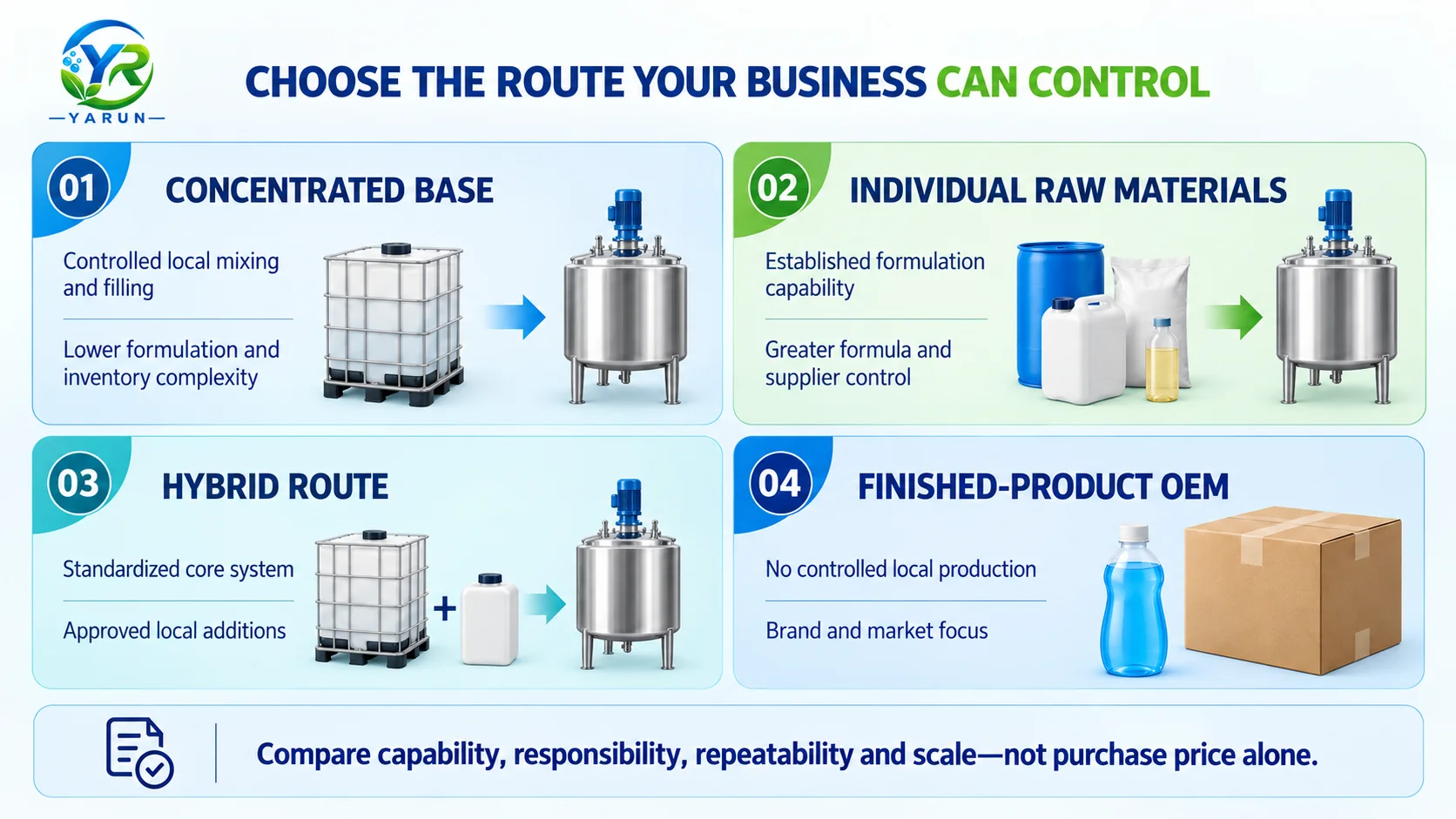
2. Quick Decision Matrix
The following table provides an initial business-positioning guide.
It is not a final technical approval.
| Current business condition | Route to evaluate first |
|---|---|
| Brand owner without controlled mixing or filling equipment | Finished-product OEM/private label |
| Distributor with mixing and filling but limited formulation capability | Concentrated base |
| Manufacturer with basic formulation and quality-control capability | Compare base and raw-material routes |
| Manufacturer with established R&D, QC and multiple commercial formulas | Individual raw materials may provide greater control |
| Business requiring a rapid standard-SKU launch | Base or finished-product OEM |
| Business requiring complete formula ownership and deep customization | Individual raw materials |
| Business unable to manage multiple raw-material MOQs | Base or finished-product OEM |
| Business without controlled water or finished-product testing | Complete a production-readiness review first |
Company size alone does not determine the answer.
A large manufacturer may use a base to launch a new category quickly. A smaller manufacturer may prefer individual raw materials because it already has an experienced formulator and appropriate quality controls.
The important issue is not how large the company is.
It is what the company can control consistently.
3. Compare Responsibility Before Comparing Price
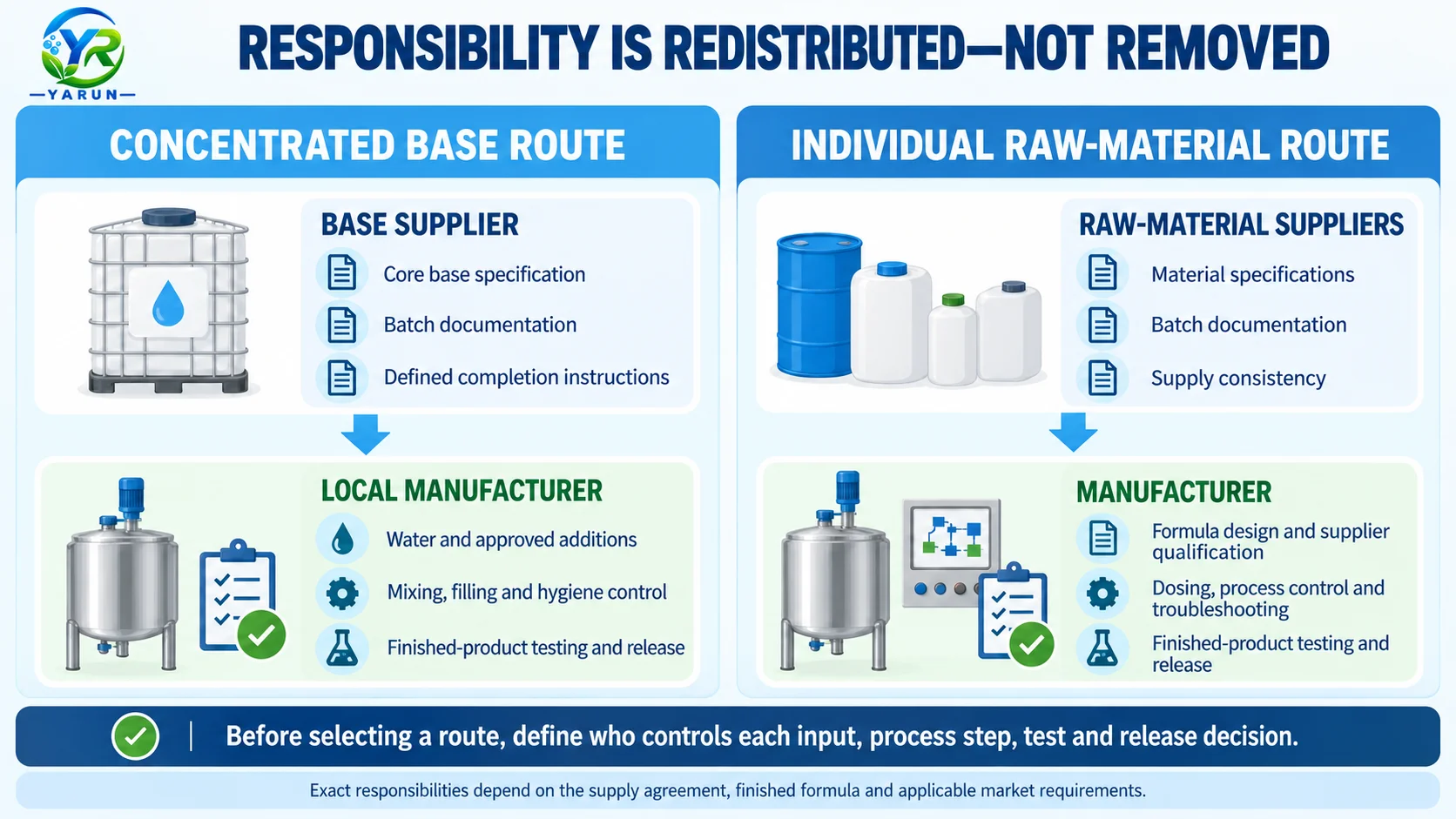
The first comparison should be the allocation of technical and production responsibility.
| Responsibility | Concentrated base | Individual raw materials |
|---|---|---|
| Surfactant-system design | Mainly completed upstream | Completed by the local formulator |
| Raw-material qualification | Concentrated into fewer purchased inputs | Required for multiple ingredients |
| Neutralization | May already be completed | Required when acid-form materials are used |
| Production-water control | Required | Required |
| Fragrance and color compatibility | Must stay within tested limits | Developed within the full formula |
| Viscosity control | May follow an approved adjustment method | Managed by the local formulator |
| Preservation | Responsibility must be explicitly confirmed | Managed as part of the local formulation |
| Stability testing | Required after local completion | Required for the complete formula |
| Batch troubleshooting | Shared according to the project boundary | Mainly the local technical team |
| Finished-product release | Local producer remains responsible | Local producer remains responsible |
| Market requirements | Confirmed for the finished product | Confirmed for the finished product |
A concentrated base may reduce part of the formulation workload.
It does not remove the local producer’s responsibility for controlled processing and finished-product release.
Before approving a base, the buyer should be able to answer:
Which water specification was used during development?
Which dilution method was tested?
Is fragrance already included?
Can color or fragrance be changed?
Does viscosity recover without adjustment?
Who is responsible for preservation after dilution?
Which finished-product tests are required?
Has the process been reproduced beyond a small laboratory sample?
4. Clarify the Dilution Ratio and Finished Active Matter
Dilution language can create serious commercial and production misunderstandings.
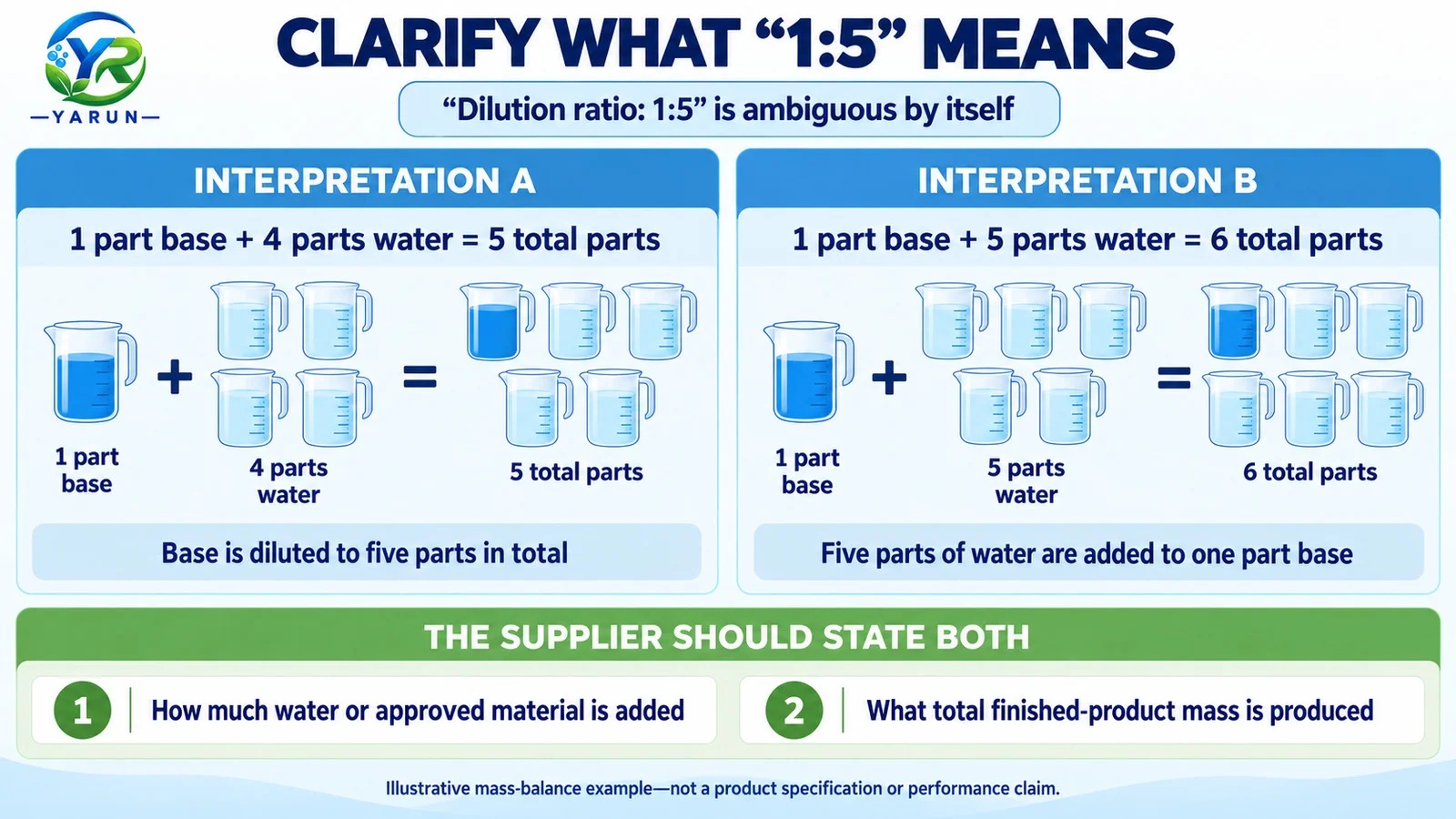
A statement such as “Dilution ratio: 1:5” is not sufficiently precise by itself. It may mean either:
One part base plus four parts water, producing five parts finished product; or
One part base plus five parts water, producing six parts finished product.
The supplier should state both:
1. How much water or other approved material is added; and
2. What total finished-product mass is produced.
For example, an unambiguous dilution instruction would be:
One kilogram of base is diluted to a total finished-product mass of five kilograms.
In this example, one kilogram of base is combined with four kilograms of water and/or other approved additions in total.
Calculating Theoretical Finished Active Matter
A basic mass-balance calculation is:
This calculation is useful, but it does not prove finished-product performance.
The result still needs to be evaluated against:
The actual composition of the base;
Water and other additions;
Mixing loss;
Test method;
Finished-product specification;
Cleaning and foam requirements;
Stability;
Production repeatability.
Buyers should also confirm whether a quoted percentage represents:
Active matter;
Total solids;
Non-volatile matter;
Or another specification parameter.
These terms should not be treated as interchangeable.
5. Compare Qualified Finished-Product Cost
The correct commercial comparison is not the purchase price per metric ton.
It is:
Base-Route Cost
A base-route calculation may include:
Landed base cost;
Duties and clearance;
Local transport;
Production water;
Approved local additives;
Labor and energy;
Mixing;
Quality control;
Filling;
Packaging;
Production loss;
Rework;
Rejected batches;
Inventory financing.
Raw-Material Route Cost
A raw-material calculation may include:
Landed cost of every ingredient;
Separate MOQ for each material;
Inventory financing;
Slow-moving stock;
Formulation development;
Laboratory trials;
Neutralization where applicable;
Labor and energy;
Quality control;
Filling;
Packaging;
Production loss;
Rework;
Rejected batches.
A base may cost more per delivered kilogram but require fewer purchased materials and less formulation work.
Individual ingredients may provide a lower theoretical material cost but require more inventory, development and production control.
Neither route should be described as cheaper until the complete project is calculated on the same finished-product basis.
6. Compare Control, Complexity and Scale
Concentrated Base Route
A base may be worth evaluating when a company:
Has controlled mixing and filling capability;
Wants to manage fewer input materials;
Has limited internal formulation resources;
Wants a standardized starting system;
Accepts a defined customization range;
Can perform the required finished-product tests.
Potential limitations include:
Greater dependence on the base supplier;
Less visibility into individual ingredient costs;
Fewer options to replace one component independently;
Need to revalidate the product if the base changes;
Limits on local formula adjustment.
Individual Raw-Material Route
Individual materials may be worth evaluating when a company:
Has an experienced formulation team;
Requires control over the surfactant system;
Needs multiple performance or price tiers;
Has sufficient volume for separate raw-material MOQs;
Can qualify and store multiple materials;
Can investigate production problems internally;
Can reproduce laboratory results at commercial scale.
Potential limitations include:
More suppliers and material codes;
More incoming specifications and COAs;
Larger inventory requirements;
More complex stock rotation;
Greater formulation and troubleshooting responsibility;
More opportunities for raw-material variation to affect the finished batch.
The important supply-chain question is not simply which route uses fewer suppliers. The more relevant question is:
Which type of operational risk can the company control more reliably?
Manufacturers considering the individual-material route can review the YARUN detergent surfactant raw-material portfolio.
7. Customization Has Technical Limits
Customization is often presented as a commercial menu:
Select a fragrance;
select a color;
select a viscosity;
select a concentration.
In practice, one adjustment may change several other properties.
For example:
Fragrance may affect clarity or viscosity;
color systems may behave differently across pH conditions;
electrolytes may increase and then reduce viscosity;
dilution may change preservative demand;
water quality may affect appearance and formulation behavior;
packaging may interact differently with the adjusted product.
Customization with a Base
The supplier should define:
Which fragrances or fragrance types have been evaluated;
permitted fragrance-loading ranges;
approved color systems;
permitted viscosity-adjustment methods;
approved pH range;
preservation responsibility;
which adjustments require new stability testing.
Customization from Raw Materials
The manufacturer has more freedom, but it must establish the complete formula and validation program.
Greater freedom is commercially useful only when the manufacturer can control the associated technical work.
8. Minimum Evidence Required Before Approving a Base
A professional base evaluation should not rely only on a fresh sample, a dilution claim or an attractive purchase price.
Before commercial approval, buyers should request or establish the following evidence.
Product Identity and Control
Product name and controlled specification;
defined active matter or solids terminology;
representative batch COA;
SDS;
applicable TDS or processing instruction;
batch identification;
storage and handling requirements.
Dilution and Processing
Unambiguous water-addition and final-yield statement;
required water specification;
order of addition;
mixing conditions;
temperature requirements where applicable;
rest or equilibration time;
permitted local adjustments.
Finished-Product Evaluation
Appearance;
odor;
pH and test method;
viscosity and test method;
theoretical or measured active matter;
cleaning and foam comparison under defined conditions;
dilution stability;
relevant temperature stability;
preservation responsibility;
packaging compatibility.
Scale-Up and Commercial Control
Laboratory batch record;
pilot-batch record where applicable;
comparison between laboratory and pilot results;
approved finished-product specification;
batch-release requirements;
retained-sample plan;
traceability.
Not every project will require the same test package, but any omitted item should result from a documented project decision—not an assumption.
9. A Hybrid Route May Be Practical
The choice does not always have to be completely Base or completely raw materials.
A hybrid route may use:
A standardized base for the main surfactant system;
controlled local water addition;
an approved local fragrance;
approved color;
a defined viscosity-adjustment method;
locally sourced packaging;
selected non-core local materials.
This approach may allow a company to begin with a more standardized system and gradually develop additional local formulation capability.
However, a hybrid route does not mean uncontrolled modification. Every locally sourced material should have:
A defined specification;
An approved dosage range;
A controlled addition procedure;
A compatibility assessment;
An appropriate finished-product test.
10. Information Needed Before Selecting a Route
A useful production-route review requires more than a request for price.
Business Information
Target country;
business type;
current supply model;
planned sales channel;
expected monthly output;
target packaging;
destination port.
Production Information
Available mixing equipment;
filling capability;
production-water source;
weighing accuracy;
pH and viscosity testing;
internal technical staff;
batch-record capability.
Product Information
Target finished-product type;
target active matter where known;
target viscosity;
required foam profile;
fragrance and color direction;
market-positioning level;
target finished-product cost;
required customization.
This information helps determine whether the project should begin with:
Finished-product OEM;
a concentrated base;
individual raw materials;
or a staged hybrid route.
Which Production Route Are You Evaluating?
YARUN is reviewing how manufacturers, distributors and brand owners evaluate different hand dishwashing liquid production routes.
Use the short assessment below to identify your current position.
Which Production Route Are You Evaluating?
YARUN is reviewing how manufacturers, distributors and brand owners evaluate different hand dishwashing liquid production routes.
Which option is closest to your current project?
Concentrated base for controlled local completion
Individual raw materials for complete local formulation
Finished-product OEM/private label
A hybrid route
Not decided—cost and capability comparison required
If you would like to discuss your production route, send the following basic information:
Preferred route;
target country;
business type;
current production capability;
expected monthly output;
main concern.
Share Your Production Route on WhatsApp
This market-research stage is intended to understand production requirements and buyer preferences. Product specifications, dilution instructions, samples and commercial availability should only be discussed after the applicable development and verification stages have been completed.
Frequently Asked Questions
What is a concentrated dishwashing liquid base?
It is a partially completed formulation intended for controlled local processing. The remaining work may include water addition, mixing, fragrance, color, pH or viscosity adjustment, preservation verification and finished-product testing.
Does a dishwashing liquid base only require water?
That depends on the specific base. Buyers must confirm the required water quality, dilution method, permitted local adjustments, preservation responsibility and finished-product tests.
Is a base always cheaper than individual raw materials?
No. The comparison must include landed cost, local processing, additional materials, labor, inventory, quality control, loss, rework and finished-product yield.
How should a dilution ratio such as 1:5 be interpreted?
The supplier must confirm whether it means one part base plus four parts water to produce five total parts, or one part base plus five parts water to produce six total parts. Water addition and total finished yield should be stated separately.
What equipment is required to use a concentrated base?
Requirements depend on the product, but controlled weighing, suitable mixing, production water, basic quality testing, hygienic filling and batch records are common starting requirements.
Who is responsible for the finished product?
Responsibilities should be defined technically and contractually. The company manufacturing, filling and placing the finished product on its market still has responsibilities for production control, product release and applicable market requirements.
What information is needed before selecting a route?
Provide the target market, business type, expected output, available equipment, water source, target product, customization requirements, packaging, destination port and main commercial concern.
Conclusion
A concentrated base and a raw-material formulation are not simply two prices for the same result.
They allocate formulation work, inventory, technical control and production responsibility differently.
A base may be appropriate when a company has controlled mixing and filling capability but wants to reduce formulation and inventory complexity.
Individual raw materials may be more appropriate when the manufacturer has an established formulation team, sufficient production volume and a commercial reason to retain complete formula control.
A company without controlled local production may be better served by finished-product OEM.
The objective is not to select the most concentrated or technically complex route.
It is to select the route that the business can control, repeat and scale.
Share Your Production Route on WhatsApp